
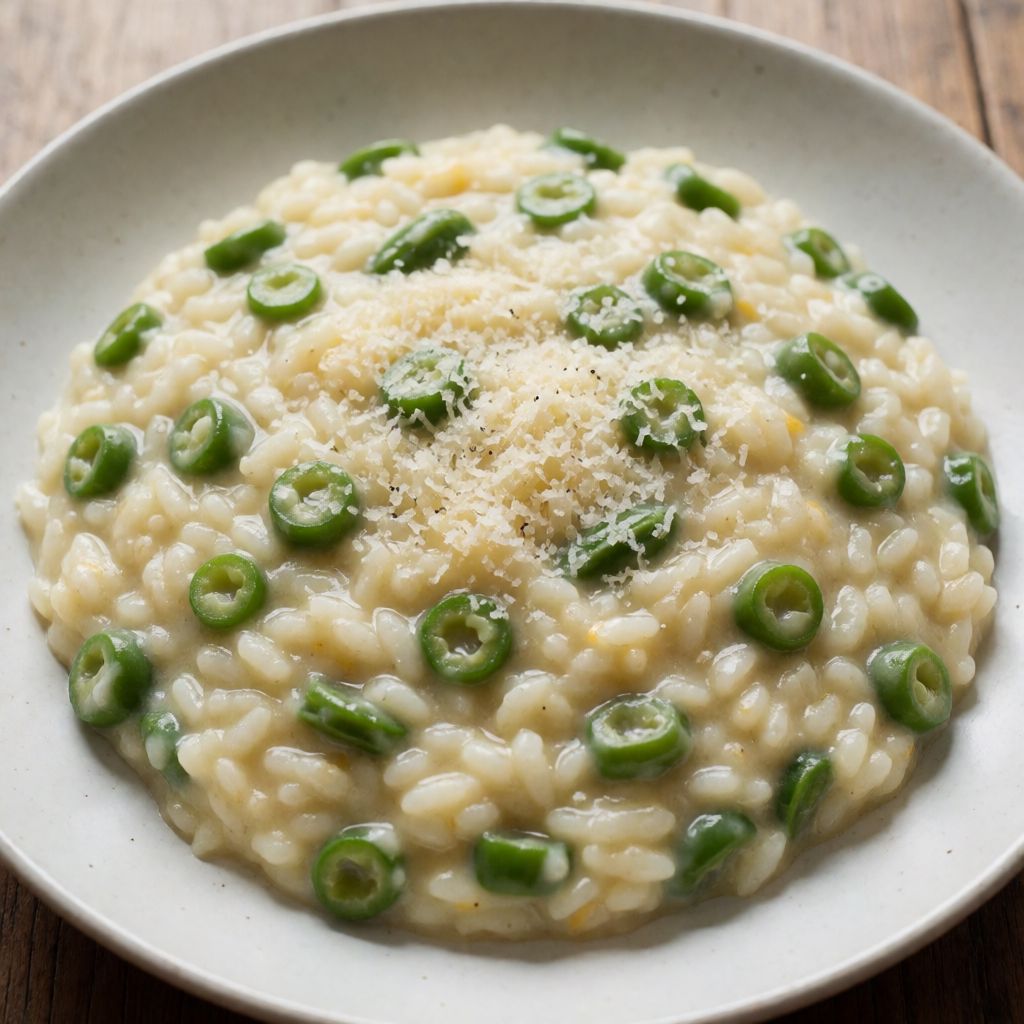
 AI photo
Green Bean Risotto
A creamy Italian-style risotto with tender green beans, smoked provolone and Parmesan.
Labels are worked out automatically from the ingredients and can be wrong. Check the packaging if it matters to you.
Ingredients
- 320 g Rice Carnaroli
- 300 g Green Beans
- 200 g Smoked Provolone
- 50 g Parmesan
- Vegetable Stock as needed
- Salt to taste
- Black Pepper to taste







Steps
Rinse the green beans under running water and trim the ends.
Bring salted water to the boil and cook the beans until tender.
Drain the beans, leave to cool, then cut into small pieces.
Heat the oil, add the rice and sauté for a few minutes.
Pour in the vegetable stock a little at a time, stirring constantly, until the rice has absorbed the liquid.
Add the beans and continue cooking the rice.
Add the smoked provolone, cut into cubes, and the grated Parmesan, stirring until done.
Risotto isn't rice boiled in stock — it's rice talked into giving up its own starch, bit by bit, until that starch becomes the sauce. No cream goes in here. The cream you see at the end is rice flour dissolved in hot liquid, nothing more mystical than that. The green beans are there for colour and a clean bite against all that softness; the provolone and parmesan carry the fat and the salt that bind the whole thing into something you can call a sauce rather than wet rice.
What decides whether it works is the rate at which that starch comes out. Too fast — stock dumped in all at once, pan too hot — and the outside of the grain collapses before the inside is cooked: you get porridge with a bullet in the middle. Too slow, too cold, too little stirring, and the grains sit there sulking, cooking unevenly, some soft, some chalky. The whole job is pacing.
Some say you must stir risotto without stopping, hand glued to the spoon, or it fails. No — because stirring isn't a ritual, it's a delivery system. It moves the starchy liquid off the bottom of the pan and across every grain so none of them cook in isolation. You can put the spoon down for twenty seconds to answer the door. You cannot leave it for ten minutes.
Carnaroli is specified for a reason, not snobbery. It's bred with a higher proportion of amylose starch than most rice, and amylose is what gelatinises slowly and holds structure — which is exactly why Carnaroli forgives a slightly late ladle of stock when Arborio would already be mush. If you can't get it, Arborio works, just watch it more carefully near the end; Vialone Nano works too and actually cooks a touch faster. What you're hunting for, if the bag doesn't say 'risotto rice,' is any short, fat-grained variety grown and milled specifically to hold a high starch content — long-grain rice, basmati, anything bred to stay separate and fluffy, is built to do the opposite job and will not do this one.
The oil in step four isn't named, and that's deliberate — it's there to stop the rice sticking and to carry heat evenly into the grain for the toasting, not to flavour anything. Any oil with no smell of its own does the job: a light olive oil, sunflower, groundnut. Toasting the rice before any liquid goes in matters more than it looks — it seals the outside of the grain slightly, so that later, in the stock, it absorbs liquid gradually instead of flooding and splitting. Skip that step and you've built the mushy-outside, raw-middle problem into the dish before you've even reached for the stock.
Green beans go in boiling water and come straight out again, cooled, cut small. Boiling them separately rather than in the risotto itself is the only way to keep their colour — add raw beans straight into simmering rice and twenty minutes of gentle heat will turn them the grey-green of a tinned vegetable, and nobody wants that on a plate that's otherwise bright. Fresh beans should squeak faintly when you snap one; if they bend soft and quiet, they're old. Frozen beans, blanched the same way, are a perfectly honest substitute when it's January and the ones in the shop look tired.
Smoked provolone is doing two jobs: it melts into the starch to thicken the sauce further, and it brings a wood-smoke note that plain cheese can't. The criterion for substitution is simple — any semi-firm cheese that melts smoothly rather than splitting into oil and solids, with some smoke character if you can find it. Smoked scamorza is the obvious Italian swap. In a British kitchen, a good smoked cheddar isn't cheating — it's the same economic logic that put smoked provolone in this dish in the first place: a way for cheesemakers to use mild, quickly-made cheese and sell it as something with more character, through smoke rather than long ageing. Parmesan, by contrast, gets its flavour the slow way — a hard grana-type cheese aged a year or more, which is why it's used sparingly, grated fine, mostly for salt and savour rather than melt. Grana Padano is the budget cousin and does the job almost as well.
On the stock: it needs to go in hot, ladle by ladle, not cold from the fridge. Cold liquid hitting hot starch stops the gelatinising process in its tracks for a minute or two every time, which is how you end up with rice cooked unevenly despite your best stirring. Keep it at a gentle simmer on the next ring over. Homemade stock from vegetable trimmings is the traditional economy here — using what would otherwise go in the bin — but a decent stock cube dissolved properly is an honest shortcut, not a defeat; just go easy on extra salt afterwards, since both the cube and the cheeses are already carrying plenty.
A wide, heavy pan stands in fine for the pot a risotto wants — what you're really after is a base thick enough not to scorch while you toast the rice, and sides low enough that you can see and stir easily. No lid is needed at any point; risotto is cooked open, which is one less thing to worry about in a kitchen that's short on specialist equipment. And give it the time it asks for — this isn't a dish you start and then wander off from to put the kettle on. Twenty-five minutes of attention is the price of the sauce; rush it and you'll have rice with cheese melted on top instead of through it, which is a different and lesser thing.