
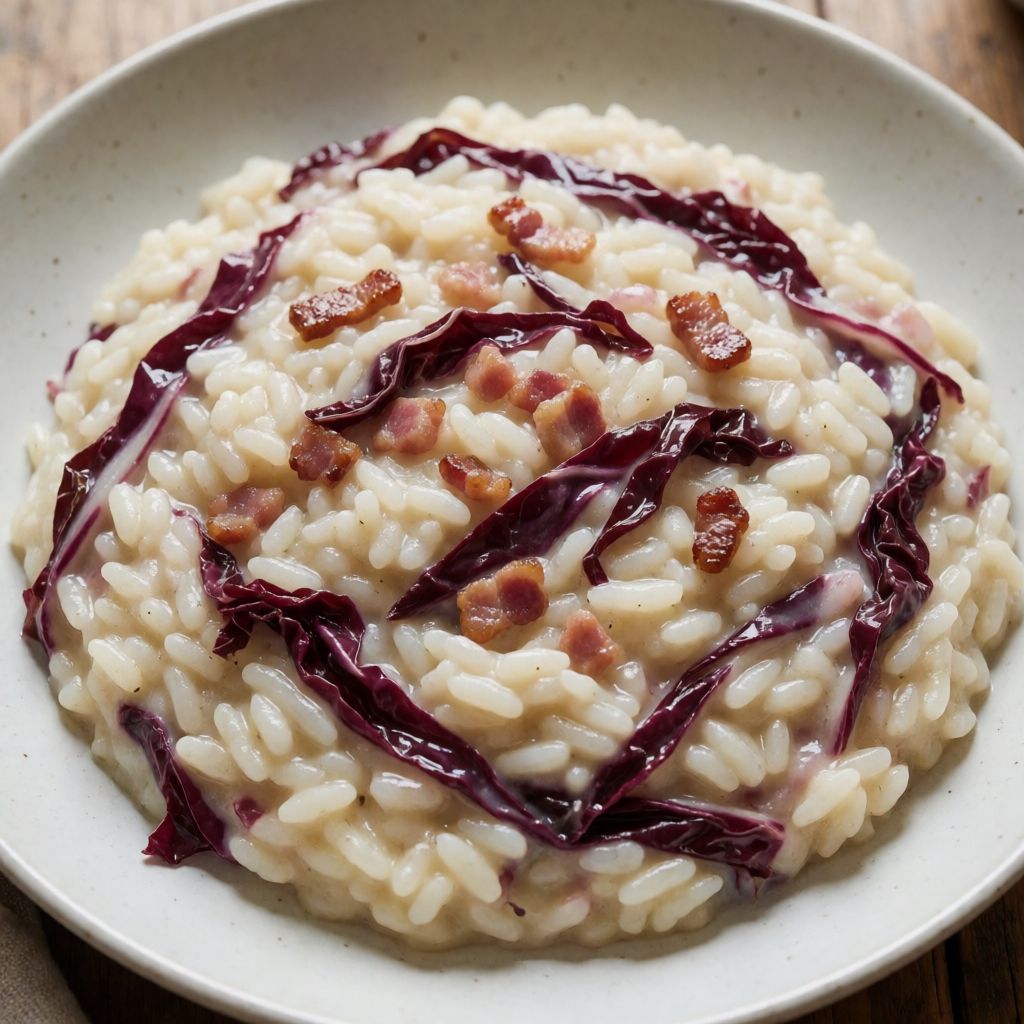
 AI photo
Risotto with Bacon and Radicchio
A creamy Italian-style risotto with radicchio and crisp bacon, finished with butter and Parmesan.
Labels are worked out automatically from the ingredients and can be wrong. Check the packaging if it matters to you.
Ingredients
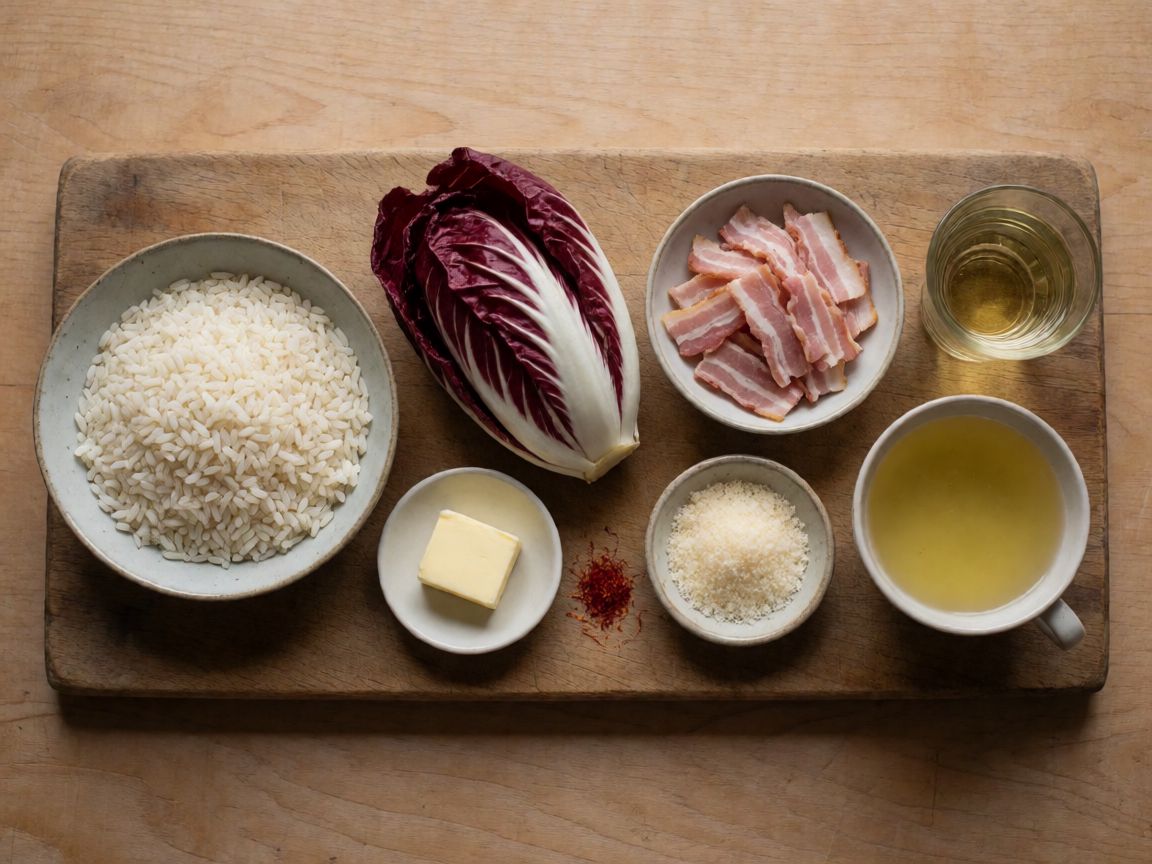
- 350 g Carnaroli or Arborio rice
- 2 pcs radicchio
- 100 g bacon
- olive oil
- butter
- 60 g Parmesan
- 120 ml white wine
- 1 pcs saffron a sachet
- salt
- black pepper
- 1 l vegetable stock
- 1 pcs shallot












Steps
Finely chop the shallot, cut the bacon into thin strips, and slice the washed and dried radicchio.
In a saucepan, fry the shallot and bacon in olive oil, then add the rice and toast it for a few minutes until the edges turn translucent.
Pour in the white wine and let it evaporate.
Gradually add the hot vegetable stock, pouring it in a little at a time as the rice absorbs the liquid.
Add the sliced radicchio and continue cooking the risotto, adding more stock, until the rice is done.
Season with salt, black pepper, stir in the saffron and mix well.
Stir in a knob of butter and grated Parmesan until creamy. Serve immediately.
What was changed
Prep time is set to 0 minutes because the original did not state one .
Risotto is not a rice dish, it's a technique for building a sauce out of starch. Every grain of Carnaroli or Arborio is wrapped in a coat of amylopectin that dissolves slowly as you stir and feed it liquid — that's the "creamy" everyone talks about, and it has nothing to do with cream ever touching the pan. This version takes that base sauce and runs bitterness and smoke through it: radicchio for the bitter edge, bacon for the fat and salt that tame it, saffron for a thread of something floral underneath.
What decides whether it works is your attention, not your clock. You add stock in small amounts and you wait until the pan goes almost dry before the next ladle — that's what forces the rice to release its starch into the liquid rather than just boiling in a lake of it. Dump the whole litre in at once and you get rice soup, not risotto. The grain should end up bending to the tooth with the faintest resistance in the centre — al dente the Italian way, not the pasta way, where a hard core would just mean undercooked.
Radicchio goes in late because bitterness cooks out fast — give it the full twenty minutes and you lose the point of using it. It wilts, loses its red snap, and turns a sad brownish purple if you add it with the shallot. A few minutes at the end is enough: it softens, it still bites back a little, and that's the contrast you want against the fat of the bacon.
The rice is the whole argument. Carnaroli and Arborio are both high in amylopectin, the starch that breaks down into that glossy, slightly sticky sauce — Carnaroli holds its shape a touch better under heat, which is why restaurant kitchens lean on it, but Arborio is cheaper, easier to find in a UK supermarket, and forgiving if you're still learning to read the grain. Don't reach for basmati or long-grain "just because it's rice" — those varieties are bred to stay separate and fluffy, the opposite of what you need here. No substitute exists for this one; it's the starch content that makes the dish, not the shape of the grain.
The shallot and bacon go in together in fat because that's where the base flavour of the whole pot comes from — this is the only moment anything gets properly browned, so don't rush it into a pale sauté. Use olive oil with no strong character of its own; a loud, grassy extra-virgin will fight the saffron later. Any streaky or back bacon works, smoked or not — it's standing in for the pancetta an Italian kitchen would use, and in a British kitchen it's the more honest choice anyway, since supermarket pancetta here is often just repackaged bacon with a fancier sticker.
White wine isn't decoration — its acid cuts through the fat from the bacon and the eventual butter, stopping the dish from tasting flat and heavy. Let it evaporate properly, meaning the sharp raw-alcohol smell should be gone before you add stock; if you rush this, that harshness stays trapped in the rice. No wine in the house — a splash of white wine vinegar loosened with a bit of stock does the acid job, though it won't bring the same depth.
Saffron is added at the very end here, not steeped early as some recipes do — a sachet of powdered saffron dissolves fast, so there's no need to bloom it in warm stock first the way you would with whole threads. If you're using threads instead of a sachet, do steep them in a splash of hot stock for ten minutes before stirring in, or you'll get streaks of colour instead of an even gold.
The stock should be hot and kept hot on a low simmer beside the main pan — cold stock added to simmering rice stalls the cooking and throws off the texture, because the rice keeps absorbing liquid at a different rate as the whole pot cools and reheats. A litre for 350g rice is a guide, not a rule; have a bit more on standby. Vegetable stock is specified because it won't fight the saffron and bitterness the way a heavy beef stock would — a stock cube is fine, just use it at half the salt you'd normally add, since the dish gets more salt later from Parmesan and bacon both.
The butter and Parmesan stirred in off the heat at the end are called "mantecatura" in Italian kitchens, and it's the step that actually makes the sauce glossy rather than just wet — the fat and cheese emulsify into the starchy liquid clinging to the rice. Do it on the stove but with the flame off, or in a flat's electric hob terms, with the pan simply off the ring. Too much heat at this stage and the Parmesan seizes into little grains instead of melting through — a defect, not a seasoning choice. Grate the Parmesan yourself; the pre-grated kind is often cut with anti-caking starch that won't melt the same way.
Patience is the real ingredient missing from most risotto gone wrong. Twenty minutes at the stove with a ladle in hand, not wandering off to check your phone between additions — that's the labour the dish asks for, and there's no shortcut that doesn't show up as grainy, soupy, or gluey rice on the plate.