
 AI photo
Roast Pork with Crispy Crackling
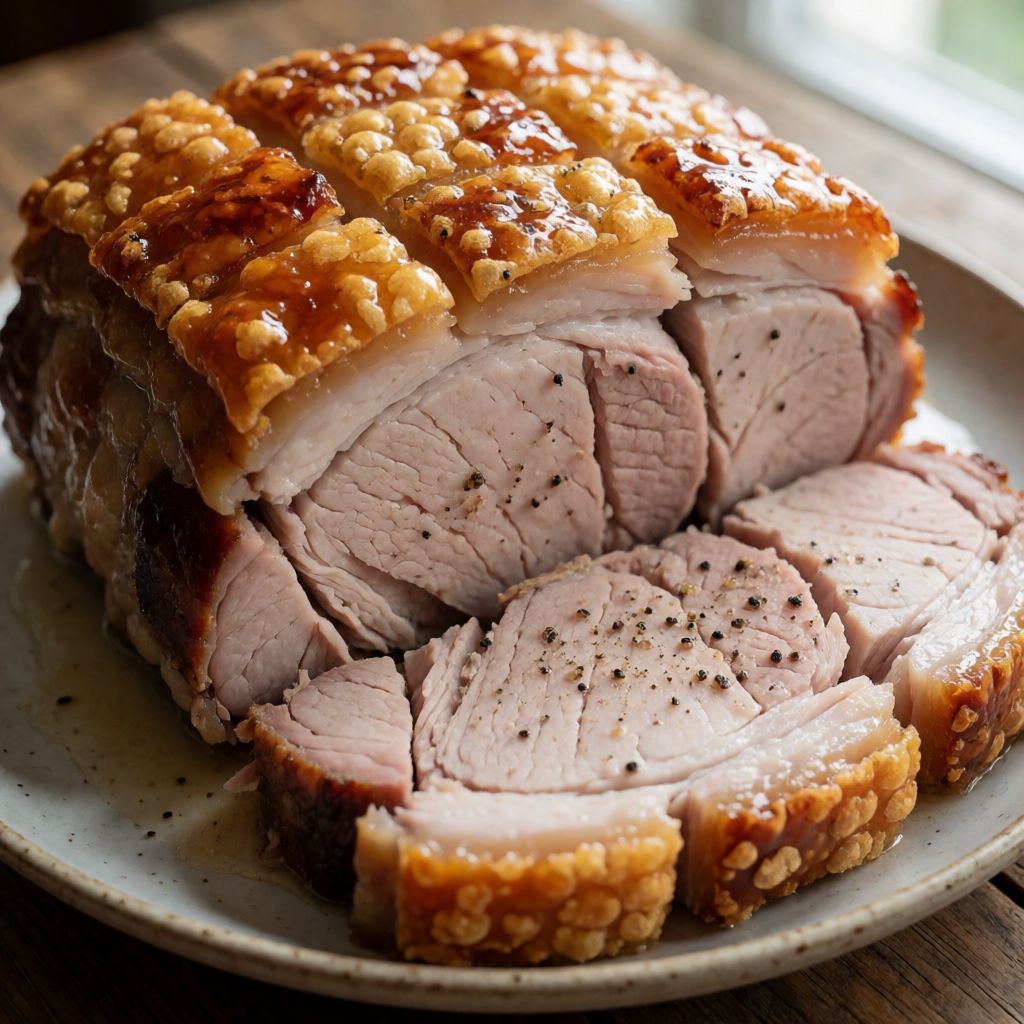
Crispy roasted pork with golden crackling, seasoned simply with salt, pepper, bay leaf and thyme.
Ingredients






Steps
Check the scores on the pork with a sharp knife. Cut through the skin and fat, stopping just short of the meat or exactly at its edge.
Avoid cutting into the meat itself — this lets meat juices soften the skin during roasting, making it harder (though not impossible) to get crispy crackling.
Finely crush the salt in a mortar, mix with freshly ground pepper, then rub it thoroughly into the skin, working it into every score. This matters a great deal for perfect crispy crackling.
Place the pork on a rack set over a roasting tray (or in an ovenproof dish with a rack). Put the bay leaves and thyme underneath the meat on the rack, so the meat doesn't sit in the liquid.
Make sure the skin sits level — if needed, prop up one edge with a peeled potato. Pour water into the bottom of the tray; it must not touch the meat, just sit below the rack.
Put the pork into a cold oven! Turn on the fan setting to 130°C and roast for 2 hours.
120 minRaise the temperature to 200°C and roast for a further 30 minutes.
30 minFinally raise the temperature to 230°C and roast until the skin is crispy. This takes about 15-20 minutes; if it needs longer, finish under the grill.
20 minThe grill isn't usually needed, but it can help crisp the skin at the end if meat juices have seeped into it (from cuts that were too deep) or if not enough salt was worked into the scores.
Let the pork rest on a carving board for 15 minutes before slicing.
15 min
What was changed
Oven temperatures were rounded to the nearest 10°C step used in this market: and .
This is not a seasoning problem, it's a drying problem. Crackling is nothing mystical — it's fat rendering out from under the skin while the skin itself loses enough moisture to turn brittle, the way a cracker is brittle. Everything in this recipe exists to manage that drying, nothing more.
The scoring depth is the first fork in the road. Cut only to the edge of the meat, never into it. Some cooks score deep, thinking it lets more fat escape — no, because it also opens a channel for meat juice to seep upward and dampen the skin from underneath, right while you're trying to dry it out from above. A shallow, confident cut through skin and fat only is the whole trick; anything deeper works against you, not for you.
The oven goes in cold and climbs in three stages, and that sequencing is the engine of the dish. Low heat first (130°C, fan) gives the fat under the skin time to melt and run off slowly, while the loin itself comes up to temperature gently, so the inside finishes moist rather than dry and stringy by the time the outside is ready to crackle. Only at the end does the heat go aggressive — 200°C, then 230°C — to finish driving off the last moisture and blister the skin. Starting hot does the opposite of what people hope: the surface seizes and blisters unevenly before the fat beneath has had any chance to render, so you get patches of hard, raw-tasting skin next to patches that never crisp at all.
The rack and the water tray are doing one job each, and it's a modest one. The rack keeps the meat up off its own rendered fat, so the underside doesn't sit stewing in it — that's the same logic as the shallow scoring, just applied from below. The water underneath catches that dripping fat so it doesn't scorch and smoke on a hot tray — a real concern in a domestic oven with no real ventilation, unlike a kazan with airflow all around it. Keep the water level below the rack, not touching the meat; it's there to protect your tray and your kitchen air, not to baste anything.
Pork loin, skin-on, is the right cut here because it's lean enough to cook through in the time the crackling needs to form, without drying out the way a leaner joint alone would. Look for skin that's dry and matte at the butcher's counter, not glossy or wet — wet skin usually means the joint has been frozen and thawed, and that extra moisture is exactly what you're fighting against for the next three hours. If your butcher hasn't scored it, ask them to — a sharp blade on their board does a cleaner job than most kitchen knives at home. A pork shoulder or belly with skin will take the same method, just expect a different ratio of fat to meat and judge the crackling the same way, by sound and look, not by habit.
Salt is crushed fine on purpose — coarse crystals sit on top of the skin and do nothing, fine salt gets worked down into the scores where it can actually pull moisture out. Pepper is there for flavour, not function; you can leave it out entirely and the crackling won't know the difference. Don't reach for a spice rub here — any oil or paste on the skin traps moisture against it and works directly against the crackling, which is why this dish stays deliberately plain.
Bay leaf and thyme are scent, not structure — they flavour the steam and the fat collecting under the rack, nothing more. Any woody herb works the same way, rosemary included, and if you've got none in the flat, skip it; the crackling doesn't care, and the meat will still taste of itself.
The potato wedged under one edge is just levelling — any small, heavy, heatproof object does the job, a scrunched ball of foil included. The point is that if the skin tilts, salt and rendered fat run off to one low side and you get crackling on half the joint and rubber on the other.
Resting for fifteen minutes afterwards is patience doing its proper job: the juices that got driven to the centre of the meat under heat need that quiet time to redistribute, or they'll just run out onto the board the moment you cut in. Don't tent it in foil the way you might with other roasts — foil traps steam, and steam is the one thing that will undo everything you just spent three hours achieving. A kilo of loin like this feeds four properly, with crackling for everyone, and usually enough cold meat left for sandwiches the next day — which is half the point of a Sunday roast to begin with, a slow oven doing two days' meals for the price of running it once.