
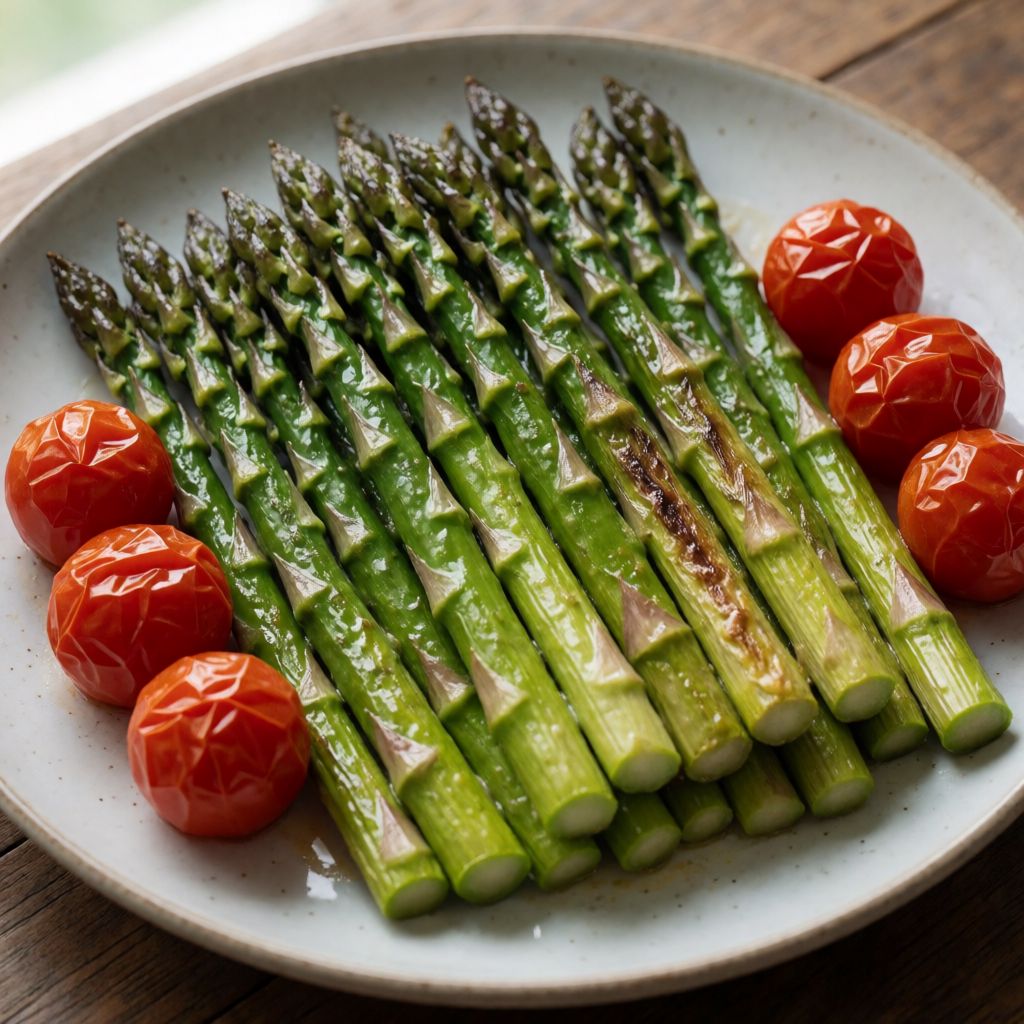
 AI photo
Roasted Asparagus with Cherry Tomatoes, Lemon and Parmesan
A quick roasted asparagus side dish with cherry tomatoes, lemon and Parmesan.
Labels are worked out automatically from the ingredients and can be wrong. Check the packaging if it matters to you.
Ingredients
- 1 bunch Asparagus
- 130 g Cherry tomatoes halved
- 2 clove Garlic crushed
- ½ pcs Lemon juice and finely grated zest
- 50 g Parmesan freshly grated
- 2 tbsp Olive oil
- Salt to taste
- Black pepper freshly ground, to taste







Steps
Snap off the woody ends of the asparagus. Toss the asparagus with the halved cherry tomatoes, garlic, lemon juice, Parmesan and olive oil.
Spread out evenly and roast in a preheated oven at 180°C (fan) for 15 minutes.
15 minTransfer to a serving dish, grate over the lemon zest with a little extra Parmesan.
Sprinkle with flaky salt and freshly ground black pepper before serving.
What was changed
The list now uses Asparagus instead of plain greens, and the oven temperature is shown as to fit British display steps.
This is not a recipe with hidden techniques, it's a lesson in what happens when water leaves vegetables fast. Everything on that tray in a hot oven is drying, not stewing, and that's the whole mechanism. Asparagus and cherry tomatoes sit well together because both can give up moisture quickly without collapsing into mush — if you let them.
What decides this dish is spread, not time. One loose layer on the tray lets steam rise and escape; crowd the vegetables and you've built a stew with an oven instead of a roast — the moisture has nowhere to go but back into the asparagus. Doneness is something you see, not a number on a timer: the asparagus bends when you lift a spear with tongs instead of staying rigid, and the tomato skins split and start to slump, letting a little juice catch and darken at the edges. Fifteen minutes at 180°C fan is where you start checking, not where you stop.
Snap the woody end off by hand, don't cut it with a knife and guess. The stalk breaks exactly at the point where the fibre turns from tender to stringy — your fingers find that line more honestly than a blade ever will. Some people still peel asparagus out of habit; no, that was for the thick, old-fashioned French spears, and most of what you buy today doesn't need it.
This feeds four as a side, and it's really built for a roast dinner — the method is the same trust you already put in your oven on a Sunday: hot dry air, one tray, minimal interference.
Pick spears of roughly the same thickness in the bunch, because thin and fat ones side by side on a tray cook at different speeds and you end up fishing out burnt thin ones to save the fat ones. British asparagus has a short season, May into June, which is why it used to be treated as an event rather than an ingredient — outside that window you're buying imported spears, usually thinner, usually a bit less sweet. Fine for this dish, just don't expect the same depth.
Halve the cherry tomatoes rather than leaving them whole. A cut face exposed to dry heat lets the sugars inside concentrate and catch a little char; a whole tomato mostly just warms through and steams gently inside its own skin, which is a different, wetter result. Any small tomato works the same way — avoid large ones here, their watery centre needs far longer than the asparagus to reduce down, and by then your asparagus is overcooked.
Crush the garlic rather than mincing it fine. Crushing breaks the cells enough to let the oil out without turning it into paste with huge surface area — and surface area is exactly what burns fastest and turns bitter under oven heat. Fine mincing is a knife-skill flex that costs you flavour here.
The lemon does two separate jobs and that's why it's used in two places. The juice goes in raw with the oil before roasting — acid is stable under heat, and it seasons the vegetables from the inside as they cook. The zest goes on only at the end, because the aromatic oils in zest are volatile; put them in the oven and they either cook off or turn faintly bitter. Some recipes tell you to always add zest and juice together — no, that's advice for cold dishes. Heat treats the two very differently.
Parmesan appears twice for the same reason. The portion that goes in before roasting melts into the oil and tomato juice and sets into a loose savoury crust at the edges, because it's dry and fat-rich rather than watery like a soft cheese. The portion grated on at the end keeps its sharp, crumbly bite, which you'd lose entirely if it all went in raw at the start. If you don't have parmesan, use any hard, aged, grating cheese — pecorino, a well-aged cheddar — the criterion is dryness and age, not the label. A soft, young cheese will just turn gluey in the heat.
The olive oil isn't there just to stop things sticking — it carries flavour into the roast and gives the parmesan something to cling to instead of falling onto the tray as crumbs. So the rule for substitution here is: use any oil you'd be happy to taste on its own. A flavourless frying oil defeats the point of this dish. And season the flaky salt on at the very end, not before — salted before roasting, it just dissolves into the juices on the tray and you lose the crunch it was meant to give you on the tongue.