
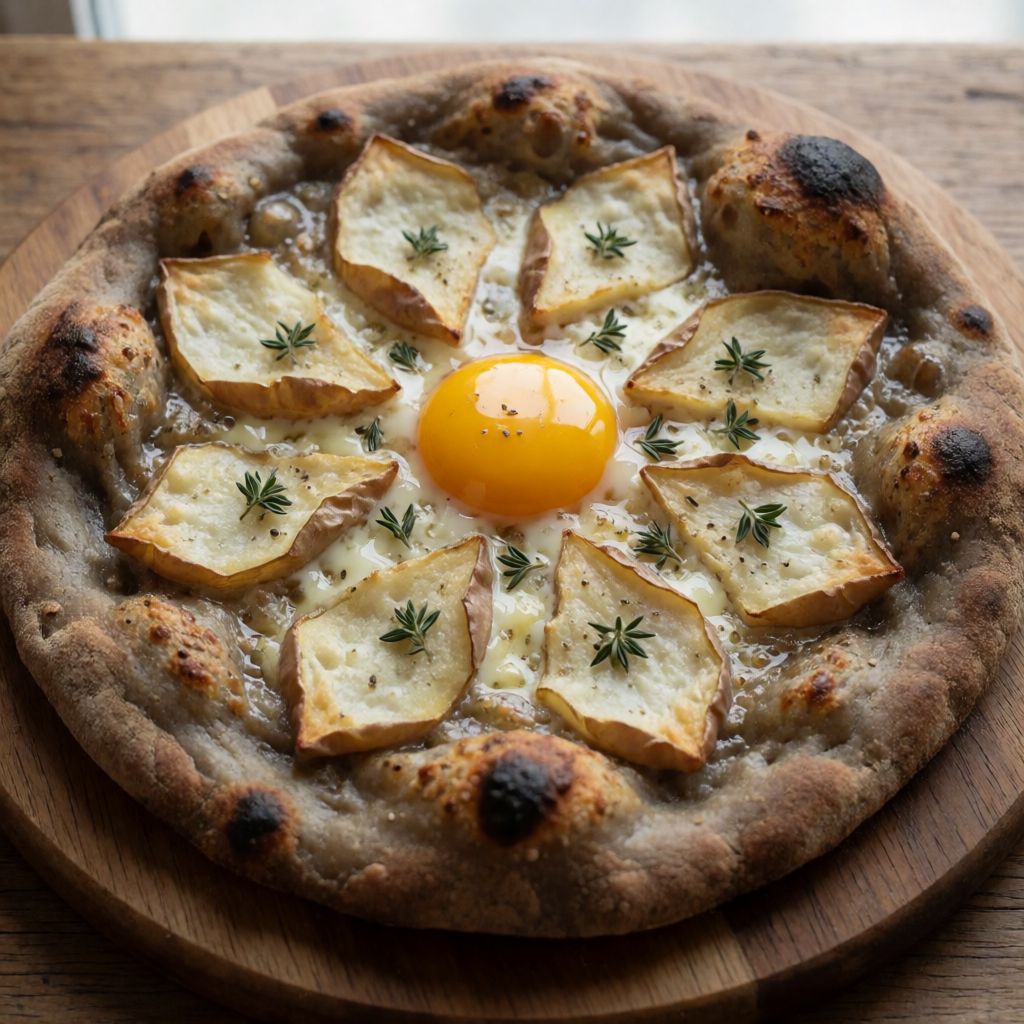
 AI photo
Rye Pizza with Jerusalem Artichoke, Thyme and Egg
Small rye pizzas topped with Jerusalem artichoke, mozzarella and red onion, finished with a baked egg and fresh thyme.
Labels are worked out automatically from the ingredients and can be wrong. Check the packaging if it matters to you.
Ingredients
- 20 g Yeast
- 200 ml Water about 37°C
- 1 tsp Salt
- 2 tbsp Olive oil
- 250 g Rye flour
- 200 g Plain flour
- 125 g Mozzarella fresh
- 4 pcs Jerusalem artichoke peeled
- 1 bunch Thyme sprigs, fresh
- 6 pcs Eggs
- 1 pcs Red onion thinly sliced
- 1 pinch Salt to taste
- 1 tsp Olive oil to drizzle over each pizza




Steps
Dissolve the yeast in the water and add the oil, salt and rye flour.
3 minMix well until smooth, then gradually add the plain flour until the dough becomes elastic.
7 minPlace the dough in an oiled bowl and let it rise on the worktop, covered with a clean towel, for 45-60 minutes.
50 minSlice the Jerusalem artichoke very thinly, ideally with a vegetable peeler.
5 minPat the mozzarella dry with kitchen paper and crack the eggs into a bowl.
2 minThis makes 6 small pizzas, and if you want an egg on each one you will need 6 eggs, or as many as the number of pizzas with egg you want to make.
Once the dough has risen, divide it into 6 equal pieces, shape into small pizzas and place on sheets of baking parchment cut to size.
Scatter the Jerusalem artichoke, cheese and red onion over the pizzas and bake on a pizza stone heated until very hot (or a hot baking tray) in an oven preheated to 250°C, for about 4 minutes.
4 minQuickly remove the pizzas from the oven and meanwhile turn the oven up to its highest setting.
1 minPlace an egg in the centre of each pizza and put them back in the oven.
Bake further, until the base is crisp and the egg white has set.
4 minThe tasty little Jerusalem artichoke pizzas are ready - remove from the oven, scatter with thyme leaves, salt and pepper and drizzle with a little olive oil before serving.
1 min
This is a rye-flour pizza that does something a normal Margherita never does: it finishes with a whole raw egg cracked on top and goes back into a furnace-hot oven just long enough for the white to seize and the yolk to stay loose. That's the whole point of the dish — not the Jerusalem artichoke, not the rye. The egg is the test. Everything before it exists to build a base that can take a second blast of heat without turning to cardboard.
Rye flour has almost no gluten-forming protein compared to wheat, so on its own it gives you a dough that won't stretch — it tears. That's why this recipe cuts it with plain flour roughly 50/50 by weight. Some say rye bread and rye pizza should be "pure rye" for authenticity — no, because pure rye dough won't hold a shape thin enough to crisp in four minutes, it'll just stay dense and gummy in the middle. The plain flour is there to supply the elasticity rye can't.
Start with the yeast and the water temperature, because this is where most home bakers lose ten minutes without knowing it. Water at about 37°C — roughly the warmth of your wrist, a touch above body heat — is where yeast works fastest without dying. Some say hotter water makes the dough rise quicker — no, because yeast is a living organism, and above about 50°C you've cooked it, not fed it. Too cool and it just sulks for an hour. There's no stopwatch trick here, only the sense-check: dip a finger in, it should feel barely warm, not hot.
The proving step — 45 to 60 minutes under a towel on the worktop, not the airing cupboard, not the oven with the light on — is patience doing actual chemical work. The yeast is producing carbon dioxide and the gluten network (what there is of it, thanks to the plain flour) is stretching to trap it. Doneness here isn't a clock number, it's a poke: push a finger in, and if the dent springs back slowly instead of snapping back instantly, it's ready. If the dough just deflates and doesn't spring at all, you've gone past it and the structure's collapsed — not dangerous, just flatter bread.
Jerusalem artichoke peeled and sliced paper-thin with a vegetable peeler, not a knife, is a size decision with a reason behind it. It gets only four minutes total in a screaming oven — no time to cook through if cut thick, so thin is how it goes from raw to tender-crisp in that short window. Treat it like a root vegetable raw carrot test: if a slice is too thick to bend without snapping, it's too thick to cook through in four minutes. If you can't get Jerusalem artichoke, any crisp root that can be shaved thin and won't turn to mush under cheese works — a young parsnip, even a potato if you're not precious about it, though you lose the artichoke's particular nutty sweetness.
Mozzarella gets patted dry with kitchen paper for a reason that has nothing to do with fussiness: fresh mozzarella is packed in whey and water, and that liquid, left on, steams the base from above while it's trying to crisp from below. Dry cheese browns and pulls into strings; wet cheese pools and makes the dough beneath it damp. Any fresh, mild, high-moisture cheese needs the same treatment — the rule is "pat dry whatever's sitting in liquid," not "mozzarella specifically."
The eggs are the one ingredient with no real substitute, because the whole dish is built around what a raw egg does in a hot oven. If you genuinely don't want egg, you still bake the pizza the first way, at 250°C, a touch longer until the base is done the way you'd judge any flatbread — firm, no give, edges colouring — and skip the second blast entirely. But then it's a different, simpler dish; the oven-finished egg is what earns this one its name.
A pizza stone will give you the most even, driest heat on the base — it behaves a bit like the hot floor of a proper oven, pulling moisture out fast. Most UK kitchens don't have one, and that's fine: a heavy baking tray, preheated in the oven for a good ten minutes before the dough goes anywhere near it, does the same job less dramatically. What won't work is a cold tray straight from the cupboard — you lose the first crucial minute of contact heat, and that's the difference between a crisp bottom and a pale, limp one.