
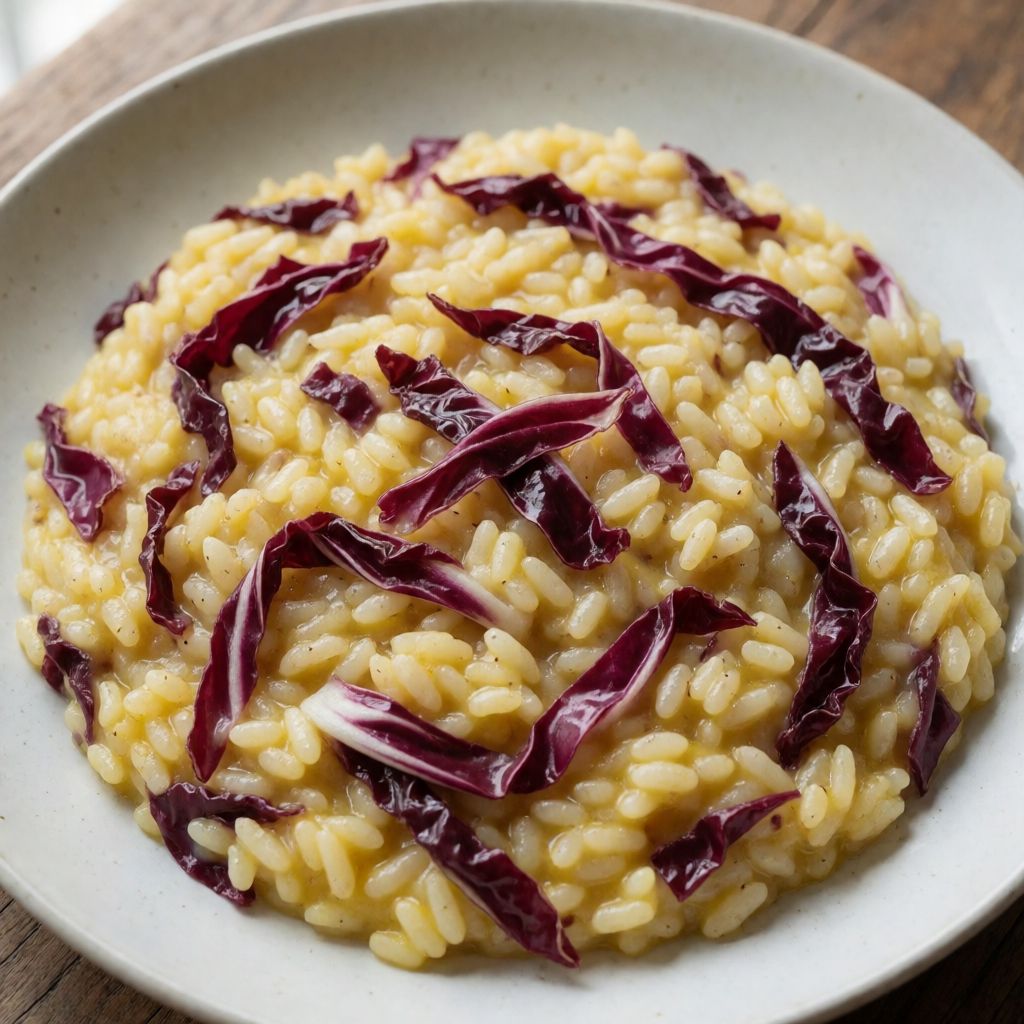
 AI photo
Radicchio and Saffron Risotto
A creamy risotto with bitter radicchio and golden saffron, finished with Parmesan and butter.
Labels are worked out automatically from the ingredients and can be wrong. Check the packaging if it matters to you.
Ingredients
- 350 g Carnaroli rice
- 1 pcs Onion
- Olive oil to taste
- 1 pcs Radicchio
- 10 g Butter
- Parmesan to taste
- 1 l Vegetable stock
- 120 ml Red wine
- 1 package Saffron
- Salt to taste
- Black pepper to taste











Steps
In a saucepan, fry the finely chopped onion in olive oil.
Add the radicchio and cook for a few minutes, moistening with vegetable stock.
Add the rice, toast it briefly, pour in the red wine and let it evaporate.
Cook the risotto, gradually adding vegetable stock.
Add the saffron, season with salt and black pepper to taste.
Remove from the heat and stir in the Parmesan and butter until creamy.
Serve immediately, sprinkled with extra Parmesan if desired.
What was changed
Parmesan Parmesan is used instead of the mismatched ingredient, since it is the cheese the recipe calls for and is easy to find.
Risotto is not a rice dish. It's a starch-management exercise — you're coaxing a controlled amount of amylopectin out of each grain, into the stock, so the whole thing binds into a loose cream that still has grains with a bite at the centre. Carnaroli is specified because it has more of that outer starch than other rices and a sturdy core that resists collapsing into mush — this is the one detail that genuinely matters, and it's why "any rice will do" is the first myth worth throwing out. Arborio works too, at a pinch, but it forgives you less.
The radicchio here does two jobs. Raw, it's bitter and purple; cooked long enough with a little stock, the bitterness softens and the leaf turns that deep wine-brown you want. Some cooks throw it in at the very end to keep the colour bright — don't. Half-raw radicchio stays sharp and stringy; you want it collapsed and sweet-bitter, folded into the rice, not sitting on top as decoration.
Saffron is there for colour and a particular dry, honeyed aroper you either love or don't — but what decides a good risotto from a bad one is not the saffron. It's the stirring and the stock. Add stock gradually, ladle by ladle, letting the rice nearly dry out before the next pour. That rhythm is what rubs the starch loose from the grains — rush it with one big flood of liquid and you get boiled rice in soup, not risotto.
Onion first, in oil, slowly, until it goes translucent and faintly sweet — not browned. Browning here means burnt sugar, not flavour, and it will sour the whole pot with a bitter edge that no amount of Parmesan fixes later. This is the base every other flavour sits on, so don't rush past it just because the instructions say "fry."
Olive oil: pick one without a strong peppery finish for this, since you don't want it fighting the saffron and wine later. Any neutral oil with no flavour of its own will do the early cooking fine — the extra-virgin character you'd want in a salad is wasted once it's heated in a pan for twenty minutes anyway, so don't spend your good bottle here.
The wine's job is acid, not alcohol — it cuts through the richness of butter and cheese at the end. Pour it in after the rice has had a minute in the hot pan (toasting, meaning you hear a faint dry rattle, not sticking), and let it bubble off entirely before the first ladle of stock. If you smell raw wine fumes once the dish is plated, it didn't cook off long enough — that's the fix, not a different wine.
Stock: vegetable, warm, kept on a low simmer beside the pan the whole time. Cold stock dropped into hot rice shocks the cooking and stalls the starch release — that's the actual mechanism behind "keep your stock hot," not some rule for its own sake. If you've only got stock cubes, that's fine; risotto has always been a dish built on whatever stock was in the house, not a sacred broth.
Butter and Parmesan go in at the end, off the heat, because both separate and turn greasy if you try to melt them into a pan that's still boiling. Use a Parmesan with some age and crumble, not the sad pre-grated dust — it won't melt the same way and the sauce turns gritty instead of silky. A domestic hob runs hotter and less evenly than people expect, so when the recipe says "remove from the heat," actually lift the pan off the ring — resting it on a cooled burner isn't off.
Patience is the real ingredient nobody lists. Thirty-five minutes of standing over the pan, stirring, waiting for rice to go from stiff to yielding without crossing into porridge — there's no shortcut that doesn't show up on the plate. Make this on a day you're not also trying to do six other things, and it rewards you.