
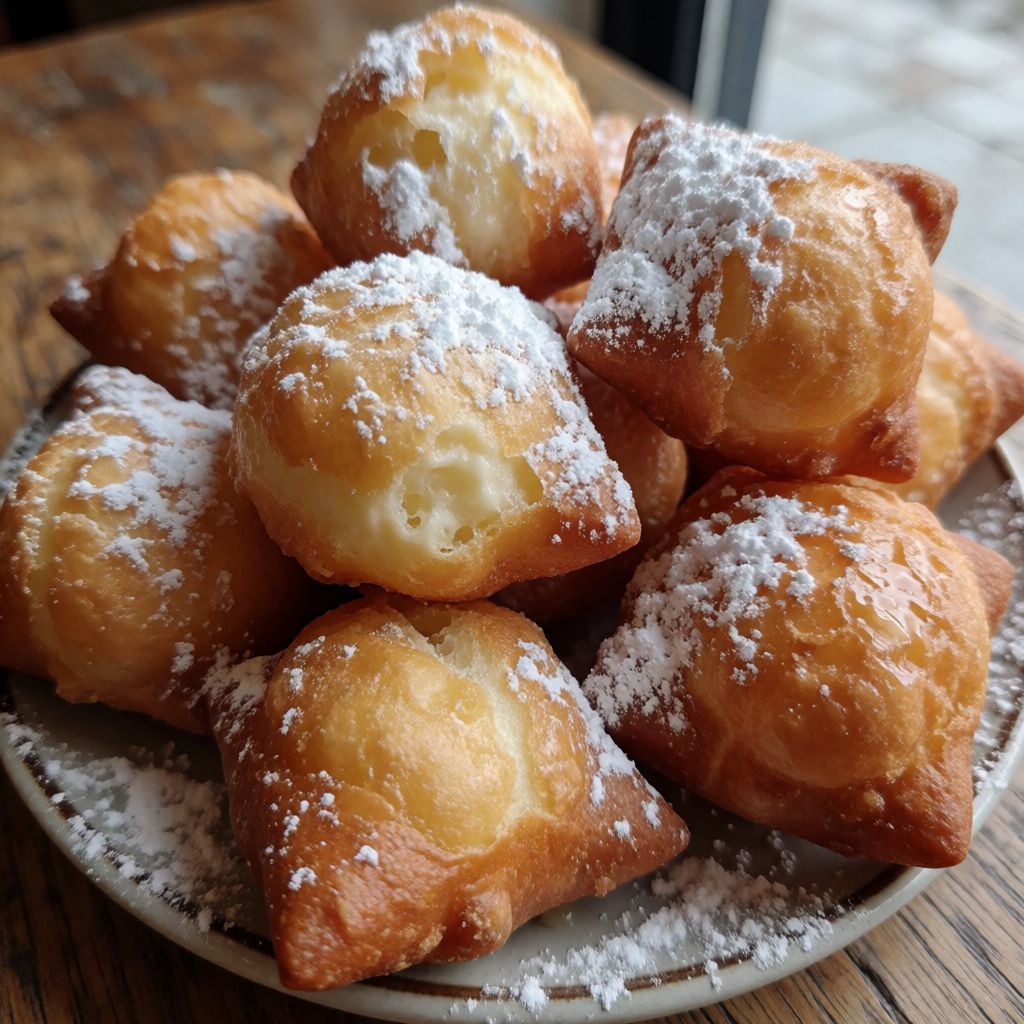
 AI photo
St Joseph's Beignets: Traditional Fried Choux Beignets
A classic Italian treat for St Joseph's Day: choux buns deep-fried and filled with lemon-scented custard cream.
Labels are worked out automatically from the ingredients and can be wrong. Check the packaging if it matters to you.
Ingredients
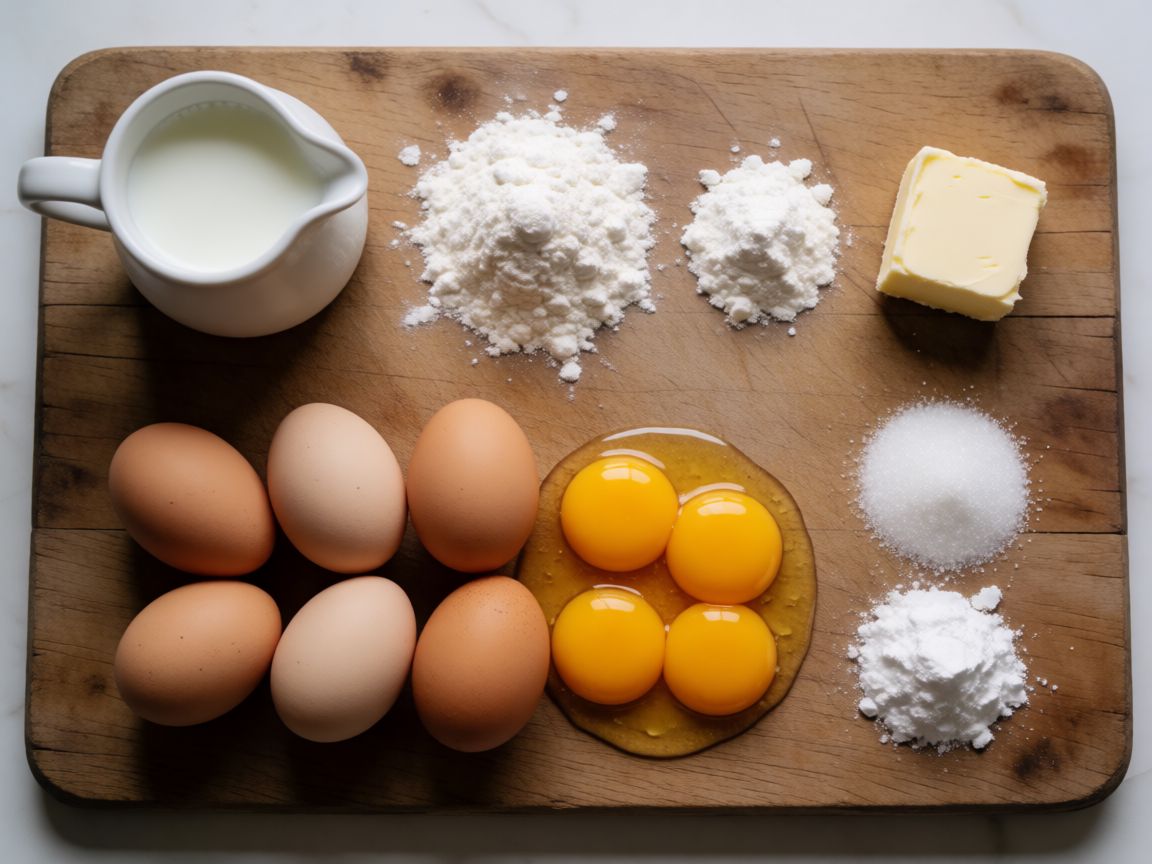
- 500 ml Milk
- 250 ml Water
- 250 g Plain flour
- 30 g Plain flour
- 50 g Butter
- 6 pcs Eggs
- 6 pcs Egg yolk
- 1/2 tsp Salt
- 150 g Sugar
- 20 g Cornflour
- 1 pcs Lemon
- 1 tsp Vanilla extract
- Icing sugar to taste
- Vegetable oil enough for deep-frying











Steps
Heat the milk in a saucepan with the whole lemon zest and bring to the boil.
Whisk the egg yolks with the sugar and vanilla extract using a hand whisk.
Add the sifted plain flour and cornflour to the egg mixture.
Strain the milk through a sieve into the egg mixture and stir well.
Pour everything into the saucepan and cook, stirring constantly, until the custard thickens.
Pour the hot custard into a glass dish, cover with cling film touching the surface and chill.
Put the butter in a saucepan with the water and salt, bring to the boil.
Remove from the heat and add the plain flour, mixing well with a wooden spoon.
Return to the heat and cook for 1-2 minutes, until the dough starts to come away from the sides.
2 minTransfer the dough to a bowl and let it cool, stirring occasionally.
Add the eggs one at a time, beating energetically after each until fully absorbed.
Heat plenty of oil in a saucepan to 170°C.
Fill a piping bag with the dough and pipe small balls onto baking paper.
Fry the beignets in the hot oil at 170°C, removing the paper after a few seconds.
Fry the beignets, turning them, until they have risen, are dry and lightly golden.
Remove the beignets onto kitchen paper and let them cool.
Transfer the custard cream into a piping bag fitted with a nozzle and fill the beignets.
Decorate the beignets with icing sugar and serve.
This is choux pastry — pâte à choux — fried instead of baked, then stuffed with a lemon custard. Two separate mechanisms are stacked on top of each other, and if you don't understand each one on its own, you'll get flat discs instead of puffed golden balls with a hollow, steamy inside.
The choux dough works because of a trick: you cook flour in fat and water first, driving off enough moisture that the starch gelatinises and seals, then you beat in raw egg. That egg doesn't just enrich the dough — it's the only raising agent here. There's no baking powder, no yeast. The water trapped inside the dough turns to steam in the heat of the oil, and because the starch shell is elastic (thanks to the pre-cooking) it stretches rather than cracks, puffing the ball hollow. Skip the pre-cook, or undercook it, and the shell is too weak to hold the steam — you get a wet, eggy fritter, not a puff.
Frying rather than baking changes one thing that matters: in the oven, steam escapes slowly and the shell sets gradually. In hot oil, the outside seals almost instantly — that's the job of 170°C, hot enough to set the surface into a crust within seconds, not so hot that the crust burns before the inside has finished puffing. Some say beignets are "just doughnuts" — no, a doughnut rises from fermentation or chemical leavening built in before cooking; this one rises entirely from trapped steam escaping through dough that's already in the fat. That's why piping small, even balls matters — too big and the centre never cooks through before the outside is dark.
Milk and water together build the base liquid for the custard and the dough separately, and worth keeping track of which is which: 500ml milk goes into the custard for richness and that faint sweetness milk alone gives over water; 250ml water goes into the choux base because water produces more steam, pound for pound, than milk does — and steam is the entire raising mechanism of the dough. Butter in the choux base isn't flavour so much as it's fat coating the starch granules so they don't glue together into a tight, un-stretchy mass — that's part of what lets the dough expand without splitting.
Flour appears twice and does two different things. The 250g in the choux is the structure — cooked first into a thick paste (a panade) so the starch swells and partly gelatinises before any egg goes near it; add raw flour straight to egg and you'd get something closer to batter, no strength to hold steam at all. The 30g flour in the custard, alongside the 20g cornflour, is pure thickening power — cornflour sets a cleaner, glossier custard because it has almost no protein to cloud it, flour alone gives body and a slightly more forgiving set that won't go rubbery if you overcook it a touch. Using both is a hedge — not essential, but it buys you margin if your heat control on a domestic hob is a bit coarse, which, on an induction ring with no visual flame, it often is.
Eggs and yolks split for a reason too: whole eggs (6) go into the choux because you need both the protein (structure, as it sets in the heat) and the water content (steam) they carry; yolks alone (6, into the custard) because yolks are where the fat and the emulsifying lecithin sit — whites would only thin the custard and risk making it grainy when it meets hot milk. If you're short an egg or your eggs run small, judge the dough by feel, not the recipe's count: beat it until it falls off the spoon in a slow, reluctant ribbon — a shape like a "V" — rather than counting eggs religiously. That's the real test, because egg size varies more than any recipe accounts for.
Lemon here is zest only, steeped whole in the hot milk and strained out — it's perfume, not acid; the point is oil from the zest flavouring fat (milk) without the custard splitting, which a squeeze of juice could risk given eggs are about to meet heat. Vanilla extract is doing similar work, rounding the custard rather than announcing itself. If you've no lemon, an orange zest does the same oil-into-milk job, just a different register — don't reach for juice or bottled flavouring as a straight swap, it won't carry the same way through dairy.
Oil for frying needs no flavour of its own — anything neutral and stable at 170°C works: sunflower, groundnut, a flavourless vegetable blend. Olive oil would fight the custard's lemon and burns at a lower point than you want here, so leave it for the roast. On the question of 170°C without a thermometer: a cube of bread or a small offcut of dough dropped in should sizzle steadily and colour in under a minute — too fast and dark, your oil's too hot and the beignets will char outside while staying raw within; too slow and pale, they'll drink oil and turn heavy and greasy rather than puffing light.
Some say you can skip chilling the custard and pipe it warm straight into the beignets. No — warm custard is loose, it won't hold shape inside a hollow shell, and it'll weep out through the holes you make to fill them, leaving you with a soggy outside and an empty middle. The chill is what turns a sauce into something that pipes like a filling and stays put. This whole dish rewards exactly that kind of patience — custard made and rested well before the dough goes anywhere near oil, dough beaten properly rather than rushed, beignets fried in batches rather than crowded. Crowd the oil and the temperature drops the moment you add dough, and you're back to heavy, oil-logged beignets no amount of icing sugar will disguise.