
 AI photo
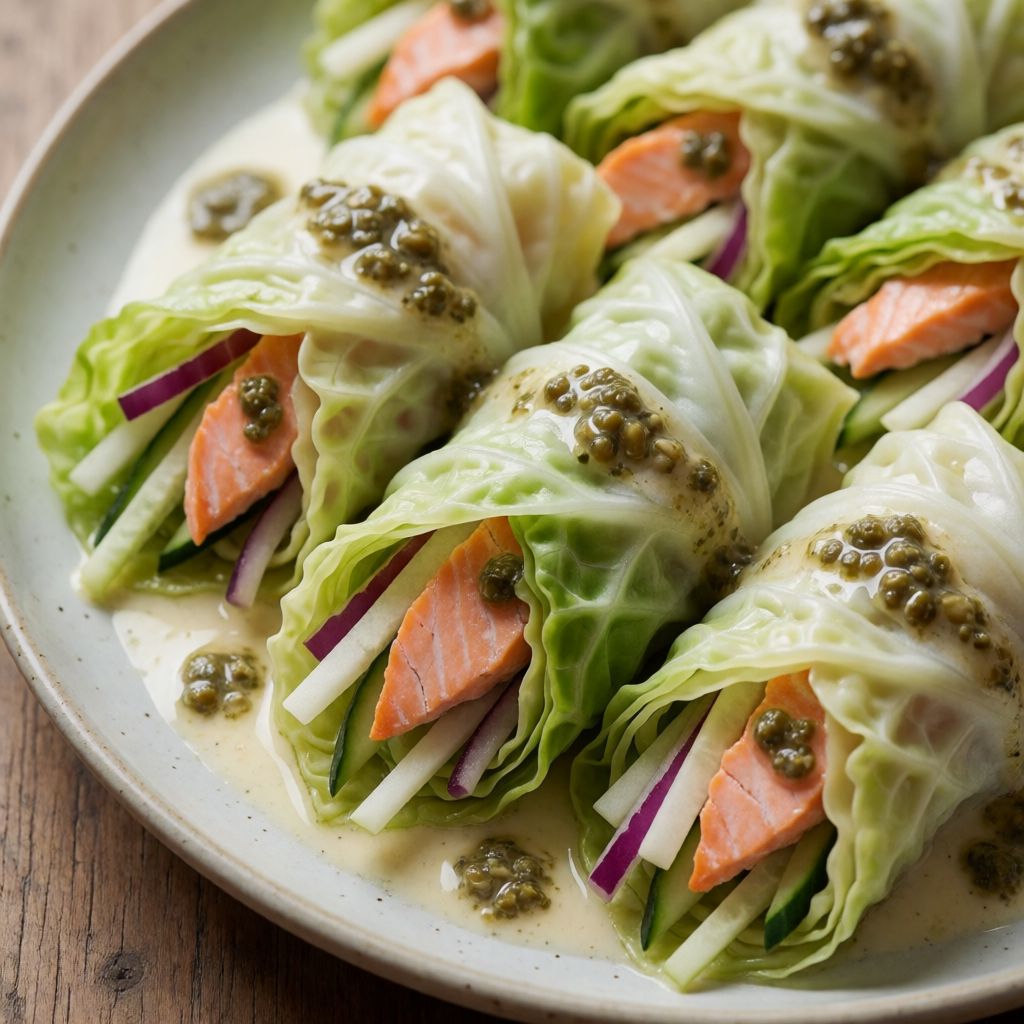
Pointed Cabbage Wraps with Salmon and Caper Dressing
A light salmon dish wrapped in pointed cabbage leaves, with pear, cucumber and a creamy caper dressing.
Labels are worked out automatically from the ingredients and can be wrong. Check the packaging if it matters to you.
Ingredients
- 300 g Salmon
- ½ pcs Lemon juice only
- 1 pcs Pointed cabbage
- 1 pcs Red onion finely chopped
- 2 pcs Pear cut into small cubes
- ½ pcs Cucumber cut into small cubes
- Salt to taste
- Black pepper freshly ground, to taste
- 100 ml Greek yogurt
- 2 tbsp Capers finely chopped
- 2 tbsp Chives finely chopped






Steps
Place the salmon in an ovenproof dish lined with baking paper. Drizzle with a little lemon juice and sprinkle with salt and pepper.
Bake the salmon in a preheated fan oven at 180°C for 15 minutes.
15 minMix the yogurt, capers and chives for the dressing and season well to taste.
Serve the pears, onion, cucumber and dressing in small bowls at the table, so everyone can assemble their own pointed cabbage wrap.
This is a build-it-yourself plate, not a composed dish. Pointed cabbage leaves stand in for a flatbread or a lettuce cup, the salmon is baked plain in the next room over, and a bowl of sweet-sour-crunchy bits plus a dressing sit in the middle so everyone folds their own. Pointed cabbage — sweetheart, hispi, whatever the greengrocer calls it that week — is chosen because its leaves separate like petals instead of fighting you, and the rib down the centre is thin enough to bend around a filling rather than snap it in half. Try the same trick with a tight round white cabbage and you'll be fighting a solid ball of leaves stuck together, each one with a rib like a pencil.
What decides the whole plate is the salmon, and specifically whether you treat "done" as a look rather than a clock. Fifteen minutes at 180°C in a fan oven is a starting point for a fillet of average thickness — a thin tail piece wants less, a thick middle cut wants more. What you're after is the fillet going from translucent coral to an even pale pink, still faintly soft when you press the thickest part, not something that falls apart into flakes the second your fork touches it. Some people say fish is done when it flakes easily — no, that's already past the point. Flaking means the muscle proteins have tightened hard enough to squeeze their own moisture out onto the paper, and that moisture isn't coming back.
The salmon itself is the one ingredient with no real substitute in spirit — you want a fillet with enough fat running through it to baste itself as it bakes, which is why farmed salmon is more forgiving here than a lean wild fish: more fat under the skin means a wider window before it tips into dry. If you're using a leaner cut, watch it more closely rather than giving it more time blindly. Skin on or off is a kitchen choice, not a rule; skin on, in the oven, mostly stops the underside drying against the paper. Lining the dish with baking paper instead of greasing a tin isn't tradition for its own sake — it means nothing catches and burns on the metal, and the fish's own moisture stays trapped under it as a mild self-steam rather than evaporating straight into the oven. A lid would do the same job if you had a dish with one; most of us don't, so paper is the honest substitute.
Pointed cabbage is a seasonal, fast-growing crop, harvested young before the leaves have time to toughen and wrap tight — that's the economic reason it's cheap and common for exactly this kind of raw-eating job, and why a mature storage cabbage, bred to sit in a cold shed through winter, is the wrong tool: it's built for durability, not for folding raw around salmon. If you can't find pointed cabbage, look for anything with the same loose, separable leaf and a rib that bends rather than cracks — little gem lettuce, Chinese leaf, or savoy with the thick central vein cut away.
The dressing's whole character comes from capers, and capers are there to do one job: punch a clean, briny sourness through the softness of the yogurt and the salmon, the way a squeeze of lemon would, but with salt built in. If yours taste aggressively salty rather than sharp, rinse them before chopping — that's a sign of the brine rather than a flaw in the recipe. No capers in the cupboard, chopped gherkin with a little extra salt gets you close enough; green olives, chopped fine, get you a cousin of the same idea rather than a copy. Chives are there for a green, mild onion note without heat — any soft allium top works, spring onion greens being the obvious stand-in since they're the same family doing the same job.
Choose the pear firm, not soft-ripe — a pear that gives at the neck will turn to mush the moment you cube it and sit on the table weeping its own sugar water into the bowl. You want crunch and sweetness as a contrast to the raw onion's bite, not another soft texture competing with the yogurt. An apple, cut the same way, does the identical job if pears are out of season or just not good that week — slightly more acid, slightly less perfume, but the mechanism is the same: something crisp and sweet to balance something sharp and raw.
The red onion is cut fine and left mostly alone on purpose. Some people insist raw onion always needs a soak in cold water to tame it — no, only if you actually want it milder, and here you don't, not entirely. Its sharpness is one of the few assertive flavours on the table against a fish that's deliberately cooked plain and a dressing that's deliberately creamy; soften it too much and the whole plate goes flat. A quick rinse under the tap, not a long soak, is enough to take the raw edge off without losing the point of it.
And patience belongs in here even though nothing simmers for an hour. Let the salmon sit a couple of minutes out of the oven before you break it onto the table — the juices that have moved toward the surface during cooking need that short pause to settle back through the fillet rather than running straight onto the board the second you cut it. It's a small thing, and it's the difference between a fillet that stays moist on the second helping and one that's already gone dry by the time the cabbage leaves come round the table.