
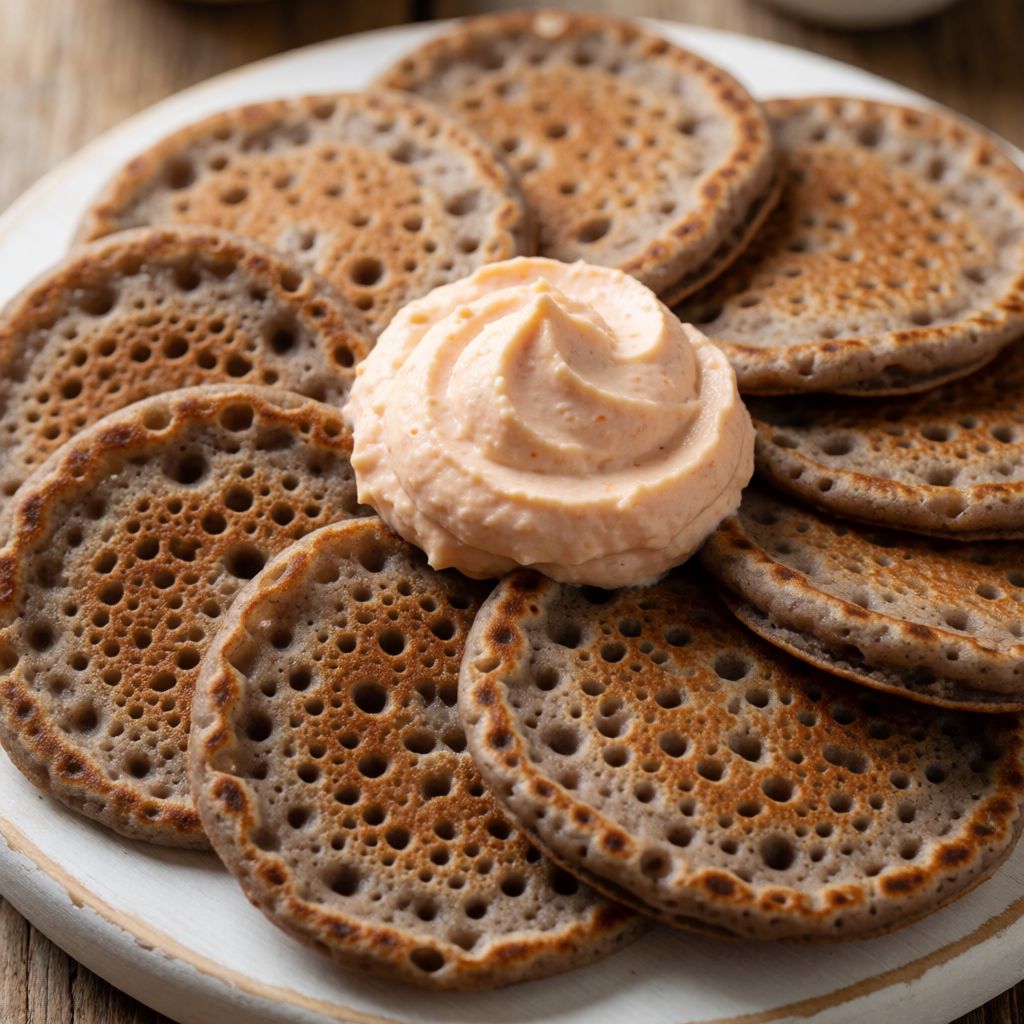
 AI photo
Smoked Salmon Pâté with Buckwheat Blini
A quick salmon rillette served on little buckwheat blini, finished with dill and lemon.
Labels are worked out automatically from the ingredients and can be wrong. Check the packaging if it matters to you.
Ingredients
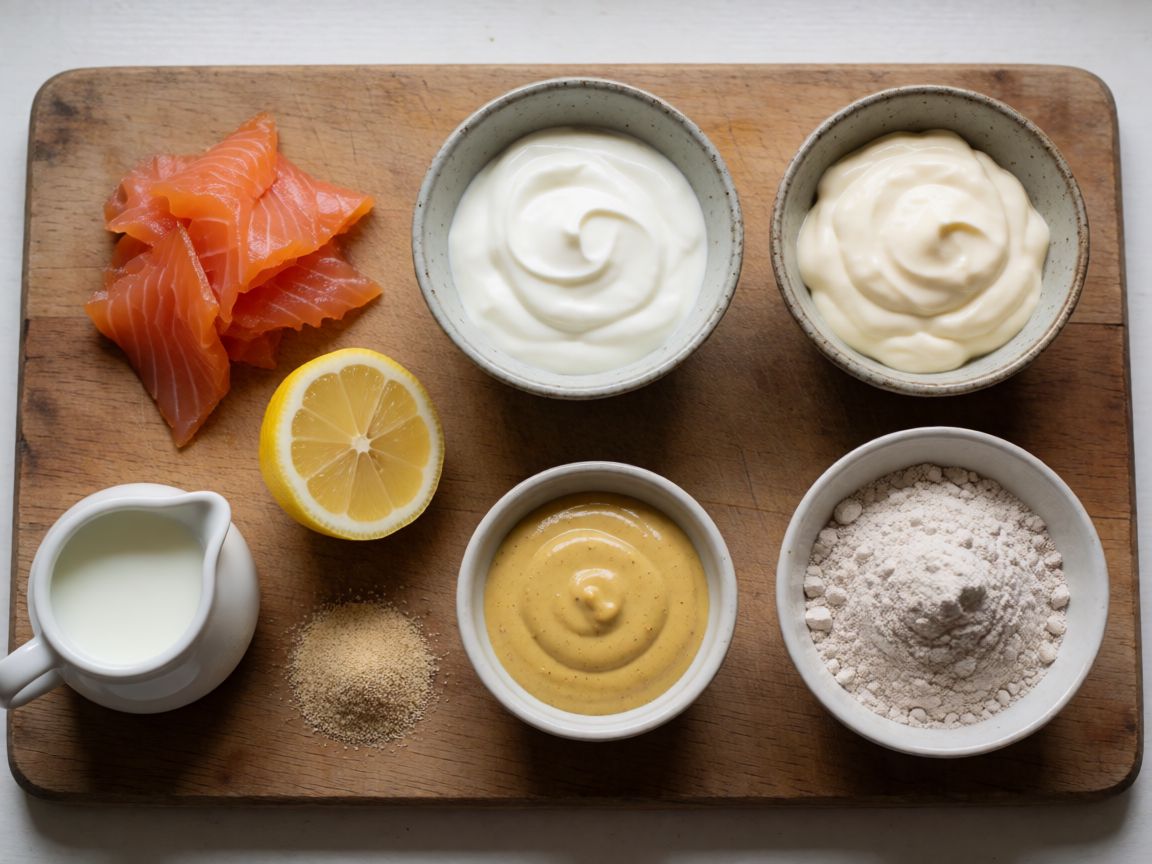
- 200 g Smoked salmon hot-smoked
- 50 ml Crème fraîche 38%
- 3 tbsp Mayonnaise
- ½ pcs Lemon organic, finely grated zest and juice
- ½ tsp Dijon mustard
- Salt
- Black pepper freshly ground
- 200 ml Milk at room temperature
- 20 g Yeast
- 100 g Buckwheat flour
- 50 g Plain flour
- 1 pcs Egg
- 1 tsp Butter for frying
- 1 bunch Dill
- ½ pcs Lemon for serving














Steps
Mash the smoked salmon with a fork and place in a bowl with the crème fraîche, mayonnaise, lemon zest and juice; mix and season with Dijon mustard, salt and black pepper.
Pour the milk into a bowl, dissolve the yeast in it, then stir in the buckwheat flour, plain flour, salt and egg yolk to a smooth batter.
Cover the batter with a towel and let it rise for 1 hour.
60 minWhisk the egg white to a stiff foam and gently fold it into the batter so as not to knock out the air.
Melt the butter in a frying pan and drop small spoonfuls of batter in, frying until golden on both sides.
Spoon the rillette onto the blini, sprinkle with dill and serve with lemon wedges.
This is two small mechanisms wearing one plate: a cold pâté that needs no heat at all, and a yeasted buckwheat blin that needs patience more than skill. The salmon side is just chemistry of fat and acid — crème fraîche and mayonnaise carry the smoke flavour, lemon juice cuts the richness so it doesn't sit heavy on the tongue, and mustard is there to wake the whole thing up, not to taste of mustard. You mash, you mix, you taste, you stop. There's no cooking to get wrong here, which is rare comfort in a fish recipe.
The blin is where the real decision gets made. Buckwheat flour has no gluten, so on its own it gives you a batter that falls apart in the pan — that's why plain flour is doing structural work here, not flavour work. The yeast isn't for lift in the bread sense; it's there slowly, over that hour, to build flavour and a few bubbles while you get on with something else. Some say blini must prove on a warm windowsill or near a radiator — no, because yeast doesn't need heat, it needs time; a kitchen at normal room temperature does the job, just slower, and slower is fine.
What decides whether this works is the egg white. You whip it stiff, then fold it in gently — "gently" meaning you're protecting air pockets you can't put back once they're gone. Beat it in instead of folding and you get flat, dense discs that taste fine and look like regret. Doneness on the pan isn't a clock question: you're watching for the surface to go from wet-shiny to matte and bubbled at the edges, that's your cue to flip, not a count of seconds.
Hot-smoked salmon, not cold-smoked, is specified for a reason: cold-smoked salmon is silky and raw-textured, it won't mash with a fork into something spreadable, it'll just shred into ribbons. Hot-smoked is already cooked through by its process, firm enough to break down into flakes that bind with fat. If you only have cold-smoked, you can still make this, but flake it finer and lean harder on the crème fraîche to hold it together — it'll be a different, looser thing, not a failure, just not this.
Crème fraîche at 38% fat matters because fat is the carrier for smoke flavour — smoke molecules are fat-soluble, which is why smoked fish always tastes better with something rich alongside it, not because anyone decided it should be elegant. Mayonnaise adds more fat plus its own acidity and egg structure, which is why the two together give you a pâté that holds a shape on a spoon rather than running. If you're out of crème fraîche, full-fat soured cream or even whipped cream cheese does the same fat-carrying job, just adjust the lemon since cream cheese brings less natural tang.
The lemon zest and juice aren't interchangeable with vinegar, despite what some recipes claim about "any acid will do" — zest carries citrus oil, a flavour note, not just sourness, and that's doing something vinegar can't. Use an organic or unwaxed lemon for the zest specifically because you're eating the skin's oil; waxed lemons carry a coating you don't want grated into your food.
For the blini: buckwheat flour gives you that nutty, slightly bitter backbone — it's the reason this isn't just a pancake, it's a dish with its own character that can stand next to assertive smoked fish without disappearing. Plain flour is there purely for gluten, for structure, so don't be tempted to go all-buckwheat for authenticity's sake; you'll get batter that won't hold a shape in the pan and falls apart when you try to flip it. If you need this gluten-free, a gluten-free plain flour blend will do the structural job adequately, though the blini will be a touch more fragile — handle them with a wider spatula than you think you need.
Fresh yeast at 20g is specific and if you only have dried yeast, halve the weight — dried yeast is more concentrated, and using the same amount will over-ferment the batter, giving you a sour, boozy edge instead of a clean rise. Let it dissolve fully in room-temperature milk before adding flour; cold milk slows the yeast down for no reason, and you've got nowhere to be in a hurry here anyway — that hour of proving is not dead time, it's the ingredient you can't buy at the shop.
A small butter note: in a British kitchen with a domestic hob, not a kazan, not a professional blini pan, the real enemy is too much heat too fast — butter will brown and the first side will catch before the batter's cooked through in the middle. Keep the butter just melted and glossy, not foaming hard, and do these in batches rather than crowding the pan; crowding drops the pan's heat unevenly and you'll end up with one side pale and one side burnt on the same blin.