
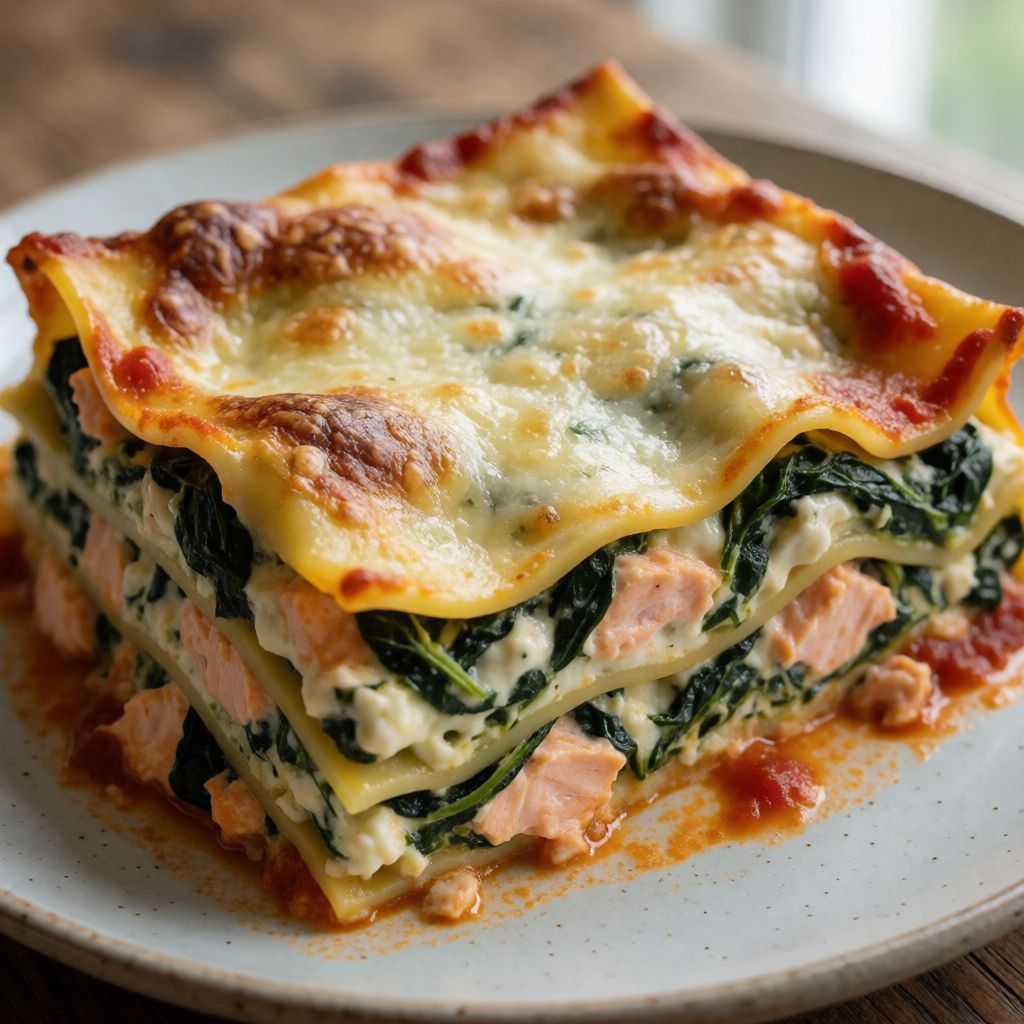
 AI photo
Salmon and Spinach Lasagne
A creamy layered lasagne with salmon, spinach and a rich tomato sauce.
Labels are worked out automatically from the ingredients and can be wrong. Check the packaging if it matters to you.
Ingredients
- 2 pcs Onion finely chopped
- 500 g Spinach frozen
- 1 pinch Nutmeg grated
- 175 g Mascarpone
- 1 clove Garlic finely chopped
- 400 g Chopped tomatoes, tinned
- 50 ml Double cream
- 0.5 tsp Oregano dried
- 500 g Salmon
- 10 pcs Lasagne sheets
- 1 tbsp Olive oil for frying
- Salt to taste
- Black pepper freshly ground, to taste













Steps
Fry the onion in olive oil until soft, add the frozen spinach and heat through until fully thawed. Add the nutmeg, salt, pepper and mascarpone, mix well and taste.
In another pan, fry the garlic in a little olive oil. Add the chopped tomatoes, double cream, oregano, salt and pepper to taste. Bring to the boil and simmer for a few minutes.
Remove the skin from the salmon and cut it into roughly 2 x 2 cm cubes.
Grease a heatproof dish with olive oil and layer: spinach, tomato sauce, salmon and lasagne sheets, alternating the layers until both sauces and the salmon are used up.
Bake the lasagne for 20-25 minutes in a preheated fan oven at 175°C, until the pasta is tender but still slightly firm.
25 min
This isn't really an Italian lasagne wearing a salmon disguise — it's a built sandwich of two sauces around raw fish, relying entirely on the oven to do three jobs at once: cook the salmon, soften the pasta sheets, and bind everything with heat long enough to set but not so long the fish turns to chalk. That's the whole tension of the dish. Everything else is assembly.
What decides whether it works is the salmon's internal temperature at the exact moment the pasta becomes tender. Salmon goes from silky to sawdust over a narrow band — somewhere past 60°C it starts pushing out white albumin and tightening up, and there's no fixing it once it's gone. Dried-out lasagne sheets at the edges are forgivable; dry salmon cubes in the middle are not. So the cube size (2x2cm, as given) isn't decorative — bigger cubes buy you more time before the centre overcooks, which matters because the pasta needs its own 20-25 minutes to go from cardboard to tender.
Some say you must pre-cook the fish separately and fold it in at the end, the way you'd treat it in a risotto. No — because the whole point of baking it raw in the layers is that the fish releases a little moisture and savour straight into the sauce around it as it cooks, which a lasagne needs since there's no long braise here to build flavour. Pre-cooking it loses you that, and you gain nothing, because the oven's moist, enclosed heat (foil or a tight dish lid, effectively) is gentler on raw fish than a dry pan ever is.
On the salmon: buy it as a whole fillet, skin on, and remove the skin yourself with a sharp knife run flat against the board — pre-cut "lasagne-ready" salmon pieces are usually trimmings and cook unevenly because the pieces aren't uniform. Farmed Scottish salmon is the easy, consistent choice in a UK supermarket; it has enough fat to survive the oven's dry edges. If you're using a cheaper or leaner cut, or trout instead, cut the cubes a touch bigger to compensate — more mass means more buffer before the centre overcooks.
Frozen spinach, not fresh, is the right call here and not a compromise — fresh spinach for 4 people would be two full carrier bags, it collapses to almost nothing, and you'd spend ten minutes just wilting and squeezing water out of it before you could even start the sauce. Frozen spinach arrives already reduced and partly drained; you're just reheating and seasoning it. If you only have fresh, wilt it hard in a dry pan first and squeeze it in a tea towel — skip that and your lasagne turns watery, because spinach's water has nowhere to go once it's sealed between pasta sheets in the oven.
Mascarpone is there for richness without the sourness of ricotta or the thinness of cream cheese — it has almost no flavour of its own, which is exactly the point, since the nutmeg and the spinach are meant to carry the taste. Any full-fat soft cheese with a mild, barely-there tang will do if mascarpone isn't in the fridge — crème fraîche thickened slightly, or even clotted cream loosened a little, both work on the same principle: fat and body, minimal flavour of their own.
Tinned chopped tomatoes plus double cream is doing the job a proper tomato sauce would do with hours of reduction — the cream shortcuts you to a sauce that already tastes rounded rather than sharp, because raw tinned tomato on its own is thin and acidic. Oregano here is for a background herbal note, not a starring one; half a teaspoon dried is right because dried oregano is more concentrated than fresh and burns bitter if you go overboard, especially baked uncovered where the top layer gets direct, dry heat.
Dried lasagne sheets, not fresh, make sense in this build precisely because they're thirsty — they pull moisture from the two sauces around them as they bake, which both cooks them and slightly thickens the sauces at the same time. Fresh lasagne sheets are already soft and would go past tender into mush in the same bake time, so if that's what you've got, pull the dish out 5 minutes earlier and check the pasta by pressing a fork through it, not by the clock — bend, don't snap, is the same test you'd use on a carrot, just applied to pasta.
On the oven: a domestic fan oven at 175°C is milder and more even than a kazan or a commercial deck oven, which is exactly why this recipe can ask raw salmon to cook safely inside a sealed stack of pasta without turning to rubber — a hotter oven would cook the outside layers of sauce and pasta long before the salmon in the centre caught up. Don't be tempted to push the temperature up to "save time" — the salmon doesn't care how fast the oven is, only how hot it gets inside the dish, and a hotter oven just gets you dry edges and a still-raw middle.