
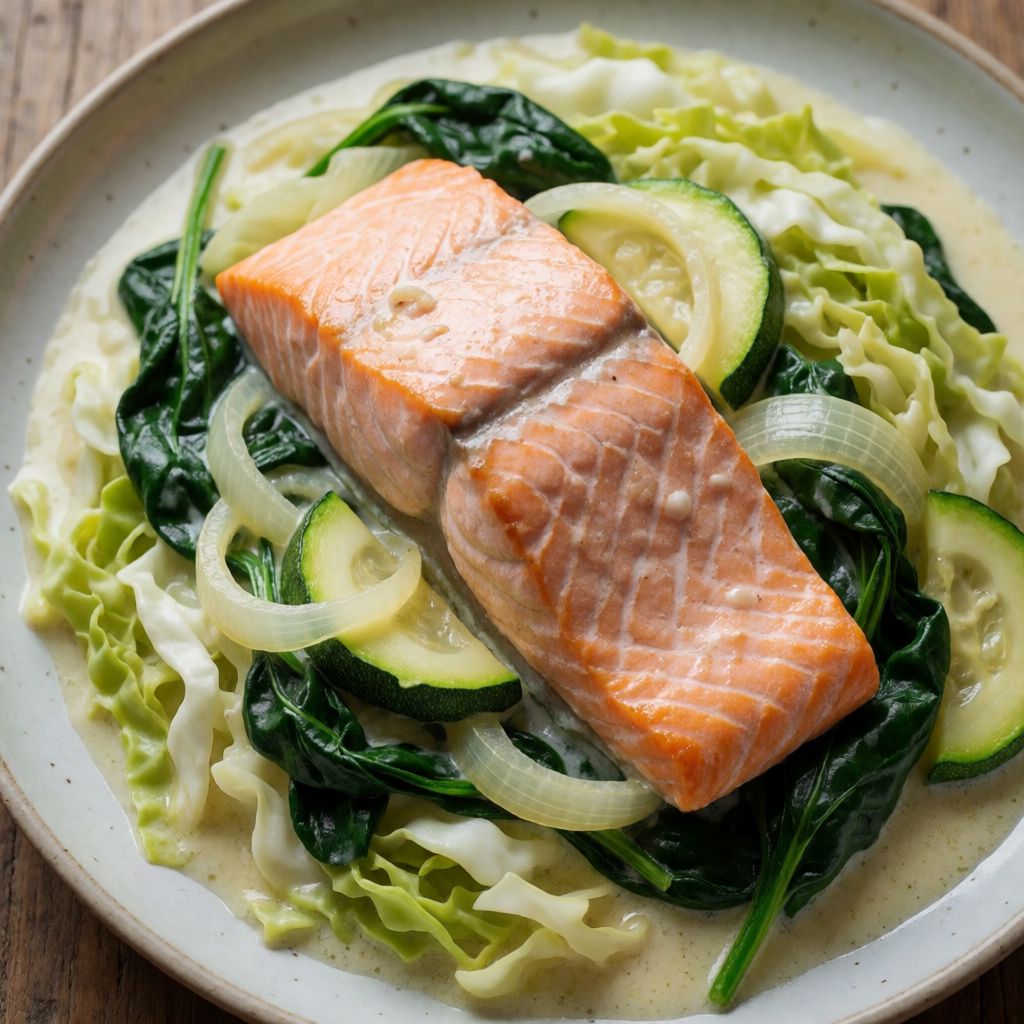
 AI photo
Salmon Traybake with Spinach and Vegetables
A simple salmon bake with spinach, courgette and cabbage, served with rice.
Labels are worked out automatically from the ingredients and can be wrong. Check the packaging if it matters to you.
Ingredients
- 1 pcs Onion finely chopped
- 150 g Cream cheese
- 100 ml Stock
- 300 g Spinach finely chopped
- 150 g Pointed cabbage thinly shredded
- 150 g Courgette coarsely grated
- 600 g Salmon
- 1 tsp Olive oil for frying
- 10 g Butter for frying
- Salt
- Black pepper freshly ground
- 300 ml Basmati rice












Steps
Fry the onion in olive oil in a large pan until soft.
5 minAdd the cream cheese and stock, stir until smooth, and season with salt and pepper.
3 minAdd the spinach and pointed cabbage and stir well so they wilt slightly.
3 minTransfer the mixture to a greased ovenproof dish along with the courgette and mix all the vegetables well.
2 minBake in a preheated fan oven at 200°C for about 10 minutes.
10 minPlace the salmon fillets on top of the vegetables and bake for a further 14-16 minutes, until the salmon is perfectly tender.
15 minMeanwhile, cook the rice according to the packet instructions.
15 minServe the vegetables and salmon with the rice.
This is a one-dish fix for the person who wants a roast-dinner feeling on a Tuesday without the three-hour commitment. You wilt a vegetable base in a cream cheese sauce, bake it half-set, then lay salmon on top so the fish steams gently in its own fat and the sauce's moisture rather than roasting dry. The whole thing lives or dies on one thing: whether the salmon goes in before or after the veg have had their own time in the oven.
That's why the recipe splits the bake in two. Ten minutes for the vegetables alone lets the courgette's water boil off and the cabbage soften past its raw crunch, so you're not left with a watery dish once the fish joins in. Salmon has almost no connective tissue to break down — it's basically muscle and fat held in thin sheets — so it has no business sitting in a hot oven for the same stretch as a chicken thigh. Put it in from the start and by the time the cabbage is ready, the salmon is already past done: dry outside, grey inside, flaking into sawdust. Put it in late and it only needs to go from raw-translucent to opaque-and-barely-giving, which is a job of minutes, not quarter-hours.
Some say fish needs a long, low oven to "cook through gently." No — slow doesn't mean gentle for fish, it just means a longer window in which to overshoot. What actually protects salmon here is the vegetable bed underneath: a buffer of moisture and lower-conducting mass between the tray and the fillet, plus the fact that it's only in the heat for a short, defined stretch at the end.
The cream cheese and stock aren't there for richness alone — they're what stops this being a dry vegetable saute. Cream cheese melts into a loose sauce when it meets hot stock rather than separating, because it's already an emulsion of fat and water held by milk proteins; stirred in off rough heat it just loosens rather than breaks. If you've only got full-fat soft cheese without the stabilisers cream cheese has, add it off the heat and whisk hard, or use crème fraîche, which behaves the same way and won't curdle on you.
The onion goes in first and alone, in oil, because onion needs time and a dry-ish pan to actually caramelise its sugars rather than just go translucent and raw-tasting — five minutes is the lower bound, not a target; you're watching for it turning soft and faintly golden, not timing a countdown. Olive oil here is just a frying medium with a bit of flavour; any plain oil with no smell of its own — sunflower, groundnut — does the same job if that's what's in the cupboard. The butter that goes in with it is for the richer edge butter gives alongside oil's higher smoke tolerance, not instead of it.
Spinach and pointed cabbage go in together and only need to "wilt slightly," not cook through, because they'll keep cooking in the ten-minute oven stage and again under the salmon — stop them too early in the pan and you avoid a mushy, grey-green mess by the time it's plated. Pointed cabbage (sometimes called sweetheart cabbage here) is sweeter and softer-leaved than a round white cabbage, which is why it's chosen — a round cabbage would need longer and shred tougher. If you can't get it, use the tenderest cabbage you can find, or lean harder on spinach and use less cabbage altogether.
Courgette is added raw to the greased dish, not pre-cooked, because it's mostly water held in a loose cell structure that collapses fast under heat — coarse grating exposes more surface for that water to escape in the ten-minute pre-bake, which is exactly why that stage exists: cook it raw straight under the salmon and you'd get a watery pool under the fish instead of a dish that holds together.
600g salmon for four people is roughly 150g a fillet — a fair main-course portion, not a starter cut. Skin-on or off is your call: skin-on protects the underside from the sauce's moisture a little longer and crisps faintly on top if you flip it, skin-off takes the sauce's flavour straight in. Either way, don't buy one thick centre-cut loin for the whole lot and expect even cooking across four smaller cuts of the same piece — try to get fillets of a similar thickness so they all hit "gives like a ripe plum" at roughly the same minute.
Basmati rice is simply a long-grain rice bred to stay separate and dry rather than sticky when cooked — it's there to soak up the sauce without turning the plate into porridge. Any long-grain rice does the job; a short-grain or risotto rice would clump and fight the sauce instead of carrying it. Cooking it "meanwhile" isn't an afterthought instruction — it's there so you're not standing over two things needing attention in the same four minutes; start the rice when the vegetables go in for their first ten-minute bake, and both land on the table at the same time, which is the only real clock this dish asks you to watch.