
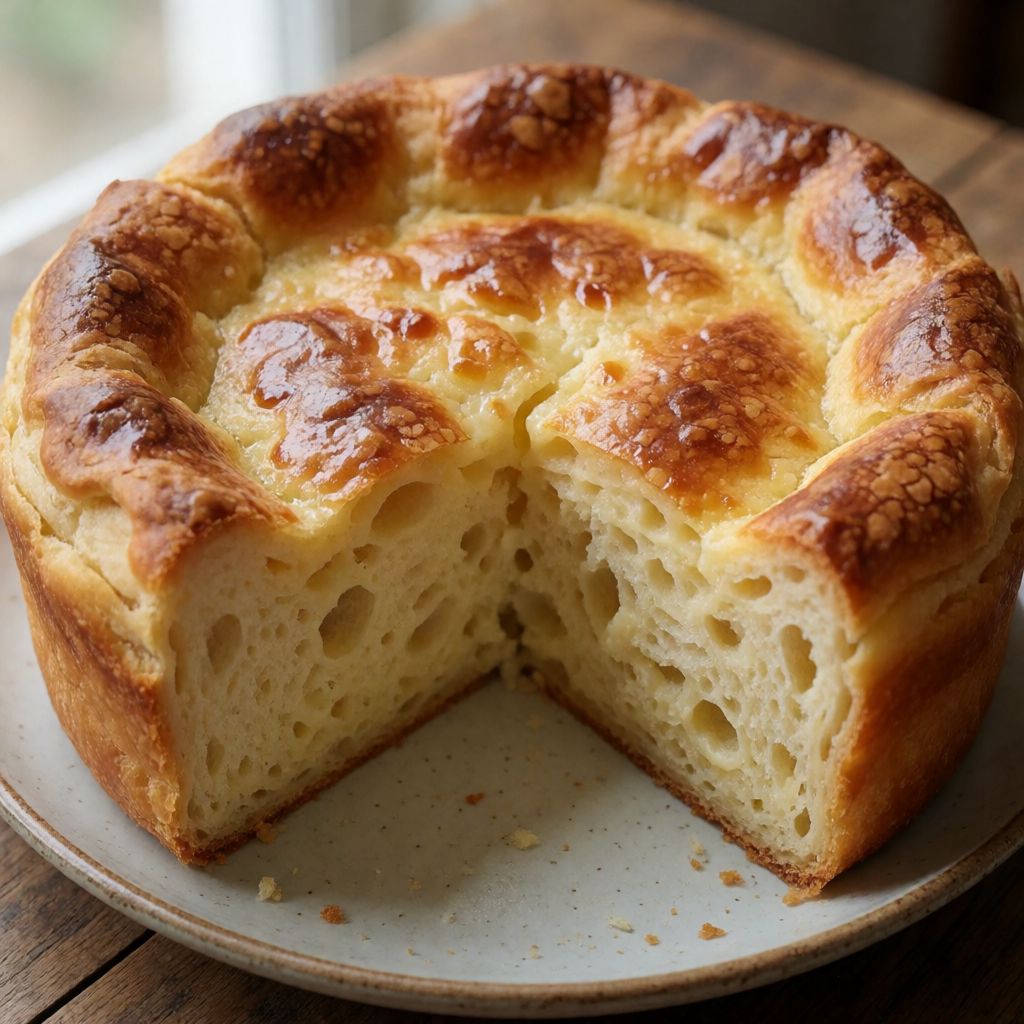
 AI photo
Savoury Bread Pie
A hearty savoury bread pie that turns stale bread into a crisp, cheese-pulling pan pie with ham and smoked scamorza.
Labels are worked out automatically from the ingredients and can be wrong. Check the packaging if it matters to you.
Ingredients
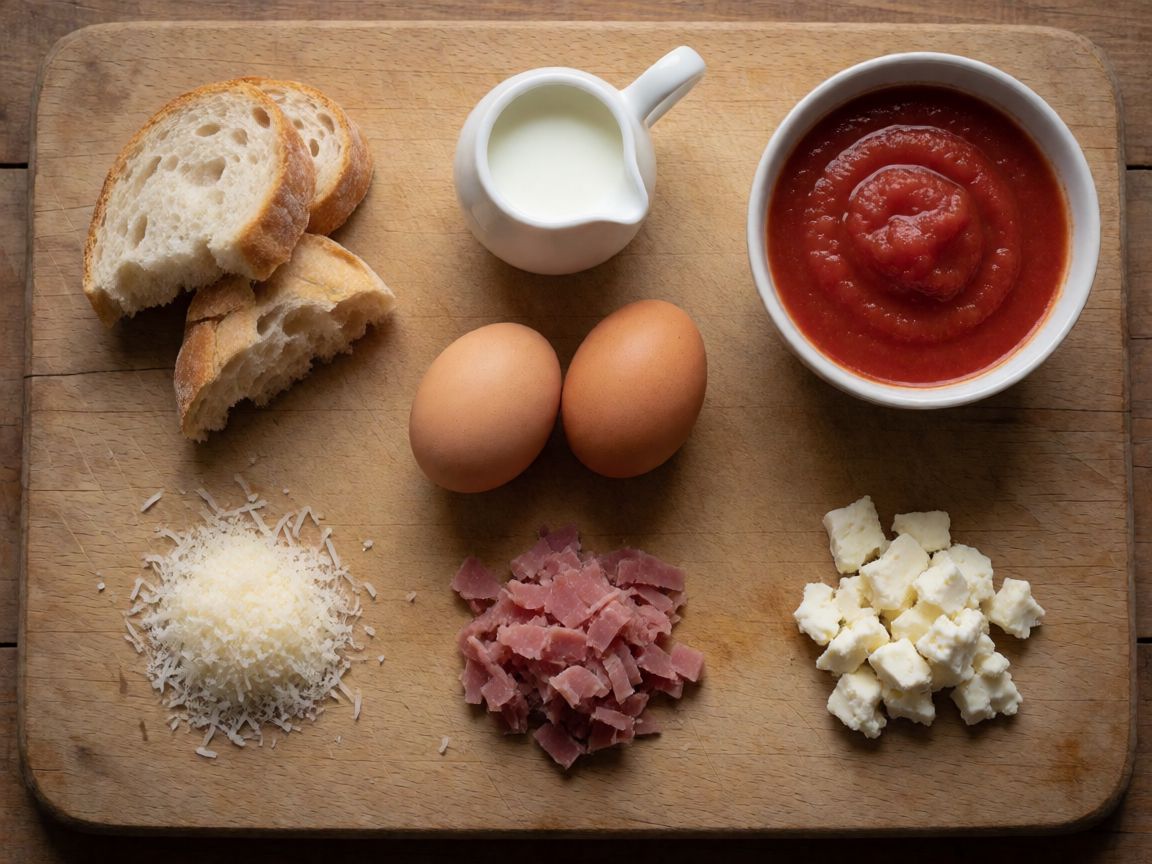
- 300 g Stale bread
- 300 ml Milk
- 2 pcs Eggs
- 60 g Parmesan grated
- Salt to taste
- Black pepper to taste
- Olive oil to taste
- Tomato passata to taste
- 90-100 g Ham
- 80 g Smoked scamorza









Steps
Cut the stale bread into pieces and place in a large bowl. Pour over the milk to soften, stir, then work the bread with your hands until it breaks down further.
Add the salt, black pepper, grated Parmesan and eggs. Knead with your hands until you get a smooth, fairly firm mixture that is easy to work with.
Heat a little olive oil in a frying pan and spread about half of the bread mixture into it.
Flatten it into an even layer, with a slightly raised edge around the border.
Add the filling: a few spoonfuls of tomato passata, the smoked scamorza and the ham.
Cover with the rest of the bread mixture, sealing the edges well.
Cover the pan with a lid and cook for about 10 minutes on each side.
10 minTo flip the pie, use a lid or a plate to help, as you would with a frittata.
Finish cooking; make sure it has reached a safe internal temperature of 70°C at its thickest point.
Serve hot, while the cheese is still stretchy!
This is a frittata's trick played on bread instead of eggs. Stale bread, soaked soft and bound with egg and Parmesan, becomes a dough you can shape, fill and flip in a pan — a way of turning leftovers into something that holds a filling the way a pastry case would, without the oven, without the rolling pin, without wasting what's gone hard in the bread bin.
What decides whether it works is the bread mixture's texture, not the filling. Too wet, and it won't hold a shape or seal an edge — it'll weep tomato and melted scamorza into your pan the second you try to flip it. Too dry, and it won't bind, it'll crumble at the cut. You're aiming for something closer to a firm mash: workable with your hands, no longer "bread" in any recognisable sense, but not porridge either. That's a feel, not a measurement — milk absorption depends on how stale and how dense your loaf is, so the 300 ml is a starting point, not a law.
The second thing that decides it is the flip. You're making a pie with no top crust and no lid in the oven sense — just a domestic frying pan and a plate standing in for a kazan's confidence. The raised edge you build around the border before filling isn't decoration, it's the only thing stopping the passata and melted cheese escaping sideways when you press the top layer down to seal. Skip that lip and you get a pan floor sticky with tomato, not a pie.
Stale bread is the whole economic logic of this dish — it's not a style choice, it's what you do with bread that's gone past sandwiches but isn't yet fit for the bin. Fresh bread would turn to paste the second milk hit it; it has no structure left to break down, only sogginess to gain. Stale bread has dried out just enough that the milk has something to rebuild — crumb that was collapsing gets re-swollen into a workable mass. If your loaf isn't properly stale, dry it briefly in a low oven first, otherwise you're adding liquid to liquid and the mixture never firms up.
The milk does two jobs: it rehydrates, and the fat and proteins in it help the bread knit together once the egg sets. Any milk works here — this isn't a dish where the fat percentage matters to the result, unlike a béchamel. If you're out, a light stock or even water with a splash of cream gets you close enough; you lose a little richness, not the mechanism.
Egg is the actual binder — without it the bread mash is just damp crumb that falls apart on the plate. Two eggs for 300 g of bread is enough to set the mixture on cooking without making it rubbery; more egg and you drift toward a strata or bread pudding texture, which isn't what you want here — you want something sliceable. Parmesan does double duty: salt and savouriness worked into the dough itself, and a little extra binding from its own protein as it melts. A hard, dry grating cheese is what you need — anything that stays firm when grated, not soft and oily. Pecorino works if you want more bite; a generic "hard Italian cheese" from the supermarket own-brand shelf is a fine substitute, the criterion is dryness and sharpness, not the label.
The filling — passata, ham, scamorza — sits inside rather than on top for a structural reason, not just presentation: a filling sandwiched between two bread layers stays put when you flip, stays hot when you cut it, and the cheese gets the enclosed, steamy environment it needs to go stretchy rather than just melted flat. Scamorza is chosen because it's a stretching cheese with enough smoke to stand up to bread rather than disappear into it; mozzarella would melt fine but add nothing of its own, provolone or a mild smoked cheddar would get you the same job done if scamorza isn't on your shelf. Ham is there for salt and chew against the softness of everything else — any cured, sliced meat does the same work, this isn't a dish where the specific cure matters.
On the heat: there's no oven temperature given here and none is needed, because the real work — setting the egg, melting the cheese, warming the filling through — happens slowly over two ten-minute sides with the lid on, trapping steam the way a dome would in a tandoor, cooking it as much from the top down as the bottom up. That's why the lid matters more than the exact minutes: it's doing the job an oven's ambient heat would do, and a pan left uncovered just dries the surface without ever warming the centre. The ten minutes per side is your lower bound, not your deadline — the real test is the thermometer, 70°C at the thickest point, because this has egg and dairy and ham sitting damp in the middle, and "it looks done" has fooled better cooks than either of us on something this dense. Patience here isn't virtue for its own sake — it's what stops you cutting into a pie that's set on the outside and cold at the core.