
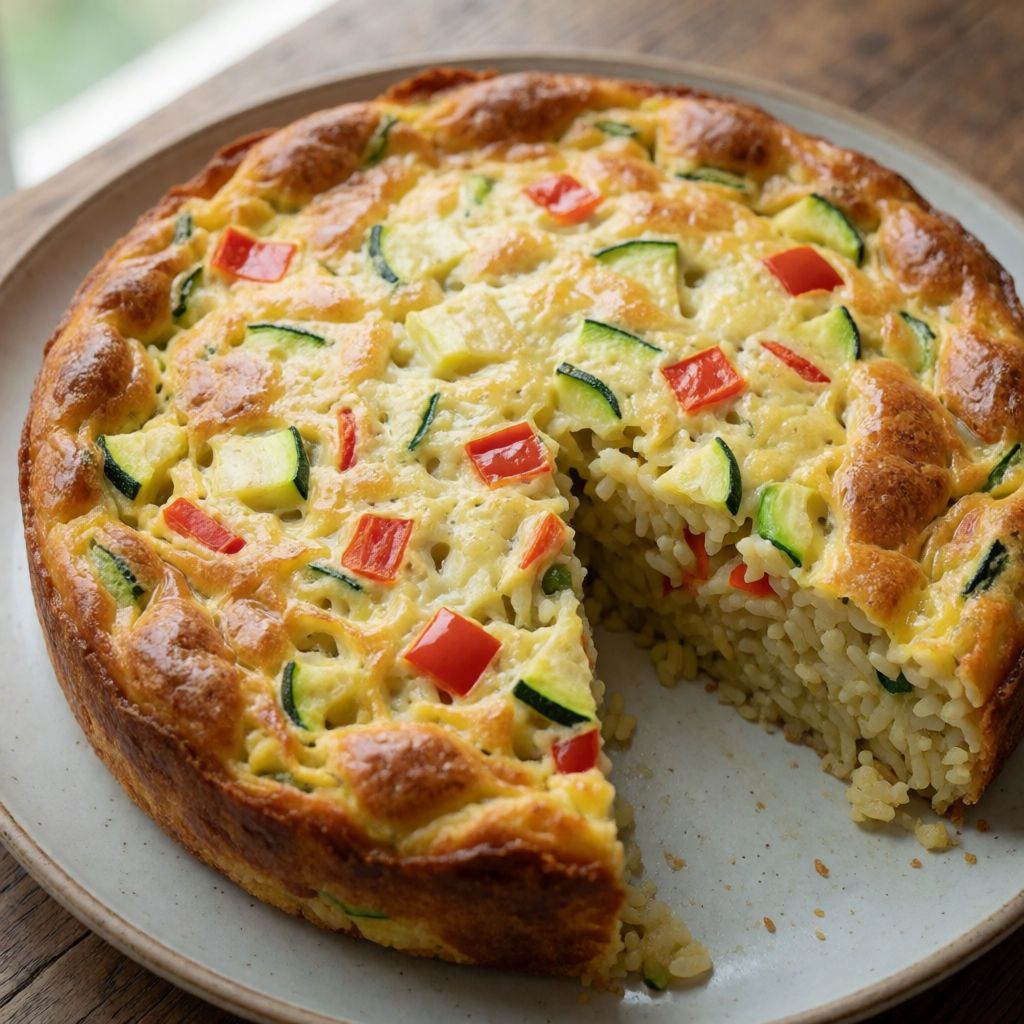
 AI photo
Savoury Rice and Vegetable Pie
A savoury baked rice pie with pepper, courgette and cheese, topped with a golden breadcrumb crust.
Labels are worked out automatically from the ingredients and can be wrong. Check the packaging if it matters to you.
Ingredients
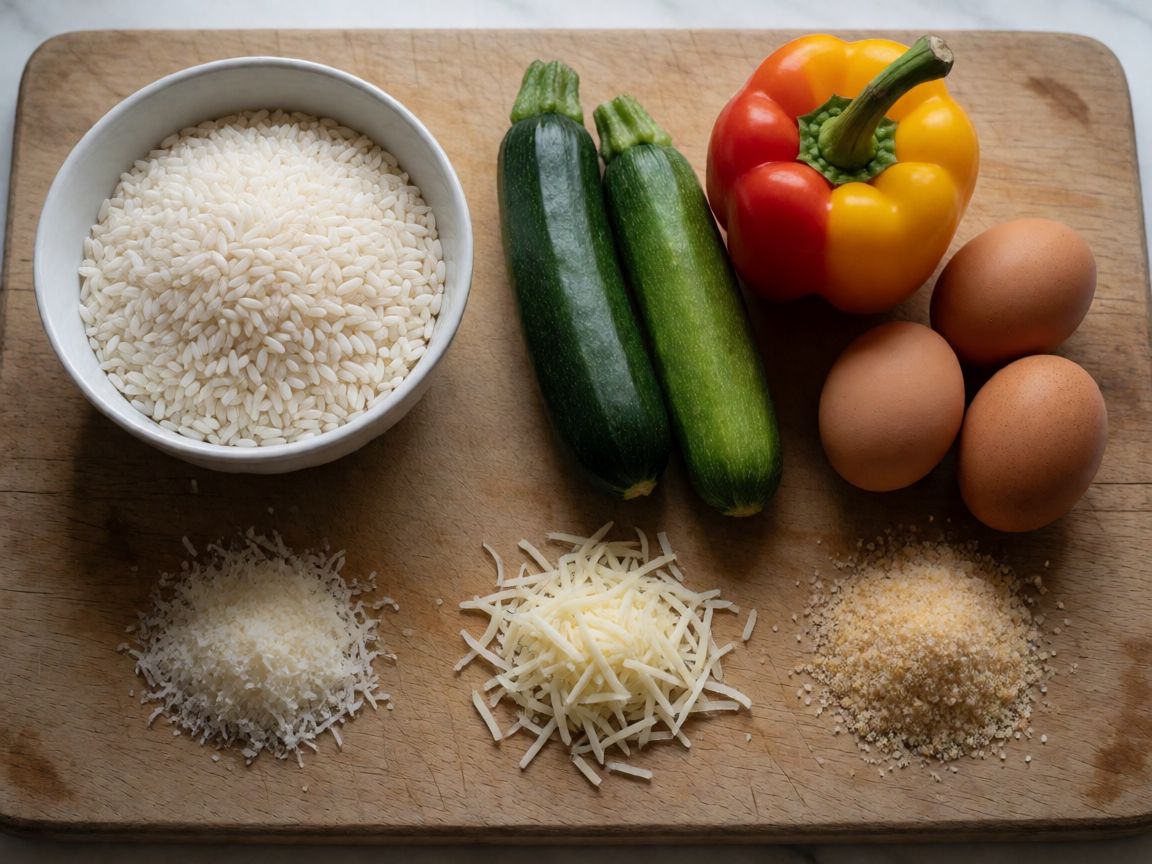
- 200 g Rice carnaroli or arborio
- 1 pcs Pepper
- 2 pcs Courgette
- 3 pcs Eggs
- 100 g Parmesan
- 200 g Provolone or Provola, Scamorza or Fontina
- Salt to taste
- Black pepper to taste
- Olive oil to taste
- Breadcrumbs to taste








Steps
Boil the rice (carnaroli or arborio), drain, transfer to a bowl, add the olive oil and leave to cool to room temperature.
Wash the courgettes and pepper, dice finely and add to the rice. Mix well, season with salt and black pepper, then add the parmesan.
Beat in the eggs one at a time, mixing well after each addition until smooth.
Dice the provolone and fold it into the mixture.
Transfer everything into a 26 cm tin lined with baking paper. Smooth with the back of a spoon.
Sprinkle with breadcrumbs and drizzle with a little olive oil.
Bake in a preheated oven at 170°C until golden on top.
30 min
Forget the word "pie" for a second — there's no pastry here. What you're making is a rice and vegetable terrine, held together by egg, baked in a tin until it sets like a thick frittata you can slice. The whole question of whether it works comes down to one thing: does the egg set into a firm net that holds the rice and vegetables together, or does it either stay wet in the middle or go dry and rubbery on top. Everything else — the cheese, the dice size, the breadcrumbs — serves that one outcome.
Some say a pie needs a crust, or it isn't really a pie. No — because in the Italian kitchen this comes from, "torta" just means something shaped by a tin, not something sealed in dough. Pastry is butter and flour, both once expensive; rice, egg and a bit of cheese were what a household actually had. The breadcrumbs on top aren't a crust standing in for pastry — they're a thin, crisp skin, the cheap trick that gives you a golden, textured surface without touching flour or fat beyond a drizzle of oil.
The hinge of the whole recipe is patience, and it happens before the oven even gets involved: you let the boiled rice cool fully before the eggs go anywhere near it. Beat eggs into hot rice and they start to set on contact — you end up with threads of cooked egg running through loose grains instead of a smooth, bindable mixture. Rushing this step is the single most common way to ruin the texture before you've even switched the oven on.
Rice first. Carnaroli and arborio are named because they hold their shape and don't turn gluey when boiled and then left to cool — that's the whole criterion, not some rule carved in stone. Any short, round, firm-grain rice that stays separate after boiling will do: paella rice, even a sturdy long-grain in a pinch. What you want to avoid is anything bred for stickiness — pudding rice, sushi rice — because it'll turn the whole filling into paste instead of a mixture with texture, grain against vegetable against cheese.
The courgette and pepper go in raw and finely diced, and that size isn't fussiness — it's the only way they cook through in the time the egg needs to set, without staying crunchy and raw-tasting in the middle of the tin. Dice them bigger and you'll get a pie that's golden and firm on the outside and full of undercooked little bullets of vegetable in the centre. They also do real work beyond flavour: as they bake, the water inside them bastes the rice slightly from within, so the filling doesn't dry out the way a pure rice-and-egg mix would.
Three eggs for 200g of rice and 300g of cheese is a ratio, not a random number — it's roughly what you need for the egg's protein to set the whole mass firm without turning it into an omelette with rice floating in it. Beating them in one at a time isn't superstition either; it's simply easier to get a smooth, lump-free mixture that way than dumping all three in at once and fighting with it.
The two cheeses have different jobs, and it helps to know which is which before you start substituting. Parmesan is there for background — dry, salty, concentrated — and it melts into the mixture rather than staying as pieces, seasoning every bite evenly; a hard, aged, salty cheese like pecorino does the same job. The provolone (or scamorza, fontina — any semi-firm cheese that melts into soft pull rather than breaking down to oil) stays in visible dice, so when you cut a slice you get pockets of stretch rather than a uniform crumb. Swap it for a strong cheddar if that's what's in the fridge, but go easy — cheddar releases more fat and can leave the pie greasy rather than moist.
Lining the tin with baking paper is doing a specific job: there's no fat-and-flour crust here to help the pie release itself the way pastry does, so a bare metal tin will grip the egg-set rice at the base and tear it apart when you try to turn it out. Paper is the flatless kitchen's answer to greasing and flouring a proper mould — cheap insurance against losing half the base to the tin.
In a British kitchen, nothing here needs a kazan or even much heat management beyond the oven — it's a one-dish, one-bake job, which is partly why it travels well as a Sunday side next to a roast, or cold the next day in a lunchbox. It actually improves with a night in the fridge: the egg finishes settling, the cheese pockets firm up, and it slices cleaner cold than warm from the oven. That's patience again, just on the other end of the recipe this time.