
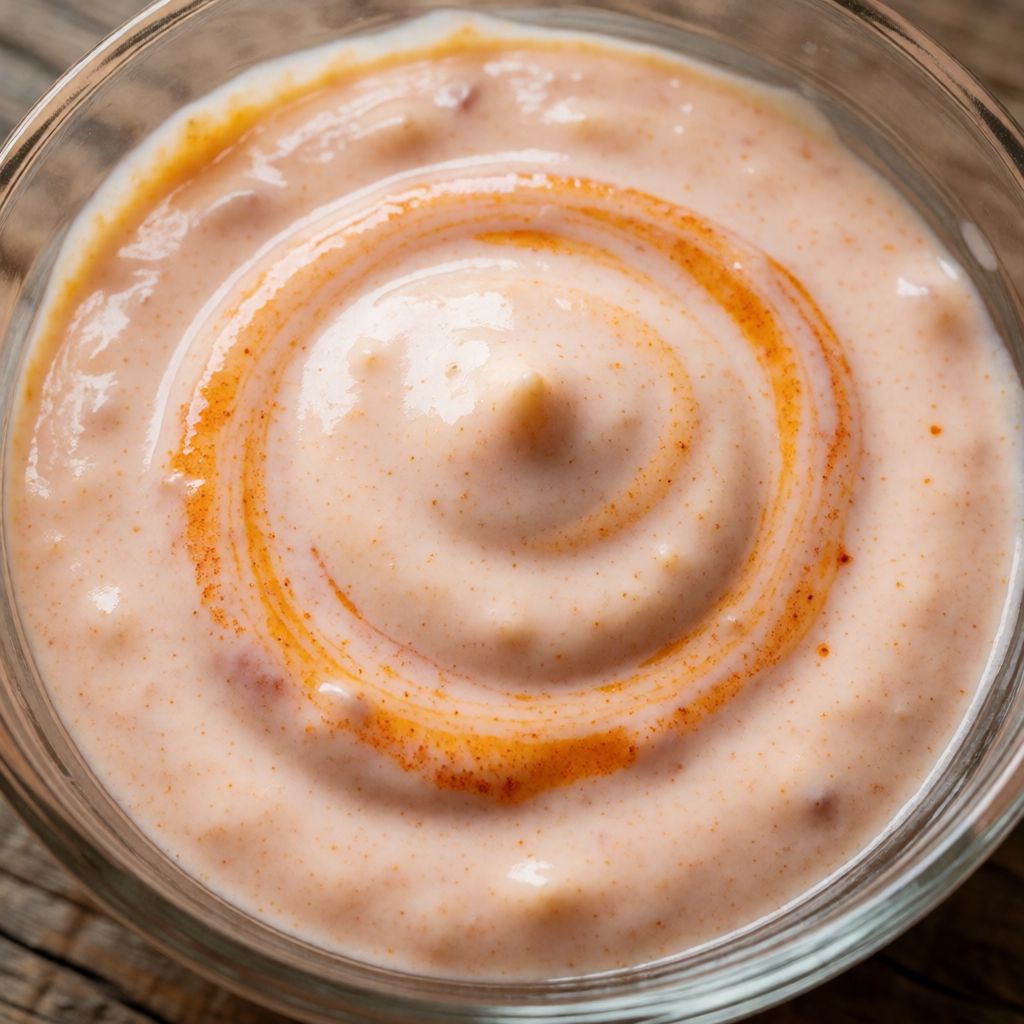
 AI photo
Seafood Sauce
A creamy sauce with crème fraîche, tomato and lemon, perfect alongside shellfish and other seafood.
Labels are worked out automatically from the ingredients and can be wrong. Check the packaging if it matters to you.
Ingredients
- 250 ml Crème fraîche 18%
- 1 tsp Caster sugar
- 1 tbsp Tomato purée concentrated
- 2 tbsp Ketchup
- 0.5 pcs Lemon juice and finely grated zest
- 1 tsp Paprika sweet
- 100 ml Whipping cream
- Salt
- Black pepper freshly ground









Steps
Mix the crème fraîche, sugar, tomato purée, ketchup, lemon zest and a little of the juice, paprika, salt and pepper, then taste.
Whip the cream until light and airy.
3 minFold half of the whipped cream into the dressing. Adjust the consistency with the remaining whipped cream until the texture is just right.
Before serving, taste again and add more salt and freshly ground pepper if needed.
This is not a cooked sauce — it is an assembly. Everything in this bowl is already flavoured: the crème fraîche is already sour, the ketchup already sweet and vinegary, the purée already concentrated. Your job is balance, not transformation. That's why nothing here touches a stove.
The thing that decides whether this works is air. A ketchup-and-cream mixture with no air in it is a heavy pink paste — the texture of a jar of "prawn cocktail sauce" that tastes mostly of sugar. Whip the cream separately until it holds a soft peak, then fold it in gently, half at a time. Folding, not stirring — stirring knocks the air straight back out, and you're left with exactly the dense sludge you were trying to avoid.
Some say a sauce needs heat to "develop" — no, not this one. Heat would do the opposite here: it would deflate the whipped cream and risk the crème fraîche going loose where it meets the acid from the lemon and ketchup. Cold is correct, not a shortcut.
The second decision point is the lemon. Zest first, for the oil and the smell — that's where the citrus actually lives, not in the juice. Then only "a little" of the juice. Crème fraîche stands up to acid better than double cream does, but push it too far and it goes thin and weepy instead of thick and glossy. Add the juice in small amounts and taste; you can always add more, you can't take it back out.
Crème fraîche is the backbone — it's cultured, so it's already thick before you do anything to it, and tangy in a rounder way than lemon alone. No crème fraîche, no problem: soured cream is the closest stand-in, same culture, similar fat. Thick natural yoghurt will also do it, but it's thinner and sharper, so pull back on the lemon juice to compensate.
Caster sugar's whole job is to answer the acid — ketchup's vinegar, crème fraîche's tang, the lemon. Without it the sauce tastes sour and flat rather than rounded; it isn't there to make the sauce sweet, it's there so no single sharp note sticks out on its own.
Tomato purée and ketchup are doing two different jobs, which is why you need both rather than a double dose of one. Concentrated purée gives colour and cooked tomato depth without adding much liquid — it's already reduced, so the flavour is dense. Ketchup gives sweetness, a vinegar edge, and crucially more moisture, which stops the texture sitting like a brick. Purée alone and the sauce is thick and a bit flat; ketchup alone and it's thinner, sweeter, less interesting.
Paprika here is for colour and a warm background note, not heat — sweet paprika, not smoked or hot. It's what pushes the sauce toward coral rather than the dull grey-pink of plain cream and ketchup. Without it, a touch more purée can carry the colour, though you lose that faint warmth underneath.
Whipping cream needs enough fat to trap air when you beat it — look for fat around 35% or higher, sold in Britain as whipping or double cream. Single cream won't whip to a peak at all; you'll beat it forever and get a foam that collapses the moment you fold it in. Three minutes with a whisk, electric or by hand, is the lower bound — stop once it holds a soft peak and sits on the whisk without sliding off. Go past that and it turns grainy, heading toward butter, and grainy cream folded into a sauce gives you lumps instead of silk.
Salt and pepper get tasted twice for a reason, not out of fussiness. Once while building the base, before the cream goes in, when the flavours are concentrated and easy to judge. Once again before serving, because folding in cold whipped cream dilutes everything, and a sauce that tastes right before it goes in the fridge can taste flat an hour later. This is a condiment, not a meal — reckon on a couple of tablespoons a head over prawns, crab, or any cold seafood, which is roughly how eight servings come out of this amount. The whole genre — tomato, cream, lemon, over prawns — comes out of British dinner-party cooking from the middle of last century, when a prawn cocktail in pink sauce counted as sophisticated precisely because tinned ketchup, cheap lemons and tub cream were all newly affordable. Crème fraîche is a later, more continental polish on what used to be built from mayonnaise. It's stayed on tables because the mechanism holds up, not out of nostalgia for a buffet.