
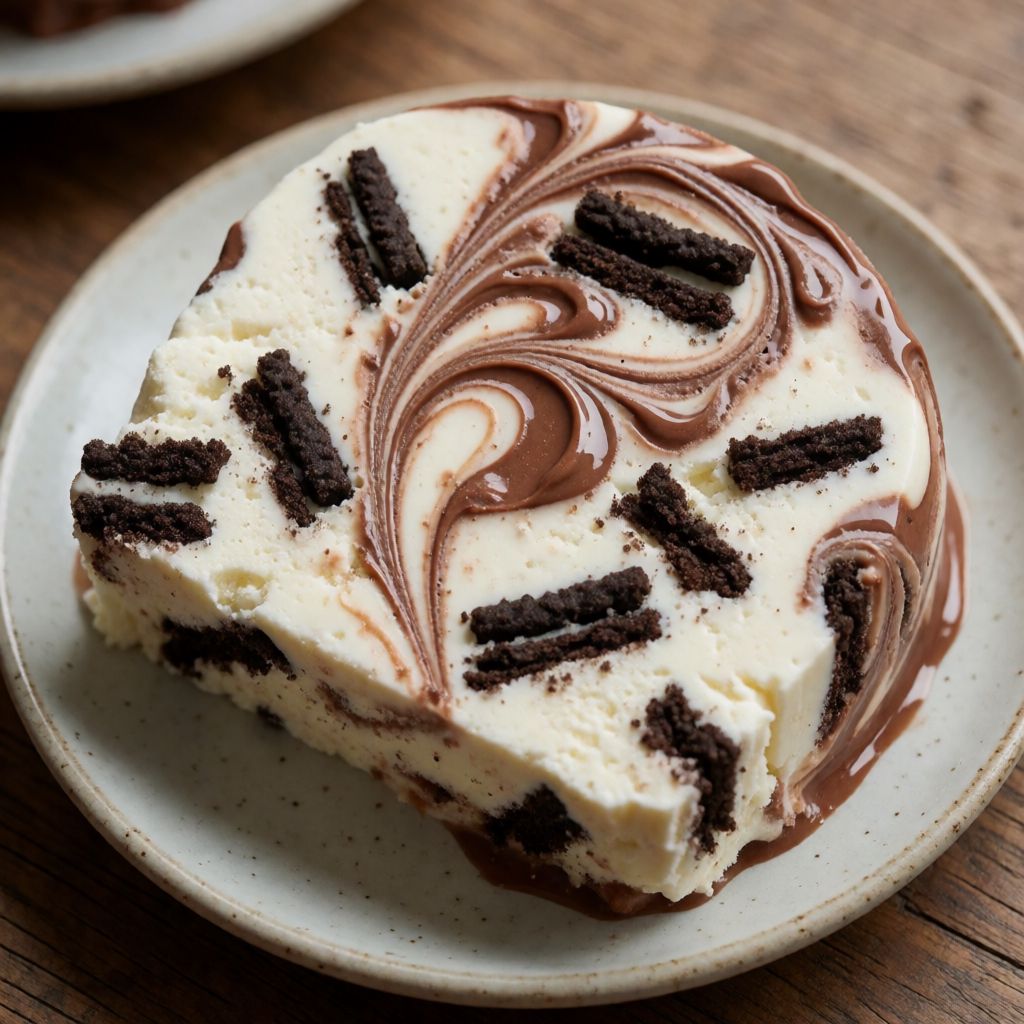
 AI photo
Pan di Stelle Semifreddo without Gelatine, with Cream Filling
A no-churn Pan di Stelle semifreddo with a rich chocolate-hazelnut cream filling, no gelatine needed.
Labels are worked out automatically from the ingredients and can be wrong. Check the packaging if it matters to you.
Ingredients
- 500 ml Whipping Cream
- 175 g Condensed Milk
- 60 g Caster Sugar
- 150 g Pan di Stelle Biscuits
- 7-8 tbsp Pan di Stelle Cream





Steps
In a large bowl, pour in the condensed milk and whipping cream, add the sugar and whisk with an electric mixer until fairly thick.
Pour about half of the cream into a loaf tin and smooth it out well with a spatula.
Spoon 4-5 tablespoons of Pan di Stelle cream over the centre.
Cover with the remaining cream and smooth the surface.
Roughly break some Pan di Stelle biscuits by hand, add 2-3 tablespoons of Pan di Stelle cream and mix well.
Spread this mixture over the surface of the semifreddo.
Place in the freezer for at least 4-5 hours.
300 minDip the tin in hot water for a couple of minutes, then use a spatula to loosen the dessert from the sides and turn it out onto a serving plate.
If you like, decorate the top with Pan di Stelle biscuits and Pan di Stelle cream.
This is not ice cream and it doesn't pretend to be. Semifreddo means "half-cold" — it never goes through the churn that breaks ice crystals as they form, and it carries no eggs, no gelatine, no custard base to hold it together. The whole structure comes from one thing: air, beaten into fat, before the freezer ever sees it. Whip the cream, trap the bubbles, and the fat walls around those bubbles are what keep the whole block from turning into a brick of ice. Skip that step, or stop too soon, and there's nothing else in the recipe to save you.
So "whisk until fairly thick" is not a throwaway line — it is the entire engineering of the dish. Thick enough to hold a ribbon, not stiff enough to look like whipped cream on a cake. Go past that point and the fat starts to separate out of the structure instead of trapping air in it — you get grain, not softness, and once that happens there's no un-whipping it. Stop too early and you'll turn the tin out to a puddle with ambitions.
Some say you need an ice cream machine for anything frozen and smooth. No — because the machine's only job is to beat air in while the mixture cools, stopping ice crystals from growing large. Here you do the beating first, at room temperature, with a hand mixer, and the freezer just holds the shape afterwards. Different order, same physics.
Start with the cream. You need something with real fat in it — 35% or better — because fat is what forms the cell walls around the air you beat in. A "whipping cream" sold in the UK at that fat level is exactly right; single cream or anything thinner won't whip to structure at all, it'll just go runny and sad. Double cream works too, it's simply richer and a touch heavier to turn out.
Condensed milk is doing two jobs at once: it's the sugar, and it's the milk solids that in a proper gelato you'd get from cooking egg yolks into a custard. Using it tinned and raw is the whole shortcut — no stove, no risk of scrambling eggs, no waiting for a base to cool. That's precisely why this style of dessert spread through home kitchens once tinned condensed milk became a cheap supermarket staple: it does the custard's job without anyone needing to know how to make custard.
The caster sugar on top of that is for texture, not sweetness — fine grains dissolve into the cold cream as you whisk, with no cooking step to melt them later. Granulated sugar, in a dessert that never sees heat, would still be sitting there as grit when you bite into it. If caster isn't in the cupboard, blitz ordinary sugar for a few seconds — that's the fix, not a different sugar altogether.
The biscuits are there for contrast, nothing more romantic than that: a dry, snapping crumb against a smooth frozen cream. Pan di Stelle are cocoa biscuits, slightly sandy, built to survive dunking in tea or milk without collapsing — which is also exactly why they survive being frozen without turning soggy. Any plain, dry chocolate biscuit with a short, crumbly bite will do the same job; a digestive with a bar of chocolate melted over it is a poor man's version and nobody will complain.
Pan di Stelle cream is a branded cocoa-hazelnut spread — think of it as a slightly less rich, slightly more set cousin of Nutella, made by the same company that makes the biscuits, which is no accident: branding a biscuit, a spread, and a breakfast cereal all under one name is standard confectionery economics, sell the child the whole shelf. The criterion for substituting it is simple — a smooth, spreadable, cocoa-based cream that doesn't turn rock-hard in the freezer. Nutella is the obvious stand-in and works almost identically; a thinned chocolate ganache is the fallback if you want to go the long way round.
Last, the unmoulding. A loaf tin — the same one you'd use for a banana loaf — has no clever release mechanism, so the dip in hot water is doing a precise job: melting a thin skin at the very edge of the semifreddo, just enough to break the seal with the metal, not enough to soften the middle. A couple of minutes in the water, not longer — if you leave it in there daydreaming, you'll turn out a dessert that's already slumping by the time it reaches the plate. If it won't release even after that, the tin was probably cold water, not properly hot, or you rushed the dip; don't force it with the spatula before trying the water again, you'll tear the top instead of freeing the sides.