
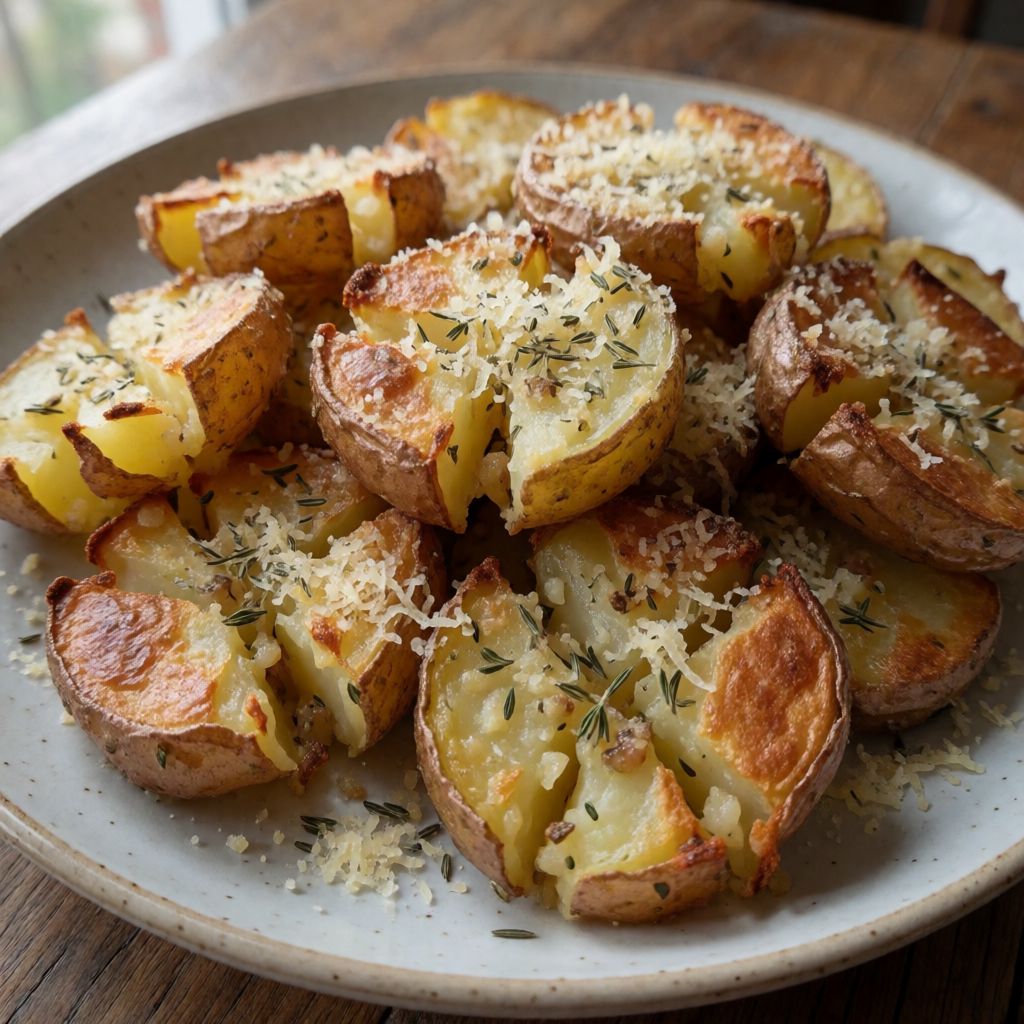
 AI photo
Smashed Potatoes with Garlic and Parmesan
Crispy smashed potatoes finished with garlic butter, thyme and freshly grated Parmesan.
Labels are worked out automatically from the ingredients and can be wrong. Check the packaging if it matters to you.
Ingredients
- 1 kg Potatoes washed or peeled
- 3 clove Garlic crushed
- 15 g Butter
- 1 tsp Dried thyme
- 40 g Parmesan finely grated
- Salt to taste
- Black pepper freshly ground






Steps
Boil the potatoes in salted water until almost tender, then drain and spread them on a sheet of baking parchment.
Gently press down on each potato to flatten it slightly, without turning it into mash.
Melt the butter and stir in the crushed garlic.
Brush each potato with the garlic butter, then sprinkle with thyme, salt, pepper and freshly grated Parmesan.
Roast in a preheated fan oven at 180°C until golden and crisp — this takes about 15–20 minutes.
18 min
This is a potato that gets cooked twice on purpose, and the whole point sits in the moment between those two cookings. You boil it soft, then you flatten it, and that single press is what turns a round potato into something with edges — edges that go dark and brittle in the oven while the middle stays like mash that forgot to be mashed. Nothing fancy about the idea. It's the same logic as a smashed burger patty: more surface touching heat, more crust.
What decides whether it works is the boiling stage, and it's less forgiving than it looks. You want the potato almost tender — a fork goes in without a fight, but the potato still holds its shape when lifted out. Boil it fully and it collapses into mush the second you press it, and mush doesn't crisp, it just dries out. Undercook it and it stays dense in the centre, pressing does nothing but bruise it, and you get a hard disc, not a flattened one. There is a window here, maybe a minute or two wide, and that's the whole skill of the dish.
Some say this is just roast potatoes dressed up with garlic and cheese. No — because roast potatoes crisp only on the outside of a whole potato, with a raw starchy core underneath doing nothing for you. Here the potato is already cooked through before it ever sees the oven, so every bit of it — not just the skin — gets a chance to turn golden. The oven's job is narrow and specific: dry the cracked surface and brown what's on it, not cook the potato.
Potato first, because everything else depends on it. You want a floury type — Maris Piper or King Edward do this well in a British kitchen — because their starch breaks down under heat and bulges slightly at the surface when boiled, giving the press something rough to grip and crisp. A waxy potato (Charlotte, salad types) holds its shape too stubbornly — it won't crack properly when flattened, and a smooth surface just steams in the oven instead of crisping. If floury is what you've got, use it; if waxy is what's in the bag, press harder and expect less crunch, not failure.
Garlic goes in crushed, not minced fine, because crushed garlic bruises its cells open without turning to paste — you get flavour without the risk of tiny scorched bits later. And it goes into the melted butter rather than straight onto the hot potato in the oven, which matters more than it looks: garlic brushed with nothing to protect it burns bitter fast under direct heat. Fat buffers it. The butter carries the garlic in gently and lets it perfume rather than char.
Butter is doing two jobs: its milk solids brown and smell of something, and it carries the garlic and helps the thyme and cheese stick rather than slide off a dry potato. If you want a dairy-free version, use any fat with no flavour of its own and accept you've traded away the nutty note — that's not a defect, it's a different dish wearing the same shape. Dried thyme, not fresh, is the right call here on purpose: dried herbs have their oils already concentrated and release them slowly, which suits eighteen minutes in a hot oven; fresh leaves this exposed would just blacken.
Parmesan wants to be grated fine, almost like sand, because that's what lets it melt and then re-set into a brittle, lacy crust rather than clumping into a rubbery patch. Any hard, aged cheese that behaves the same way will do — Grana Padano, pecorino, even a mature cheddar if that's what's in the fridge, since it browns and crisps rather than just oozing.
Salt matters twice: once in the boiling water, where it seasons the potato from the inside and costs you nothing extra, and once at the end, where a few flakes on a crisp surface do more work for your tongue than the same amount stirred in. Don't skip the first one and try to make up for it with the second — it isn't the same seasoning, it's surface dusting over an unseasoned middle.
Patience sits in two places here, and both are easy to rush past. Let the boiled potatoes sit a moment on the parchment before pressing — some of their surface moisture needs to go, or the press tears wet skin instead of cracking it cleanly. And don't pull them from the oven at the first sign of colour; golden at the edge and still pale in the dip of the smash means another few minutes, because the thin parts crisp fast and the thick parts are catching up.