
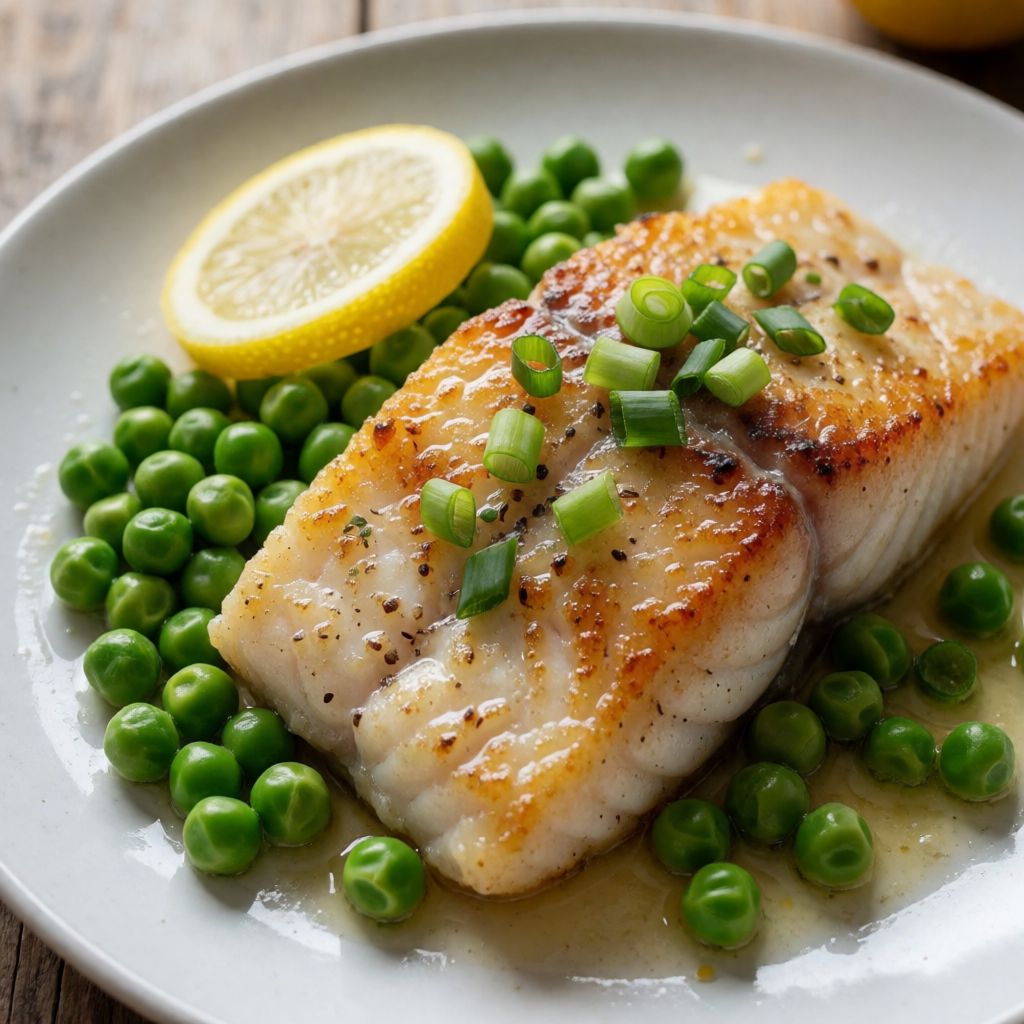
 AI photo
Sole with Peas and Lemon
A light fish supper: pan-fried sole fillets with buttery peas, lemon and a herby anchovy sauce.
Labels are worked out automatically from the ingredients and can be wrong. Check the packaging if it matters to you.
Ingredients
- 4 pcs Sole fillets
- 400 g Peas fresh or frozen
- 2 pcs Spring onion
- 50 g Butter
- 1/2 pcs Lemon juice
- 1/2 pcs Lemon zest
- 3 tbsp Plain flour
- Olive oil to taste
- Salt to taste
- Black pepper to taste
- 50 g Parsley
- 50 g Basil
- 100 ml Olive oil
- 1 tsp Mustard
- 2 pcs Anchovies
- Salt to taste
- Black pepper to taste










Steps
Tear the parsley and basil by hand into pieces and put into a blender. Add the mustard, olive oil, salt, black pepper and chopped anchovies. Blitz to a smooth, creamy emulsion.
Rinse the peas (fresh or frozen) and place in a saucepan with the chopped spring onion. Add water to come one finger above the peas and bring to the boil.
Add olive oil, salt and black pepper. Simmer gently so the peas soak up the flavour. Keep warm.
Rinse the sole fillets and pat dry. Dust in flour, shaking off the excess.
Heat a frying pan and pour in two tablespoons of olive oil. Add the fillets and fry a few minutes on each side until cooked through (63°C at the thickest point).
Sprinkle with lemon juice, add the lemon zest, and season with salt and black pepper.
Plate the sole fillets with the peas, spoon over the pan juices and finish with the herb sauce.
Sole is a flat fish, thin, delicate, and it cooks in the time it takes to read this sentence twice. That's the whole problem this recipe solves: a fillet this thin goes from translucent to dry shoe-leather in under a minute if you look away. Everything here — the flour, the butter, the gentle heat — exists to slow that fall and catch it at the right second.
The flour dusting isn't breading, it's insurance. Sole flesh is wet and fragile; without flour it sticks to the pan and tears when you try to turn it, leaving half the fillet behind as a crust on the metal. The flour forms a thin dry barrier that releases cleanly and browns into something with a bit of structure, so a fish that has almost no body of its own gets one.
Peas, simmered low with spring onion and just enough water to cover, are doing the opposite job to the fish: they need time, not heat shock. A hard boil bursts their skins and you lose the sweetness into the water. Keep it at a bare simmer and the peas swell and soften without splitting, holding their own liquor, which is the sauce as much as anything poured on at the end.
The herb sauce — parsley, basil, anchovy, mustard, oil, blitzed — is not a garnish, it's the seasoning the fish can't carry on its own. Sole has almost no fat and barely any taste of its own; the lemon cuts through, the anchovy sauce supplies the savoury weight that butter alone won't. Some say sole doesn't need anything, it's too delicate to dress up — no, because that delicacy is exactly why it needs a sauce with a backbone, or you're just eating warm, bland protein.
Buy sole as fillets, skin off, and ask the fishmonger to check there's no smell of ammonia — that's old fish, not fresh, no matter what the sell-by date says. A thin fillet, maybe 100–120g, is right for one portion; if the fillets are thicker than your little finger, they're probably a different flatfish sold under the same name, and they'll want a minute or two longer in the pan. No sole, no problem — any thin white flatfish fillet, plaice or lemon sole, behaves the same way under the same rules: flour, quick heat, out before it stiffens.
Peas: frozen is not the lesser option here, it's often the better one, because peas lose their sugar to starch within hours of picking, and "fresh" peas sitting in a UK supermarket for three days are frequently staler than a bag frozen within hours of harvest. If you've got a garden and picked them that morning, fresh wins; otherwise don't feel guilty reaching into the freezer.
Spring onion goes in with the peas not for crunch but for a background sweetness that plain onion, cooked this briefly, can't give you — a bulb onion needs longer heat to lose its bite, which you don't have time for in a five-minute simmer. If you're out of spring onion, a small shallot, very finely sliced, is the nearest thing; ordinary onion will taste raw and sharp against the sweetness of the peas.
The butter and lemon that finish the fish in the pan are doing a small trick: the butter melts into the hot pan juices and the acid from the lemon juice makes it look and taste like a sauce has formed, when really it's just fat and juice meeting at the last moment. Add the lemon off the direct heat, or close to it — butter that's pushed too hot splits and turns oily rather than silky, and you'll see the difference as a greasy sheen instead of a glossy one.
For the herb sauce, use olive oil with no strong character of its own competing with the anchovy and herbs — a cheap "extra virgin" that tastes bitter and grassy will fight the parsley rather than carry it; a light, mild olive oil is what you actually want here, not the expensive peppery kind you'd drizzle on a salad. Anchovies are the one ingredient people flinch at — some say they make the sauce taste "fishy" — no, because in this quantity, blended through oil and herbs, they vanish as a flavour and reappear only as savoury depth, the same job they do in a Caesar dressing where nobody tastes fish at all.
This isn't a dish that forgives distraction. The whole cook, from flouring to plating, happens in the time you'd normally spend deciding what to cook — which is the point. Have the peas simmering, the sauce blitzed, and the plates out before the fish goes anywhere near the pan, because once it's in, your attention belongs to it and nothing else, for as long as it takes to turn from pale and faintly grey to opaque and white through to the middle.