
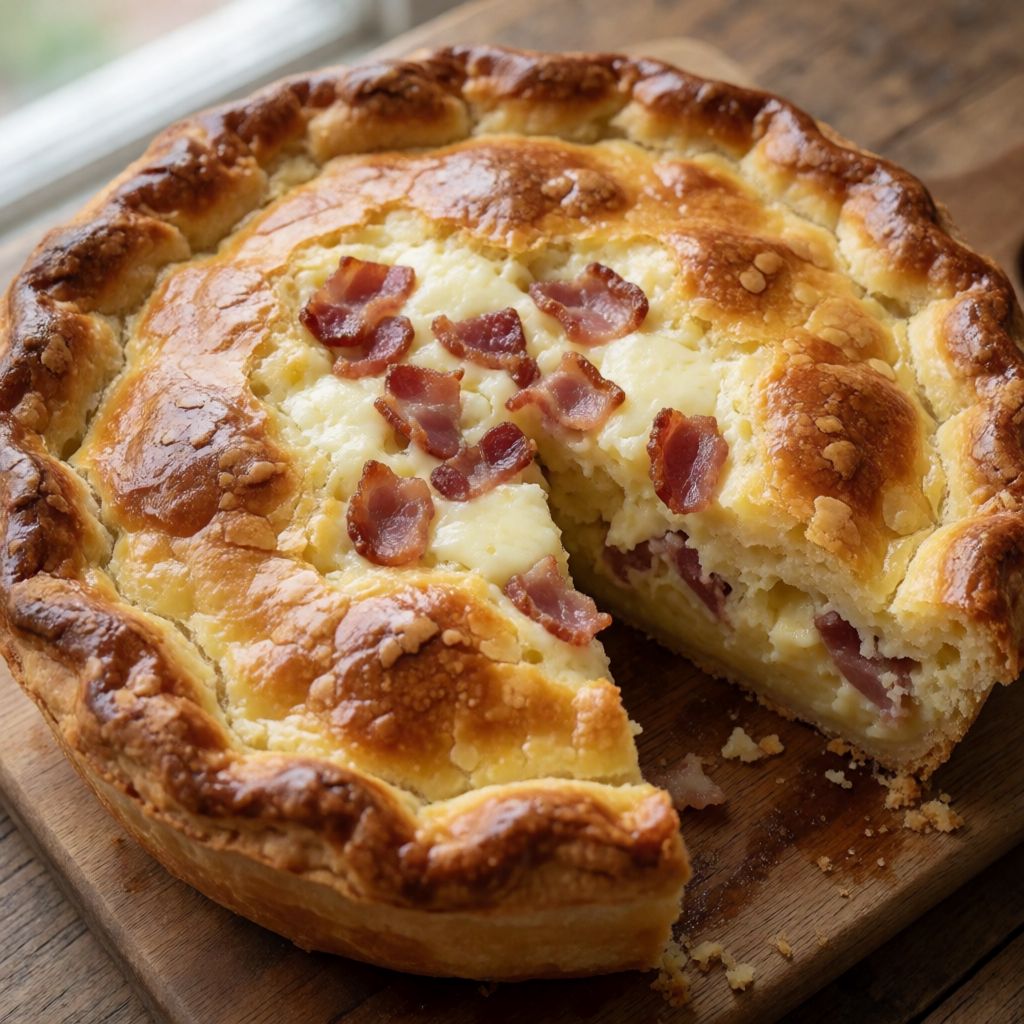
 AI photo
Savoury Pie with Mozzarella and Bacon
A savoury layered bake filled with mozzarella, bacon and cherry tomatoes — simple, hearty and easy to make.
Labels are worked out automatically from the ingredients and can be wrong. Check the packaging if it matters to you.
Ingredients
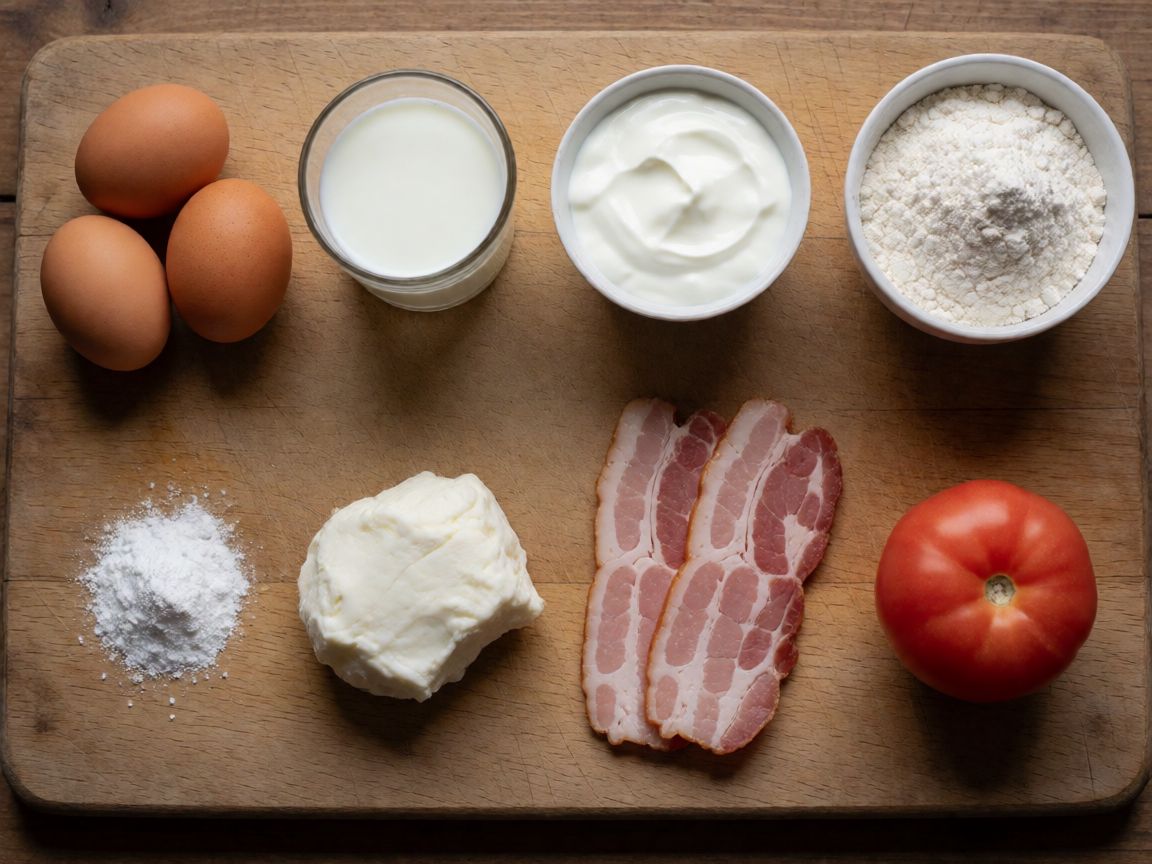
- 3 pcs Eggs
- 125 ml Milk
- 125 ml Yogurt
- 110 g Vegetable oil
- 210 g Plain flour
- 16 g Baking powder
- 5 g Salt
- Mozzarella to taste
- Bacon to taste
- Cherry tomatoes to taste
- Sesame seeds to taste










Steps
Crack the eggs into a large bowl and whisk.
While still whisking, pour in the milk in a thin stream, then the vegetable oil.
Add the yogurt and mix until smooth.
Sift in the flour, add the baking powder and salt, and mix the batter well.
Pour half of the batter into a 20cm tin greased with butter.
Bake in a fan oven at 170°C for 5–6 minutes.
6 minRemove the tin and arrange the sliced mozzarella and bacon over the batter.
Pour over the remaining batter and top with the cherry tomatoes, halved.
If you like, sprinkle with sesame seeds and return to the oven at 170°C for 40–45 minutes.
42 minThe pie is ready — serve.
This isn't a pie in the pastry sense — no shortcrust, no blind-baking, no rolling pin. It's a quick bread batter, the kind the French call a "cake salé" and the Georgians would recognise as cousin to a khachapuri filling trapped inside something closer to cornbread. The whole trick is structural: you bake the base layer on its own first, so it sets into a shelf strong enough to carry cheese and bacon without collapsing into a soggy middle once the second pour goes on top. Skip that first short bake and you get a pie with a wet seam running through its belly — the batter underneath never gets hot enough, fast enough, once it's insulated by a slab of mozzarella.
What decides whether it works is less the flavour and more the physics of baking powder and egg protein. Baking powder gives you one shot at rising — it starts reacting the moment it meets liquid, loses strength as it sits, and needs oven heat to finish the job via the second, heat-triggered reaction (that's why most baking powders are "double-acting" — one push at mixing, one push in the oven). So you want the batter in the tin promptly, not left on the counter while you slice bacon.
Eggs are the scaffolding — they coagulate under heat and hold everything else in suspension, so don't skimp or substitute with less than three; two eggs and the crumb falls apart when you cut it. Milk and yogurt together do two different jobs: milk thins the batter so it pours and spreads, yogurt brings acid and fat that keep the crumb tender rather than rubbery — if you've only got milk, add a spoon of lemon juice or vinegar to it and let it sit a minute to mimic what the yogurt's acidity does for texture. Any plain yogurt works; Greek yogurt will make a denser, richer crumb, which isn't a fault, just a different pie.
Vegetable oil, not butter, in the batter itself — and that's not laziness, it's chemistry. Butter is roughly a sixth water and solid at room temperature; oil stays liquid and distributes evenly through the mix without the risk of little cold lumps that leave dry pockets. The rule for choosing the oil is a criterion, not a brand: anything with no smell of its own — sunflower, rapeseed, a light groundnut oil. Olive oil will fight the mozzarella and bacon for attention; save it for drizzling at the table if you must.
Flour and baking powder are where the "how many minutes" question becomes genuinely the wrong one for step 6, that first short bake. You're not cooking the base through — you're setting a skin on it, just enough that the surface won't dissolve under the weight of sliced mozzarella and bacon. Judge it by sight: the top should look matte and no longer wet-shiny, slightly set at the edges, not browned. Five minutes is the floor, not a guarantee — ovens vary by 10–15°C from what the dial claims, so trust the look of the batter over the clock on your phone.
Mozzarella and bacon are "to taste" for good reason — this is a formula, not a fixed filling. Mozzarella brings moisture and mildness so it doesn't overpower the eggy base; a firmer cheese like a mature cheddar will work but will render more fat and salt, so go easy on added salt elsewhere if you swap it in. Bacon should be sliced thin enough to crisp rather than sit chewy and raw-pink in the middle once buried under more batter and 40 minutes at 170°C — streaky bacon, the kind already familiar from a Sunday roast, crisps faster than back bacon's fattier edge.
Cherry tomatoes on top aren't decoration you could skip without consequence — halved and placed cut-side up, they lose water slowly into the top of the cake as it bakes, which is exactly what keeps that top layer from drying out over 40-odd minutes in a dry oven. Sesame seeds are purely optional texture and look; if you haven't any, poppy seeds or a scatter of dried oregano does no harm and costs you nothing in structure.
The long second bake — 40 to 45 minutes — is where patience earns its keep as an ingredient rather than a virtue. The centre of this pie has the most batter to set and the most insulation from the cheese sitting right above it, so it's always the last part to finish. The real test isn't the clock: a skewer or knife into the centre should come out clean, with no wet batter clinging to it. If the top's already deeply golden but the centre's still trembling when you nudge the tin, drop a sheet of foil loosely over the top and give it the extra five or ten minutes it's asking for — better that than cutting into a pie with a raw middle because the oven said "done" at 42 minutes and you believed it.