
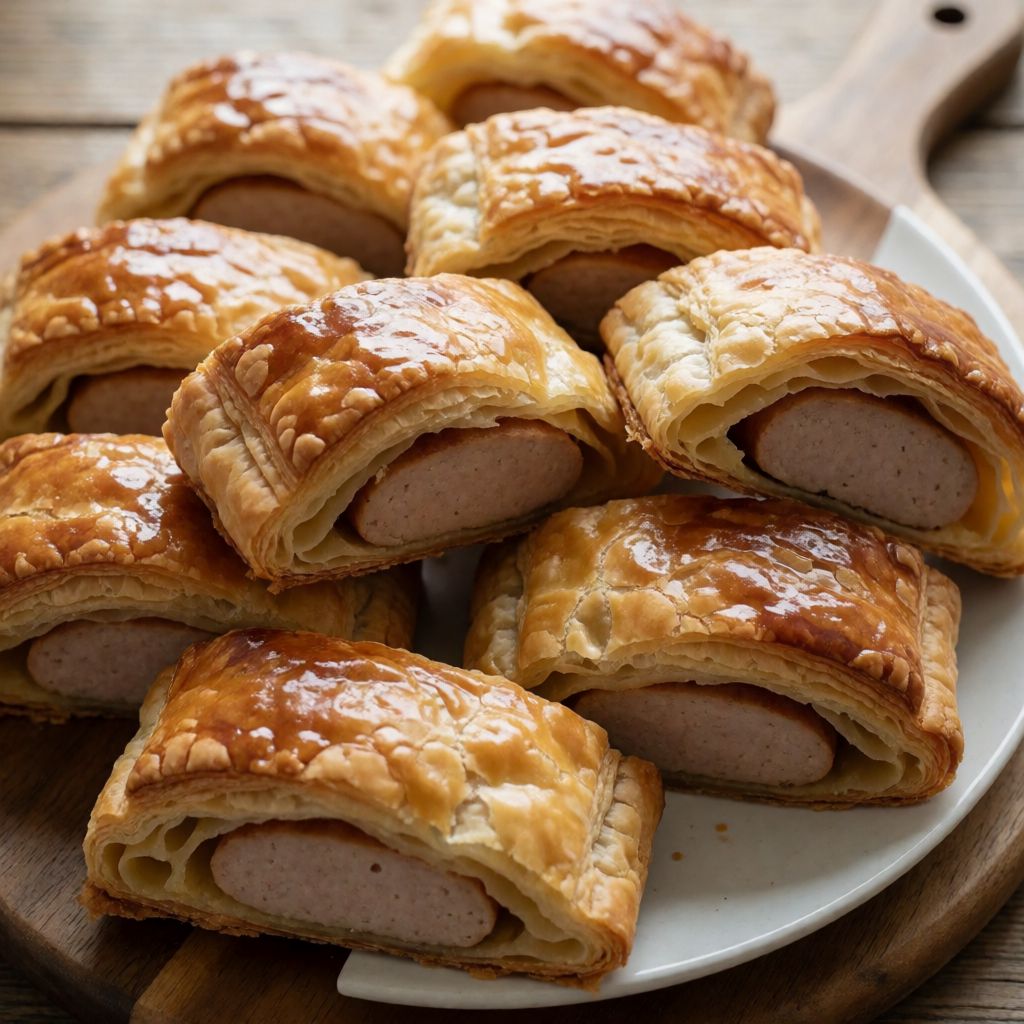
 AI photo
Sausage Rolls in Puff Pastry
Golden puff pastry rolls wrapped around savoury sausages, glazed with egg and sesame and poppy seeds, served with mustard and barbecue sauce.
Labels are worked out automatically from the ingredients and can be wrong. Check the packaging if it matters to you.
Ingredients
- 275 g Puff pastry ready-rolled
- 300 g Spicy sausages
- 4 tbsp Mustard
- 1 tbsp Dijon mustard
- 1 tbsp Honey
- 100 ml Crème fraîche
- Salt to taste
- Black pepper to taste, freshly ground
- 1 pcs Egg beaten
- 1 tsp Salt
- 1 tbsp Sesame seeds
- 1 tsp Poppy seeds
- 100 ml BBQ sauce












Steps
Mix the mustard sauce and season it well, to get a nice balance between pleasant sweetness and a light bite from the mustard.
Cut the sheets of puff pastry into strips sized so they can wrap around the sausages with an overlap.
Brush the pastry strips with part of the mustard sauce (keep the rest for serving) and lay the sausages on them.
Wrap the pastry around the sausages.
Brush with the beaten egg and sprinkle with sesame seeds, poppy seeds and freshly ground pepper.
Prick the surface of each roll with the sharp end of a fork.
Cut the rolls into pieces about 2.5–3 cm long and place on a baking tray lined with baking paper, seam side down.
Bake in a preheated fan oven at 190°C for about 22–25 minutes, or until golden and crisp.
23 minServe with the mustard sauce and the BBQ sauce.
This is a party-food classic dressed up a bit: shop sausages wrapped in puff pastry, but the mustard-honey glaze and the seam-side-down trick are what separate it from the sad school-fete version. What decides whether it works is the gap between the sausage and the pastry — or rather, whether you leave one.
Puff pastry rises because of steam. Hundreds of thin butter layers trap water vapour as it heats, and the layers push apart. If you wrap the pastry too tight around the sausage, there's nowhere for that steam to go, and you get a dense, leathery wrap instead of flaky shatter. The fix is built into the recipe already: cut the strips long enough to overlap generously, and let the seam sit loose, not stretched. Some say puff pastry needs to be pressed firmly round the filling to "seal it" — no, because a tight seal is exactly what stops it puffing. It's not a dumpling.
The overlap does double duty. Place it seam-side down on the tray, and gravity and the tray's heat do the sealing for you as it bakes — the underside crisps and glues shut before the top can gape open and leak sausage fat everywhere. That's also why you prick the surface with a fork: not decoration, it's a pressure valve, letting steam escape in a controlled way instead of blowing a crack wherever the pastry happens to be thinnest.
On the oven: 190°C fan is hot enough to force that steam-driven lift quickly, before the butter has time to melt out of the layers rather than turn to vapour within them. A cooler oven gives you greasy, flat pastry — the butter runs before it can do its job. You're looking for pastry that's gone from pale and matte to deep gold and faintly blistered, with a sheen from the egg wash cooked hard. The 22–25 minutes is your floor, not your answer — ovens lie about their own temperature more than almost any other appliance in the kitchen, so trust the colour and the sound (a proper roll sounds hollow-ish when you tap it, not soft).
Puff pastry itself: buy it ready-rolled, as the recipe says, and don't feel guilty about that. Lamination — folding butter and dough over and over — is skilled, repetitive, cold-room work; it was always something bakeries did at scale because home kitchens rarely have a marble slab and the patience for a four-hour process that mostly involves waiting in the fridge. If you want the shortcut-of-the-shortcut, ready-rolled puff from a UK supermarket chiller is already proofed thin and even — don't substitute shortcrust, it won't lift, and it won't go flaky; it'll just go short and crumbly, which is a different pastry for a different job.
The sausages: spicy ones are specified because plain pork sausage can get lost once it's wrapped and competing with mustard and honey — you want something with its own voice, chilli, herb, whatever, so the filling isn't just background. If your sausages are thick, that's fine, but know your pastry strip width needs to scale with it, or you'll run short of overlap and lose the seal.
The sauce: Dijon brings sharpness without too much vinegar punch, ordinary mustard brings volume and that familiar tang, honey rounds the heat off so it reads as "zingy" rather than "harsh", and crème fraîche loosens the whole thing into something spoonable rather than a paste. If you've no crème fraîche, soured cream behaves the same way — acidic enough to cut richness, thick enough to hold a sauce together — but don't reach for double cream on its own, it has none of that tang and the sauce turns flat and sweet.
BBQ sauce on the side is there for contrast again, smoke and tomato sweetness against the sharper mustard dip — give people both and let them choose, or mix them, nobody's checking. Sesame and poppy seeds are mostly texture and look rather than flavour at this quantity, so if you're out of one, use more of the other; the dish survives either way.
Cutting into 2.5–3cm pieces rather than baking it as one long sausage roll and slicing after is deliberate — more surface area per piece means more pastry-to-filling contrast in each bite, and more edges to go crisp. It also means more individual seams, so the seam-side-down rule matters more here, not less: six small failures are worse than one big one when you're serving a tray of these for a crowd on a Sunday, tea already poured, everyone hovering by the oven door waiting.