
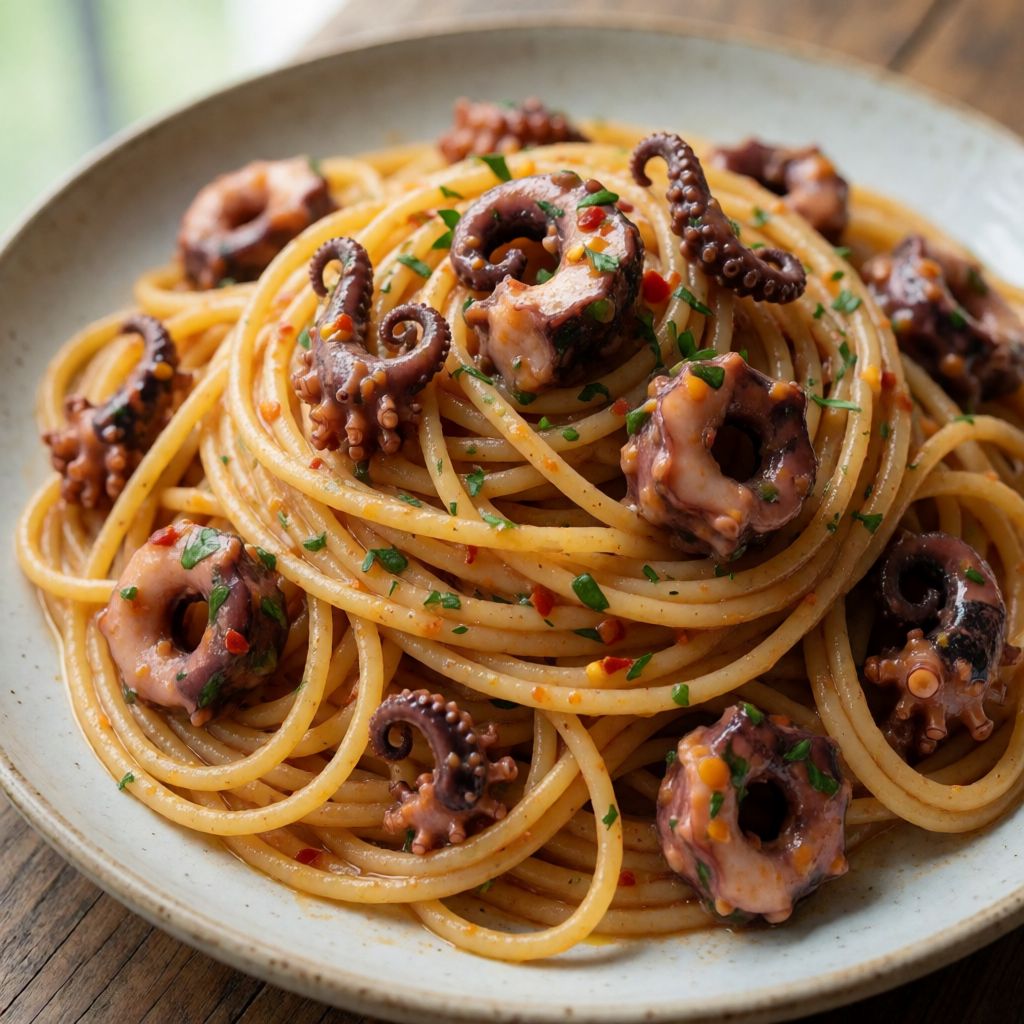
 AI photo
Spaghetti with Neapolitan-Style Baby Octopus Sauce
A simple Neapolitan-style spaghetti tossed with a rich baby octopus and tomato sauce.
Labels are worked out automatically from the ingredients and can be wrong. Check the packaging if it matters to you.
Ingredients
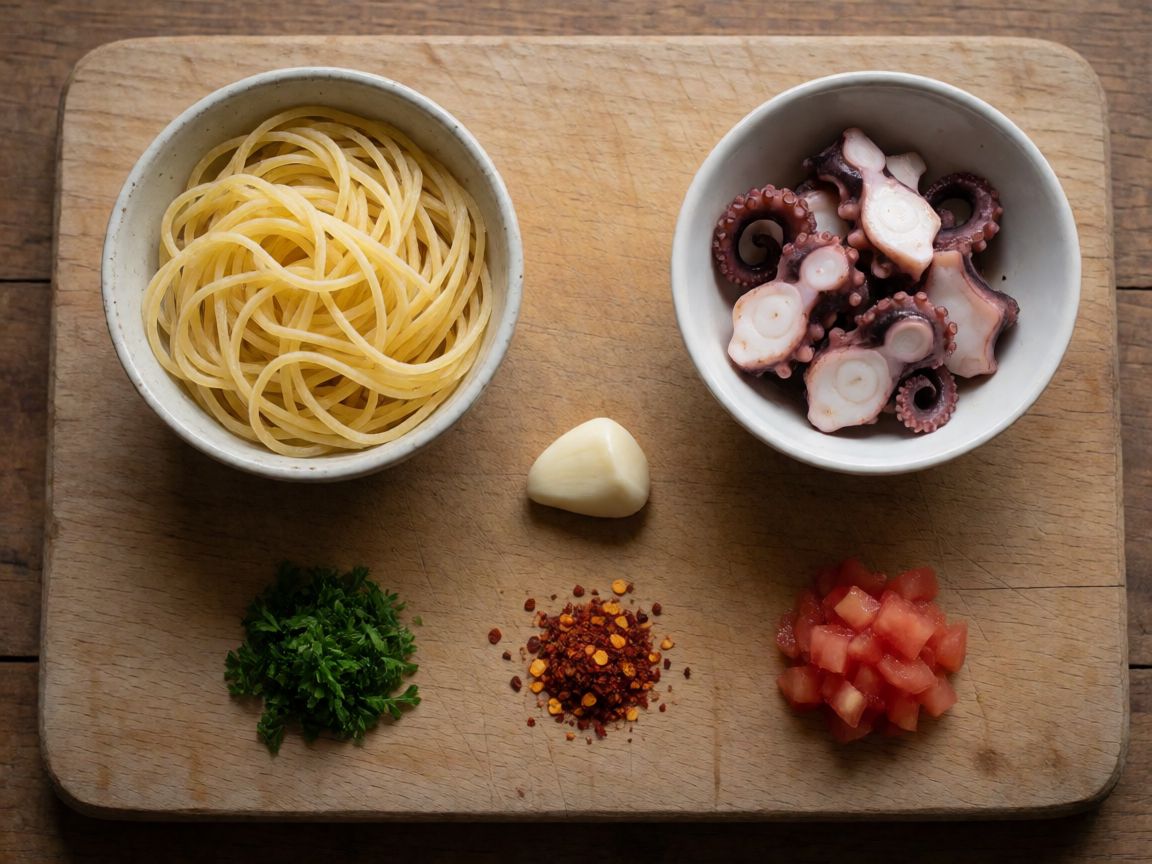
- 400 g Spaghetti
- 800 g Baby Octopus
- 1 clove Garlic minced
- Parsley to taste
- 1 pinch Chilli Flakes
- Olive Oil to taste
- 200 g Datterini Tomatoes
- Salt to taste








Steps
Fry the minced garlic, chilli flakes and parsley in olive oil in a frying pan.
Add the octopus and fry briefly, then reduce the heat, cover and cook.
30 minAdd the Datterini tomatoes, crushing them by hand, and simmer gently covered. It is ready when the thickest part reaches 63°C.
Sprinkle with parsley and season with salt to taste.
Cook the spaghetti in plenty of salted water until al dente, then drain.
Place the spaghetti in a bowl, pour over the finished sauce and toss to combine.
This is not a sauce you build over an afternoon — it's a controlled rescue job. You take something that wants to turn into a rubber band under heat, and you talk it out of it with time and a low flame, until it gives in and turns silky instead. The whole dish turns on that one transformation: octopus muscle tightens fast once it hits heat, and if you stop there, you get chewy. Keep going, gently, and the connective tissue around those fibres melts into gelatine, and the flesh goes tender again from the inside out. That's the mechanism behind this whole recipe — garlic, chilli, tomatoes, pasta, all of it sits around that one fact.
Some say you need a wine cork in the water, or forty good whacks against a rock, to tenderise octopus. No — the cork does nothing chemical, it's an old fisherman's story that outlived whatever reason anyone first believed it. What actually tenderises octopus is heat held low enough, for long enough, that collagen turns to gelatine before the muscle fibres finish squeezing all the water out of themselves. Freezing it first does help, for a real reason this time: ice crystals rupture the cell walls mechanically, which is why most octopus sold anywhere, fresh counter included, has usually been frozen once already. Starting from frozen isn't cheating. It's borrowing a bit of physics instead of folklore.
Octopus is the spine of this, so start there. Buy it already cleaned if you can — most UK fish counters sell it that way, fresh or frozen, because gutting octopus and turning the head out is fiddly work nobody wants to bill at an hourly rate for you to do at home. If what you've got is frozen, let it defrost slowly in the fridge rather than under a hot tap; fast thawing with heat starts cooking the surface before the thing's even in your pan. You'll feel doneness rather than time it: push a skewer into the thickest tentacle and it should slide in without much fight, no springy snap-back. If you want a number to hang that feeling on, the centre sits around 63°C — but your hand will tell you the same story without a thermometer. If octopus is nowhere to be found, squid will stand in, but don't treat it the same: squid has far less collagen to convert, so it cooks tender in minutes, not half an hour — overcook it on this timeline and you'll get the rubber you were trying to avoid in the first place.
Datterini tomatoes are chosen for low water content and a thicker flesh-to-juice ratio than a standard salad tomato — crush them by hand and they thicken fast instead of turning the pan into soup. No datterini, no problem: any small, dense tomato sold on the vine will do, or a tin of good plum tomatoes with the excess liquid squeezed off first. Skip that squeezing step and you'll spend twenty minutes reducing watery sauce — twenty minutes that belong to the octopus, not the tomato.
Garlic minced releases its aroma fast and burns just as fast — more cut surface, quicker scorch, and burnt garlic turns bitter in the time it takes to answer the phone. If garlic has burnt on you before and you blamed the pan, the real cause is usually heat too high for how finely it's cut. Prefer not to babysit it? Slice the clove instead, or crush it whole and lift it out once the oil smells of it — same flavour, far more forgiving.
Chilli flakes are for warmth here, not fire — a pinch, not a fistful. Any dried chilli that doesn't bring its own strong flavour alongside the heat will do the job; dried peperoncino is traditional simply because that's what hangs on strings in an Italian kitchen, not because anything else fails.
Parsley shows up twice on purpose, not by oversight — once early, cooked into the oil with the garlic and chilli for a background note, and once at the end, raw, for brightness. Heat drives off the volatile oils that make parsley smell like parsley; cook it all the way through and you lose that top note entirely, so the second handful stays uncooked, carrying the fresh smell to the table instead of the stove.
Olive oil wants some character, but nothing precious — it loses its most delicate top notes to heat anyway, since this dish isn't finished with a raw drizzle at the end. Keep the good bottle for salads; any oil with no strong smell of its own, or a decent everyday extra virgin, earns its keep here. Salt goes in at the end, after tasting, because octopus already carries salinity from the sea it came from, and a sauce that reduces concentrates whatever salt is already in it — season too early and the pan can oversalt itself as it shrinks.
For the pasta: salt the water properly, enough that it tastes faintly of the sea, because pasta only ever seasons itself from the inside, while it cooks — sauce poured over bland noodles afterwards can't fix that. Keep back a cup of that starchy water before draining; a splash stirred through at the end helps the sauce grip the strands instead of pooling at the bottom of the bowl, which is the most ordinary fault in home pasta — sauce and noodles arriving on the plate as two separate dishes instead of one.