
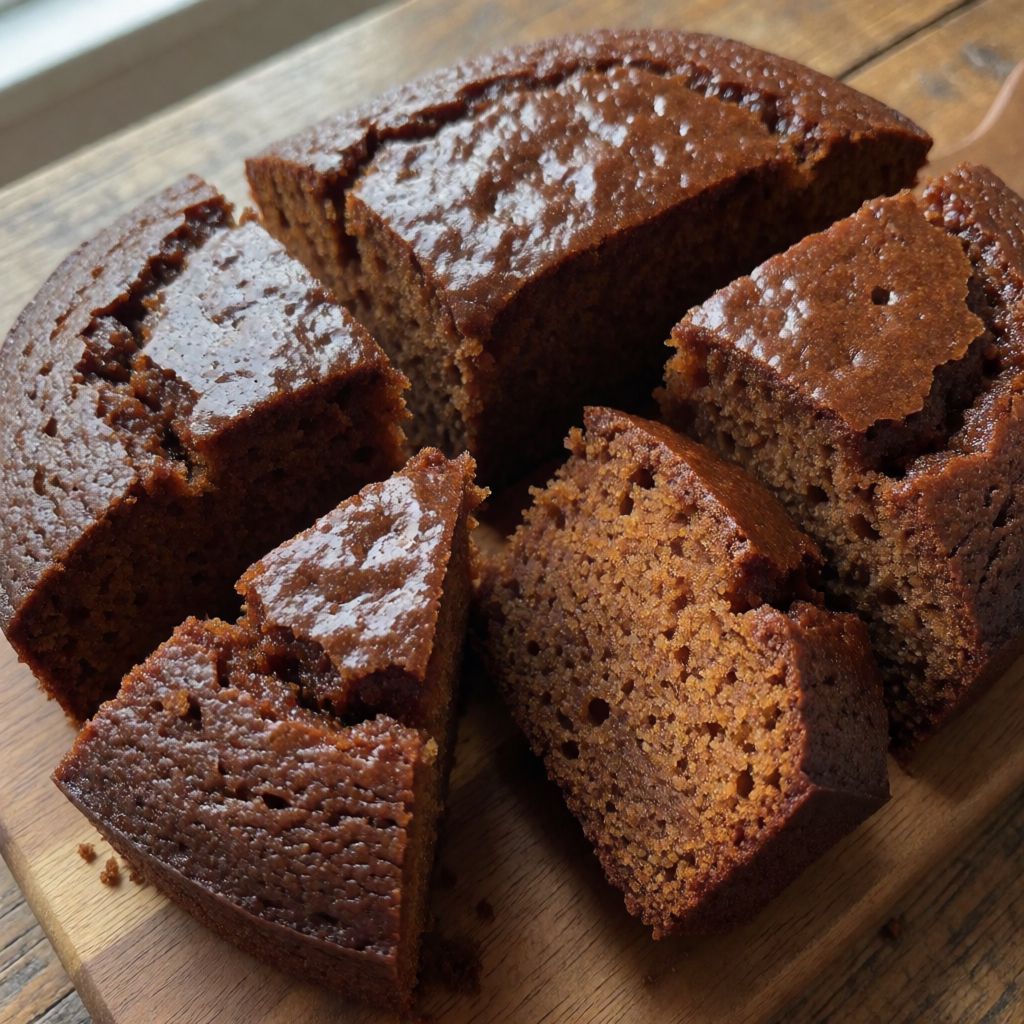
 AI photo
Spiced Cake
A warmly spiced loaf cake with cinnamon, cardamom, ginger and cloves, finished with a dusting of icing sugar.
Labels are worked out automatically from the ingredients and can be wrong. Check the packaging if it matters to you.
Ingredients
- 50 g Black treacle
- 200 g Butter room temperature
- 175 g Brown sugar
- 4 pcs Eggs
- 225 g Plain flour
- 2 tsp Cinnamon
- 2 tsp Ground cardamom
- 1 tsp Ground ginger
- 0.5 tsp Ground cloves
- 1 tsp Vanilla sugar
- 2 tsp Baking powder
- 1 pinch Salt
- 20 g Icing sugar for dusting













Steps
Beat the butter, treacle and brown sugar until light and fluffy. Beat in the eggs one at a time, continuing to whisk.
Mix the plain flour with all the spices, baking powder and salt, sift into the batter and mix well.
Spoon the batter into a greased tin of about 1 litre capacity, or a loaf tin measuring 11 x 25 cm.
Bake in a preheated fan oven at 175°C for about 45 minutes.
45 minLet the loaf cool slightly on a wire rack, then dust with icing sugar before serving.
What was changed
Black treacle replaces dark syrup with black treacle, the equivalent British shoppers buy, and Ground ginger clarifies that ground ginger is meant rather than fresh.
This is a loaf, not a cake in the Victoria-sponge sense — dense, dark, spiced like a gingerbread that's decided to grow up and get a crumb instead of a chew. Treacle does the heavy lifting here: it's not there for sweetness (brown sugar already handles that) but for moisture and that deep, slightly bitter edge that keeps the spice from tasting flat. Take it out and you get a pleasant spice loaf. Leave it in and you get something that tastes like it's been sitting in a tin since November.
What decides whether it works is the butter-sugar-treacle beating at the start. You're not just mixing, you're trapping air — tiny bubbles in fat that the baking powder later inflates. Skip this and the loaf comes out tight and wet in the middle no matter how long you bake it, because there's nowhere for the steam to go. "Light and fluffy" isn't decoration talk, it's structural: the mixture should visibly pale and increase in volume, not just go smooth.
The second fork in the road is the flour and spice going in together, sifted. Some say you can just dump cinnamon into the batter at any point — no, because spice clumps, and a clump of cardamom in bite twelve is not a flavour, it's a mistake. Sifting with the flour spreads it through every gram of the dry mix before it ever meets the wet.
Butter at room temperature isn't a suggestion for comfort — cold butter won't hold air when beaten, it just breaks into lumps and refuses to cream. If you forgot to take it out, don't microwave it soft; cut it into small pieces and let time do the work, or you'll melt the edges and lose the very structure you're trying to build.
Black treacle is the one ingredient with no easy swap — golden syrup is sweeter and paler and won't give you the bitter backbone this loaf wants; dark muscovado sugar gets you partway there if treacle isn't on your shelf, but expect a lighter, less brooding result. Brown sugar itself should have some moisture to it — the soft, slightly damp kind, not the dry demerara that stays gritty — because that moisture content is doing double duty with the treacle to keep the crumb from drying out in the oven's dry heat.
Four eggs beaten in one at a time, not dumped together, is about not breaking the emulsion. Fat and water don't naturally want to mix; the egg yolk's lecithin holds them together, but only if it's given one egg's worth of fat at a time to work with. Add all four at once and the batter can split — you'll see it curdle rather than smooth out — and a split batter bakes into a loaf with a tough, rubbery streak through it.
On the spices: cardamom in a British spiced cake is a slightly unusual guest — most tins reach for cinnamon and mixed spice alone — but ground cardamom brings a citrus-eucalyptus lift that stops the cloves and cinnamon from tasting purely of "autumn candle." Buy cardamom pods and grind them yourself if you can; the pre-ground tin loses its top notes within weeks of opening, and a stale jar will give you dust, not flavour.
Baking powder and the volume you built earlier are partners, not substitutes for each other — the powder provides the gas, the creaming provides the bubble walls to hold it. This is also why the tin size matters more than it looks: 1 litre, or that 11 x 25 cm loaf shape, gives the mixture enough surface area to set at the edges before the centre catches up. Pour the same batter into something deeper and you'll get a loaf that's done on the outside and raw in the middle, because heat simply hasn't had time to travel that far through cake batter, which is a poor conductor.
175°C in a fan oven matters because fan ovens run hotter-feeling than their dial suggests — they move air, which speeds up browning on the crust before the inside is cooked. If your oven isn't fan-assisted, you'd normally push the temperature up by about 10-20°C to compensate, though with a loaf this dense I'd rather you test early with a skewer than trust a number. Forty-five minutes is where to start checking, not where to stop — a skewer in the centre should come out clean, or the top will crack open from steam still trying to escape underneath a crust that's already set.
Letting it cool "slightly" on a wire rack before dusting is about the icing sugar, not the cake — dust it hot and it melts into a wet patch instead of sitting as a dry, pretty layer. The wire rack itself matters more than people think: sitting a hot loaf straight on a plate traps steam underneath and turns the bottom crust soggy, which is a different failure from an underbaked middle, but looks similar if you're not paying attention to where the sogginess is.
This feeds eight reasonably, more as a slice-with-tea loaf than a dessert course — it sits well alongside the kind of tea-with-milk ritual that's already a fixture here, and it keeps for several days wrapped, actually improving as the spices settle into the crumb. Patience after baking is as much an ingredient as the cardamom: a loaf eaten the day after is rounder in flavour than one cut while it's still warm from the oven.