
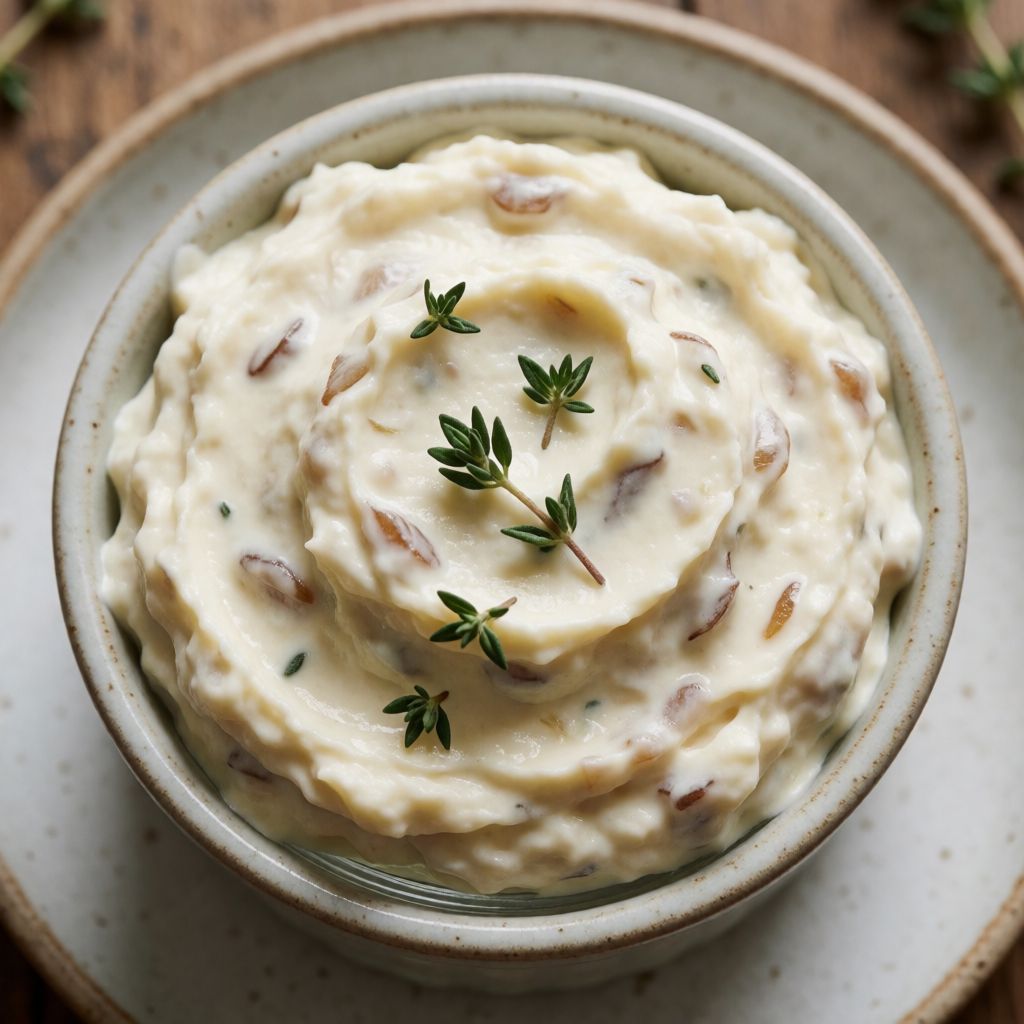
 AI photo
Spiced Lard
A traditional spiced lard spread with crackling, onion, apple and thyme, lovely on fresh bread.
Ingredients
- 500 g Salo (pork fatback) rind removed
- 1 pcs Onion diced
- 1 pcs Apple diced
- 5 pcs Thyme fresh sprigs
- 3 tbsp Duck Fat
- 2 tsp Salt
- 0.5 tsp Black Pepper freshly ground




Steps
Dice the salo into small cubes and place it in a saucepan.
Slowly render the fat over a low heat, stirring often — this will take 2-3 hours.
Remove the crackling with a slotted spoon once golden-brown and place it on a plate lined with paper towel.
Add the onion, apple, thyme, salt and freshly ground black pepper to the fat.
Cook for 5 minutes, stirring, so the fat takes on the flavours.
5 minStrain the spiced lard into clean, scalded jars, then stir in the crackling or sprinkle it on top.
Seal with a lid and refrigerate — or freeze for longer storage.
This is not a dish you eat as a dish — it's stock-in-trade, the kind of thing you make once so that a dozen other meals get better. You render pork fat down to liquid gold, let onion and apple and thyme give it their flavour, then set the crackling to one side or scatter it back on top. What you end up with is a jar of pale, scented fat for roasting potatoes, basting a bird, or spreading on toast the way your grandmother spread dripping — because that's exactly what this is, dressed up with an apple and a sprig of thyme.
What decides whether it works is not seasoning, it's heat. Some say rendering fat is just a slow kind of frying — no, because frying browns protein on the outside while the inside cooks; rendering has to melt the fat clean out of its cell walls without ever letting the solids scorch. Push the heat and the connective tissue inside the salo chars before all the fat has let go of it, and that char turns the whole batch bitter and smoky — a flavour that no amount of thyme fixes afterwards. So the heat stays low enough that the fat barely trembles, and you watch, not a clock.
Salo is just fatback with the rind taken off — firm, white, almost no streaks of meat in it. If your butcher doesn't stock pure back fat, ask for pork fat trim; what you don't want is anything with a lot of meat running through it, because meat browns and bleeds juice into your fat before the fat itself has melted, muddying both the colour and the taste. Dice it small and even, because a chunk that's thick in the middle will still be raw fat long after the thin edges have gone to crackling — uneven dice is the quiet cause of a batch where half the crackling is perfect and half is still rubbery.
Onion and apple go in only after the crackling is out, and that order matters more than it looks. Put them in with the raw fat and they'd stew for two hours in a pan that's slowly climbing toward frying heat, and they'd burn long before the fat finished rendering. Added at the end, in hot fat that's now below boiling, they have five minutes to give up their sugars and a little acidity into the fat by simple infusion — the apple cuts the heaviness of the fat, the onion gives it savoury depth, the way dripping toast always tasted better with a bit of fried onion worked through it. Thyme is the cheapest kind of perfume here; rosemary or sage would do the same job if that's what's in the garden, just use less of a stronger herb like rosemary.
The duck fat is already-rendered fat added for its own flavour, not for bulk — any other cooking fat with a flavour you actually want in the jar can replace it: goose fat, or more of your own rendered pork fat if you'd rather keep it purely porky. What you shouldn't reach for is butter or a flavourless vegetable oil as a swap here — butter burns well below the temperature you need for the onion and apple to soften, and a neutral oil adds nothing where the whole point is flavour. The rule for any substitution in this jar is simple: it has to be a fat that can stand in a hot pan for five minutes without scorching, and that you don't mind tasting.
Salt does two jobs — it seasons, and historically, salting rendered fat was part of how it kept through a larder winter before anyone had a fridge. That's the real reason dripping and salo both exist as kitchen staples across Britain and Eastern Europe alike: before refrigeration, rendering the fat and keeping it cool was the only way to stop a slaughtered pig going to waste, and salted fat lasted months where fresh fat wouldn't last a week. Scalding the jars isn't tradition for tradition's sake either — it kills the bacteria and mould spores that would otherwise have a lovely time in a jar of warm, nutrient-rich fat, and it's the difference between a jar that keeps for months in the fridge and one that turns rancid in a fortnight.
In an ordinary flat you've got a wide pan standing in for a kazan and a hob ring instead of an open flame, and that's fine — just know your lowest ring setting may still run hotter than the gentlest heat a stovetop can give you on gas, so watch the fat rather than trust the dial. One batch of 500g salo gives you a decent jam-jar's worth of flavoured fat — enough for several Sunday roasts' worth of potatoes, or a few weeks of toast, for one household. Keep it in the fridge for daily use, and freeze what you won't get through in a month; frozen, the fat holds its flavour far longer than it would just sitting on a shelf.