
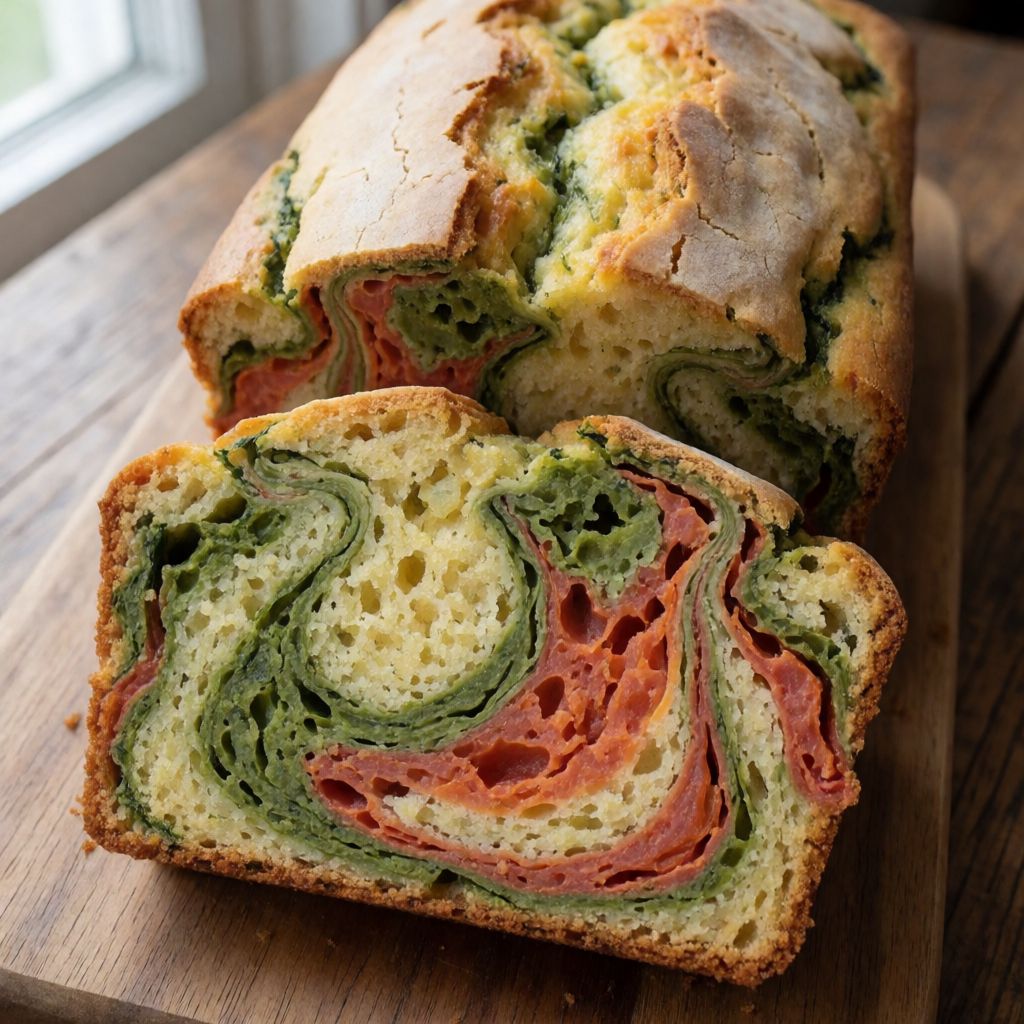
 AI photo
Marbled Spinach and Tomato Loaf Cake
A savoury marbled cake with swirls of spinach and tomato purée, baked until golden.
Labels are worked out automatically from the ingredients and can be wrong. Check the packaging if it matters to you.
Ingredients
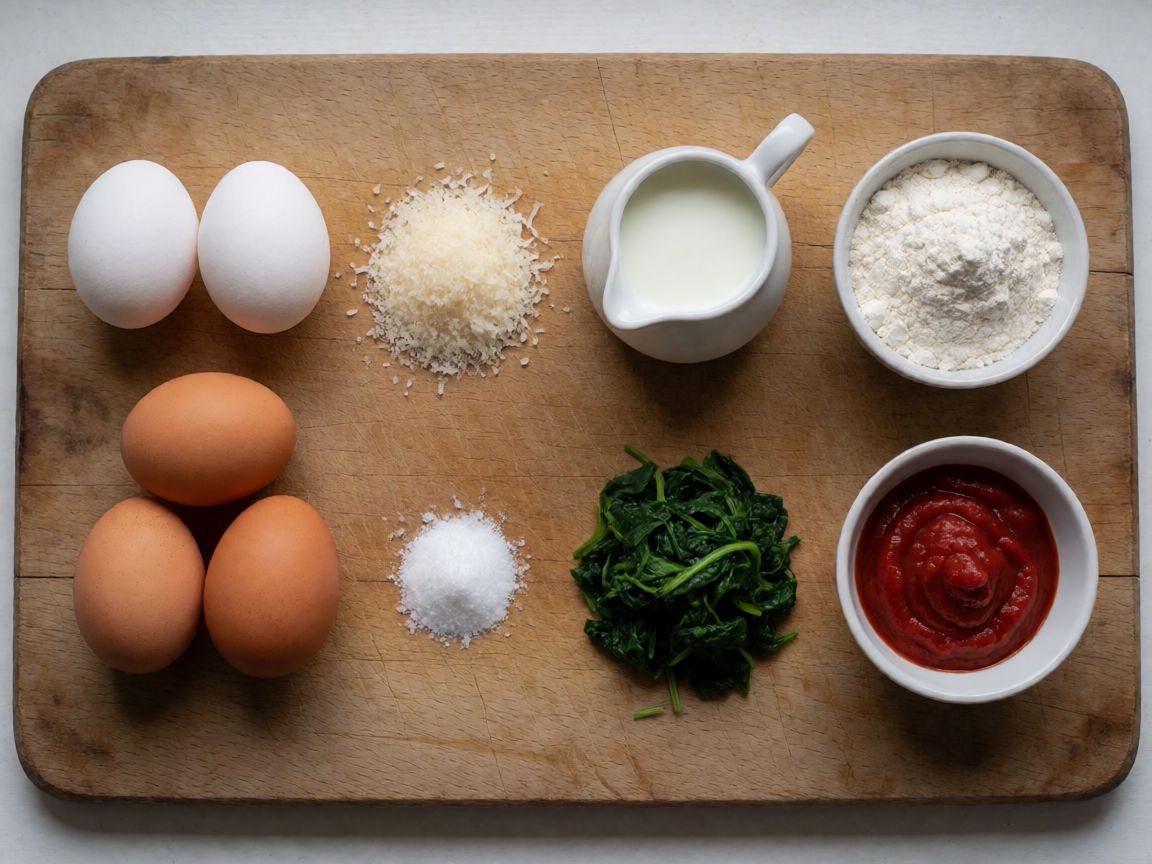
- 4 pcs Eggs
- 150 g Olive oil
- 40 g Parmesan
- 50 ml Milk
- Salt to taste
- Black pepper to taste
- 250 g Plain flour
- 15 g Baking powder
- 250 g Spinach
- 80 g Tomato purée










Steps
Heat the olive oil in a pan and add the spinach, cook for 10 minutes, stirring, season with salt to taste.
10 minTransfer the spinach to a separate container and blend to a purée with an immersion blender.
In a large bowl, whisk the eggs, pour in the olive oil in a thin stream, add the Parmesan, salt and black pepper.
Gradually fold in the sifted flour, pour in the milk, add the baking powder, and mix until smooth.
Divide the batter into two equal parts, add the spinach purée to one and the tomato purée to the other.
Spoon both batters into a baking tin, alternating them to create a marbled pattern.
Bake in a fan oven preheated to 170°C for 45–50 minutes (or 180°C conventional, 50–60 minutes).
48 minLeave the cake to cool before serving.
This is a savoury loaf — a cousin of the sweet marble cake, built the same way but with spinach and tomato standing in for chocolate and vanilla. What decides whether it works is not the oven, it's the two purées: they have to be roughly the same thickness as the base batter, or one colour will sink and you'll get a loaf with a green bottom and an orange top instead of a marble.
The structure is a standard quick-bread ratio — eggs and oil for richness and lift, flour and baking powder for the crumb, Parmesan for savour and a bit of salt it brings on its own. Cooking the spinach first isn't fussiness, it's necessity: raw spinach is mostly water locked in cell walls, and that water has to be driven off in the pan, not in the oven, or it dilutes your batter and gives you a dense, soggy streak where the green swirl sits.
Marbling itself is simple mechanics, not artistry. You're not swirling with a knife — you're dropping spoonfuls of each coloured batter next to and on top of each other in the tin, and letting them find their own boundary as they rise. Some say you need to swirl with a skewer for a "proper" marble — no, because the two batters are different weights (tomato purée is wetter and heavier than cooked spinach purée) and if you drag them through each other, the heavier one just falls to the bottom and you lose the pattern rather than making it.
Patience here is mostly about not rushing the cooling. Cut it warm and the crumb, still setting, will smear rather than slice cleanly — the marble effect you worked for ends up as a brown-green smudge.
On the eggs and oil: whisking the eggs first and adding the oil "in a thin stream" is the same logic as making mayonnaise — you're asking the egg proteins to hold the fat in suspension rather than letting it pool. Dump the oil in all at once and you get an oily, greasy crumb because the batter never properly emulsifies; a slow stream while whisking gives you a batter that bakes light instead of heavy. Olive oil is specified for its own savoury character, but the rule is "any oil with no strong flavour of its own that stays liquid at room temperature" — a mild rapeseed oil will do the job structurally, you just lose some of the fruitiness Parmesan and tomato are meant to sit alongside.
The Parmesan is doing two jobs: salt and dry umami. Use a hard, well-aged grating cheese — Grana Padano is the obvious domestic substitute, and a mature Cheddar will work in a pinch, though it brings a different, sharper note and more moisture, so go easy on added salt if you use it.
Flour and baking powder are the scaffolding. 15 g of baking powder on 250 g flour is a generous lift — this is a dense-ish savoury batter weighed down by cheese, oil and vegetable purée, so it needs more raising agent than a plain sponge would to come up properly rather than sitting flat and tight in the tin. Sift it in gradually, as the recipe says, not because sifting is magic but because adding flour all at once to a wet batter makes lumps that won't work out later — you'd be stirring hard to break them, and overworking develops gluten, which is exactly what turns a tender crumb tough and chewy.
The milk at the end loosens the batter to pouring consistency — without it, cheese and flour together can leave you with something closer to a stiff dough than a cake batter, and a stiff batter won't spread or marble at all; it'll just sit where you spoon it in ugly mounds.
Spinach: 250 g fresh is a lot of volume but it collapses hard once cooked — that's water leaving, as above. If you only have frozen spinach, use it, but thaw and squeeze it bone-dry first; frozen spinach holds even more water than fresh and will wreck your batter's balance if you skip that step. Blending it to a purée isn't for looks — whole cooked leaves are stringy and would tear through the batter in threads rather than swirling as a smooth band of colour.
Tomato purée (the concentrated paste, not fresh chopped tomato) is chosen for the same reason the spinach is cooked down: you want concentrated flavour and colour without extra water loosening the batter unevenly against its green counterpart. If you only have passata, you'll need to reduce it in a pan first to get it back to paste thickness, or your tomato half of the batter will run thinner than the spinach half and sink instead of marbling.
On the oven: this is a domestic fan oven or conventional, no kazan tricks here, and the two temperatures given (170°C fan, 180°C conventional) reflect the real difference in how fan ovens circulate heat more evenly and cook a touch faster — not a typo, not a suggestion, an honest adjustment for the appliance you actually have. Don't trust the clock alone, though: an egg-and-oil-rich batter like this is done when a skewer comes out clean and the top springs back rather than dents under a light finger-press — the time range (45 to 60 minutes depending on oven) is your lower bound, the skewer is your real answer. Cooling before slicing isn't optional patience for show — it's the starch and egg proteins finishing their set outside the heat, and skipping it is the single fastest way to turn a tidy marble loaf into a warm, pretty mess on the plate.