
 AI photo
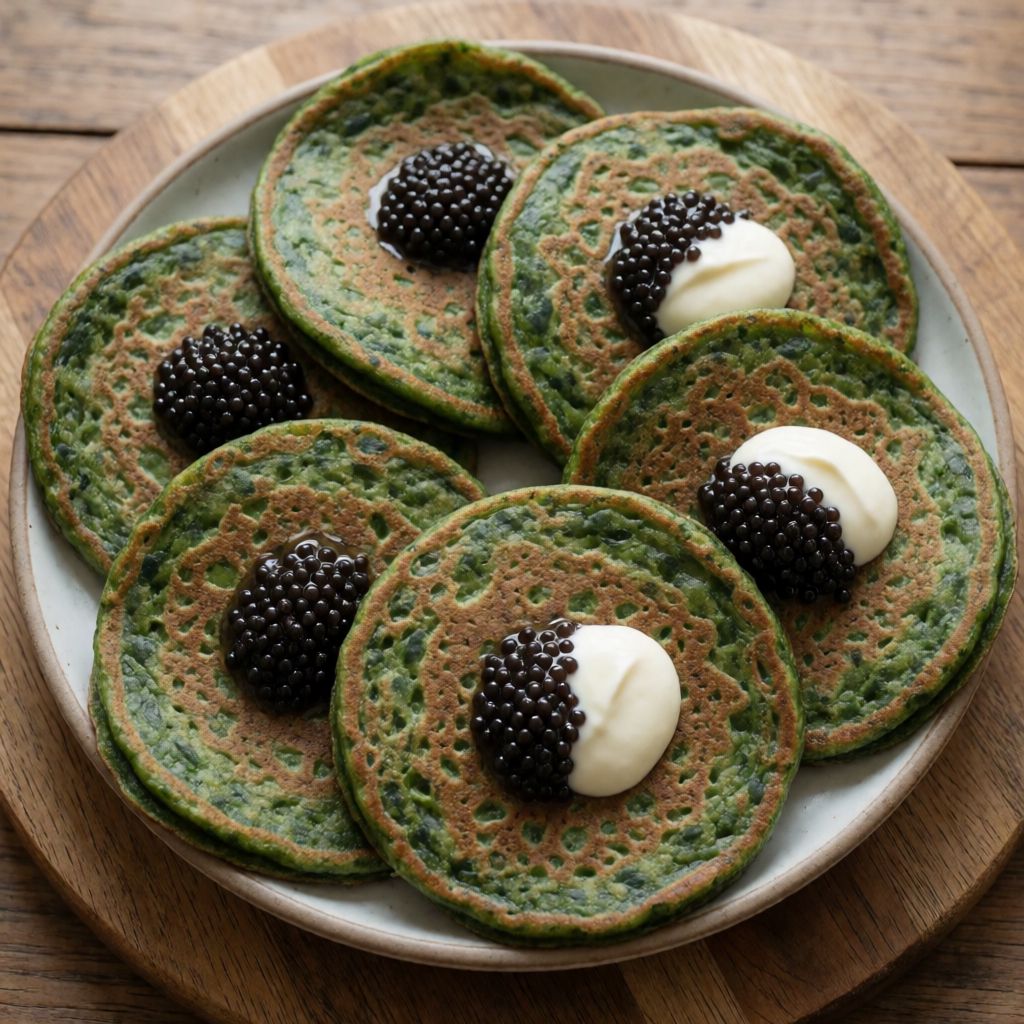
Spinach Pancakes with Lumpfish Roe
Small yeasted spinach pancakes, served with roe, crème fraîche, red onion and fresh dill.
Labels are worked out automatically from the ingredients and can be wrong. Check the packaging if it matters to you.
Ingredients
- 300 ml Milk
- 80 g Spinach fresh
- 15 g Yeast
- 150 g Buckwheat flour
- 100 g Wholemeal flour
- 50 g Plain flour
- 2 pcs Eggs
- 0.5 tsp Salt
- 2 tbsp Butter for frying
- 300 g Lumpfish roe
- 150 g Crème fraîche 18% crème fraîche
- 1 pcs Red onion finely chopped
- 1 bunch Dill fresh












Steps
Bring a saucepan with ½ litre of water to the boil.
5 minAdd the spinach to the boiling water and cook for 30 seconds, then drain and squeeze out the water well.
1 minLet it cool slightly, then finely chop the spinach.
2 minStir the yeast into the milk in a bowl.
1 minAdd the buckwheat flour, plain flour, wholemeal flour, salt and egg yolks to the batter, whisk together and stir in the spinach.
5 minLeave the batter to rise on the worktop in the bowl, covered with a clean towel, for about 30 minutes.
30 minWhisk the egg whites to a stiff foam and gently fold them into the batter.
5 minHeat the butter in a frying pan over medium heat and spoon in small portions of the batter.
2 minWhen golden and cooked on one side, flip and fry the other side.
3 minTo serve: top the finished pancakes with lumpfish roe, finely chopped red onion, crème fraîche and fresh dill.
What was changed
The roe was swapped for Lumpfish roe, and the flour was swapped for Wholemeal flour, both using equivalents sold in British shops.
These are small blinis, not big fluffy breakfast pancakes — the Scandinavian kind, built to hold a spoonful of something briny and rich without collapsing under it. Spinach goes in for colour and a faint vegetable backnote, not for flavour you'll actually taste through roe and crème fraîche. Thirty of them from this mix tells you the size: two or three bites each, canapé scale, meant for a table where people are standing with a glass in one hand.
What decides whether they work is the yeast and the egg white, pulling in opposite directions on purpose. The yeast gives you a slow, sour lift and a slightly chewy structure — buckwheat and wholemeal flour have no gluten strength to speak of, so without yeast you'd get a flat, crumbly disc that falls apart under a spoon of roe. The whisked egg white folded in at the end adds a second, faster lift on top of that — air bubbles that don't need 30 minutes to form. Skip the fold, or beat it in too roughly, and you lose that lightness; the yeast alone gives you density, not lift.
Some say you can skip whisking the whites separately and just crack the whole egg into the batter — no, because then you're relying entirely on the yeast's half hour to do all the work, and these flours don't have the gluten to trap much gas anyway. The separated, stiffly whisked white is doing a mechanical job the batter can't do for itself.
Buckwheat flour is the backbone here — it has a mineral, slightly bitter edge and zero gluten, which is exactly why it's cut with wholemeal and plain flour. All buckwheat would give you blinis that crumble the second a spoon touches them, because there's nothing to hold the crumb together once it's wet. If you've only got buckwheat in the cupboard, you can push the ratio, but you'll need to add more plain flour to compensate, not less. No buckwheat at all and you've made something else — still pleasant, just not this.
The yeast is a slow-rise lager-yeast logic, not a bread-dough logic: you're not building a network of gluten strands, you're giving carbon dioxide somewhere to sit inside a thin, wet batter for half an hour. That's why the batter goes under a towel on the worktop and not in the fridge — cold yeast barely moves, and you'd be waiting hours instead of thirty minutes for the same rise. Any domestic kitchen is warm enough for this; you don't need proving drawers or kazans, just a spot away from a draughty window.
Milk rather than water gives the yeast some sugar and protein to work with and softens the final crumb — water would work, technically, but you'd get a thinner-tasting pancake. Full-fat is worth using here because there's so little fat elsewhere in the batter; skimmed milk leaves the blinis slightly dry against all that cold roe and cream on top.
Spinach: blanched for thirty seconds and squeezed hard, because raw spinach carries far too much water into a batter that's already wet, and unsqueezed spinach will thin your mix and stop it holding shape in the pan. The squeeze isn't fussy kitchen ritual — it's the difference between a blini that sets and one that spreads into a puddle. If you've no fresh spinach, frozen leaf spinach, thawed and squeezed the same way, does the identical job — frozen spinach is already blanched, essentially, so you're just thawing and wringing it out.
Lumpfish roe is doing the job caviar does in the dish it's borrowed its format from, at a fraction of the price — that's the whole economic story of this topping. Lumpfish roe is farmed, dyed, cheap, and salty; it's not trying to be sturgeon caviar, it's trying to be affordable enough to put on thirty pancakes for a party. If you want to spend more, salmon roe (the bigger orange pearls) gives a softer, less salty pop and a completely different mouthfeel — fine, just don't expect the same briny punch.
Crème fraîche at 18% is chosen for a reason: full-fat soured cream or crème fraîche carries enough fat to cut the salt of the roe without curdling or thinning out when it meets something cold and salty, the way lower-fat soured cream sometimes can. Thick Greek yoghurt works in a pinch — it won't have quite the same tang, but the fat content does the same cutting job.
Butter for frying rather than a neutral oil is a flavour choice, not a technical one — it browns the underside with that faint nutty smell as the milk solids catch, and since you're only using a couple of tablespoons for thirty small blinis, you can afford that flavour without drowning the pancake in fat. Keep an eye on it in the pan: butter burns faster than oil, and a burnt fleck under a delicate little pancake is a bigger defect here than it would be on a steak, because there's nowhere for the bitterness to hide.
One more thing worth saying plainly: thirty of these, in batches of a few at a time in a frying pan, takes longer than the "25 min cook" suggests if you're doing it solo in an ordinary flat kitchen with one pan and no one to help you flip. Patience is an ingredient in this dish as much as the yeast is — rushed heat gives you pale, undercooked centres and a scorched edge, not a cooked-through, evenly gold little blini. Better to go a shade slower and get all thirty right than fast and get ten you have to throw back.