
 AI photo
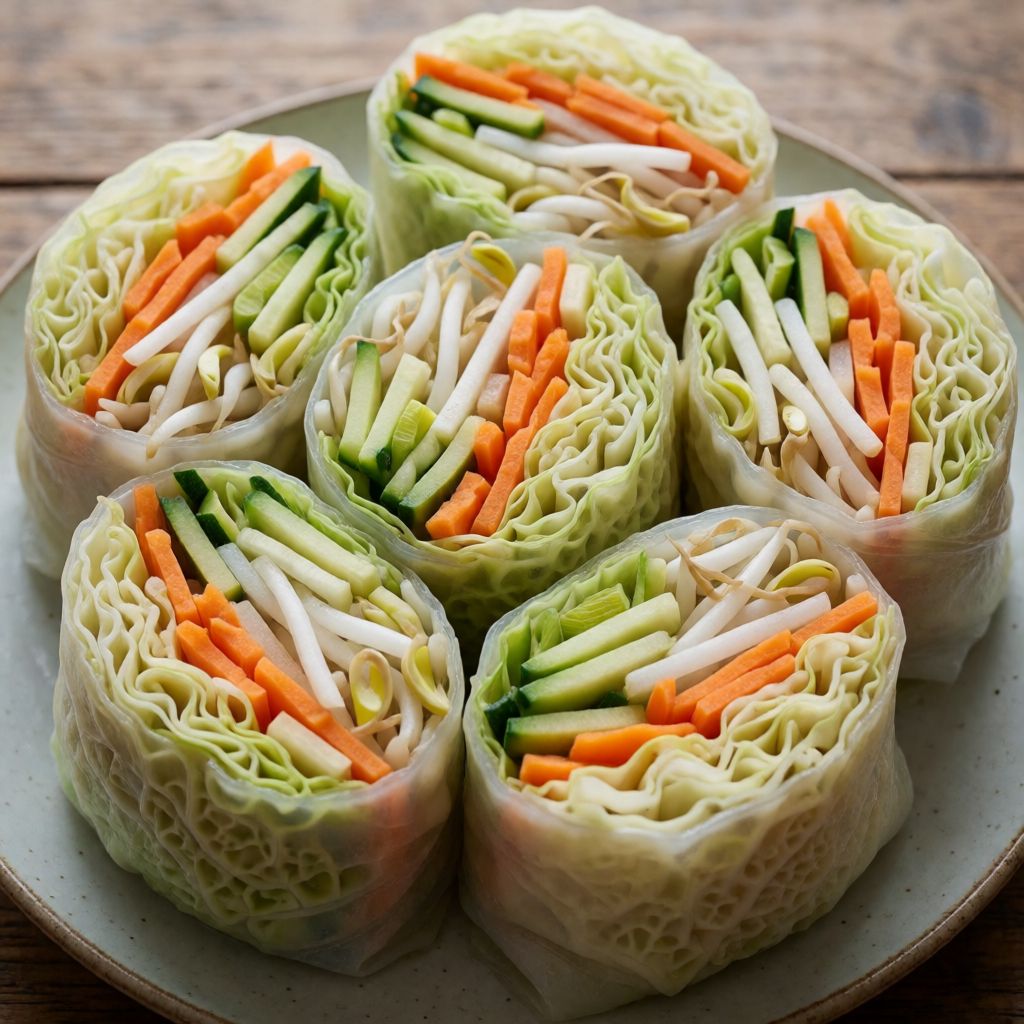
Spring Rice Paper Rolls
Crisp, golden rice paper rolls packed with crunchy vegetables and soy sauce, fried until golden.
Labels are worked out automatically from the ingredients and can be wrong. Check the packaging if it matters to you.
Ingredients
- 10 pcs Rice paper
- 1 pcs Savoy cabbage half a head
- 1 pcs Leek
- 1 pcs Courgette
- 3 pcs Carrot
- 100 g Bean sprouts
- Olive oil to taste
- Soy sauce to taste
- Vegetable oil for deep-frying, to taste
- 1 pcs Egg white








Steps
Wash the savoy cabbage and cut into thin strips, peel and cut the carrot into thin strips, do the same with the courgette. Cut the leek into rings.
Heat the olive oil in a frying pan and fry the vegetables together with the bean sprouts, adding soy sauce.
6 minTransfer the vegetables to a colander or sieve to drain off excess liquid.
Lay out the vegetable filling on a sheet of rice paper, shifted slightly to one edge.
Lift the edge of the paper, carefully roll it up, folding in the sides and rolling into a tight roll.
Brush the edge of the rice paper with egg white to seal it.
Heat the vegetable oil and fry the rolls until golden.
Remove the rolls with a slotted spoon and place on a kitchen towel to drain off excess oil.
Serve the rolls hot.
These are fried spring rolls — rice paper wrapped round a cabbage-and-vegetable filling, sealed and dropped into hot oil until the wrapper turns from translucent to a brittle gold shell. The whole trick of the dish sits in two opposite jobs the recipe asks of the same sheet of rice paper: it has to be wet enough to fold without cracking, and the filling inside it has to be as dry as you can make it. Get either wrong and you don't get a roll, you get a leak.
What decides success isn't the vegetables — any crisp, water-heavy veg will do — it's moisture management, twice over. First you cook the filling hot and fast so it wilts but doesn't stew, then you tip it into a colander and let it sit there, because a filling that's still weeping liquid will turn the rice paper to porridge the moment it touches it, and that same liquid will spit viciously when the roll hits the oil. Second, the paper itself: rice paper isn't pastry, it has no fat and no gluten holding it together, it's just rice starch and water pressed into a sheet, so it goes stiff dry and goes to glue if you oversoak it. You want it just pliable — bends like a damp tea towel, not a wet flannel.
Some say you need a steamer basket and bamboo mats for this. No — you need a wide shallow dish of warm water and a flat surface, which is to say, a plate on your worktop. This is street food dressed up as technique; the "equipment" is a bowl and your hands.
Savoy cabbage is the backbone here because it holds its shape and crunch under heat better than a softer green — it's a cabbage bred for structure, with those crinkled leaves that stay separate instead of collapsing into mush. If you've only got a tight white or pointed cabbage, use it, just cut it finer, because it has less air in the leaf and will take longer to soften without that frilly surface area. Leek goes in for sweetness without the sharp bite of raw onion; if you're out of leek, a mild onion sliced thin does the same sweetening job, just expect a rounder, less grassy flavour. Courgette and carrot are there for colour and for moisture control in opposite directions — courgette is nearly all water and will collapse fast, carrot is dense and keeps its bite, cut both into matching thin strips so they cook at the same rate and nothing's still raw while something else is going translucent. Bean sprouts bring crunch and a clean, almost cold contrast against the cooked veg; they don't want long in the pan, a minute of heat is enough, any more and they go limp and watery, which is exactly the fault you're trying to engineer out of this filling, not into it.
Soy sauce is doing the seasoning here instead of salt, and it's doing it because this dish borrows its logic from East and Southeast Asian street food, where soy gives both the saltiness and a dark savoury depth salt alone can't. Use a light soy for a cleaner, saltier hit, or a dark one if you want colour and a touch of sweetness in the filling — either works, just go easy, because the liquid you add is liquid you then have to drain back out.
Olive oil for the stir-fry is a British-kitchen-friendly stand-in more than an authentic choice — any neutral oil with a high smoke point and no flavour of its own does the job of frying hot and fast without arguing with the soy sauce. If your olive oil is a good peppery extra virgin, save it for salad dressing; its flavour will just fight the dish, and its smoke point is lower than you want for a pan that needs to be properly hot.
For deep-frying, think about what "vegetable oil" actually means on a domestic hob: you don't need a vat, you need enough oil in a decent-sized saucepan to cover the rolls by a couple of inches, and you need it hot enough that a dropped-in edge of rice paper sizzles and bubbles on contact — if it just sits there quietly, the oil's not ready, and the rolls will sit and absorb oil instead of crisping. Any flavourless oil that can take a proper fry — sunflower, groundnut, rapeseed — does this; olive oil here would be a waste of a better oil and liable to smoke before the rolls are done.
The egg white substitution, if you don't want to crack an egg for just the white, is a thin paste of flour and water or even a dab of the same soaking water brushed on thick — it won't set quite as firmly, so press the seam shut with your fingers a second longer to compensate.
Ten sheets of rice paper for four people as a starter is a fair ratio — this is a first course or a shared plate, not a main, and it rewards patience more than skill: the rolling is fiddly the first few times, the paper tears if you rush it wet, so do one well before you do ten quickly. Fried hot, they want to go straight to the table — rice paper that's been fried and then left to sit goes from crisp to leathery within minutes, there's no fixing that once it's happened, only avoiding it by timing your frying to your sitting-down.