
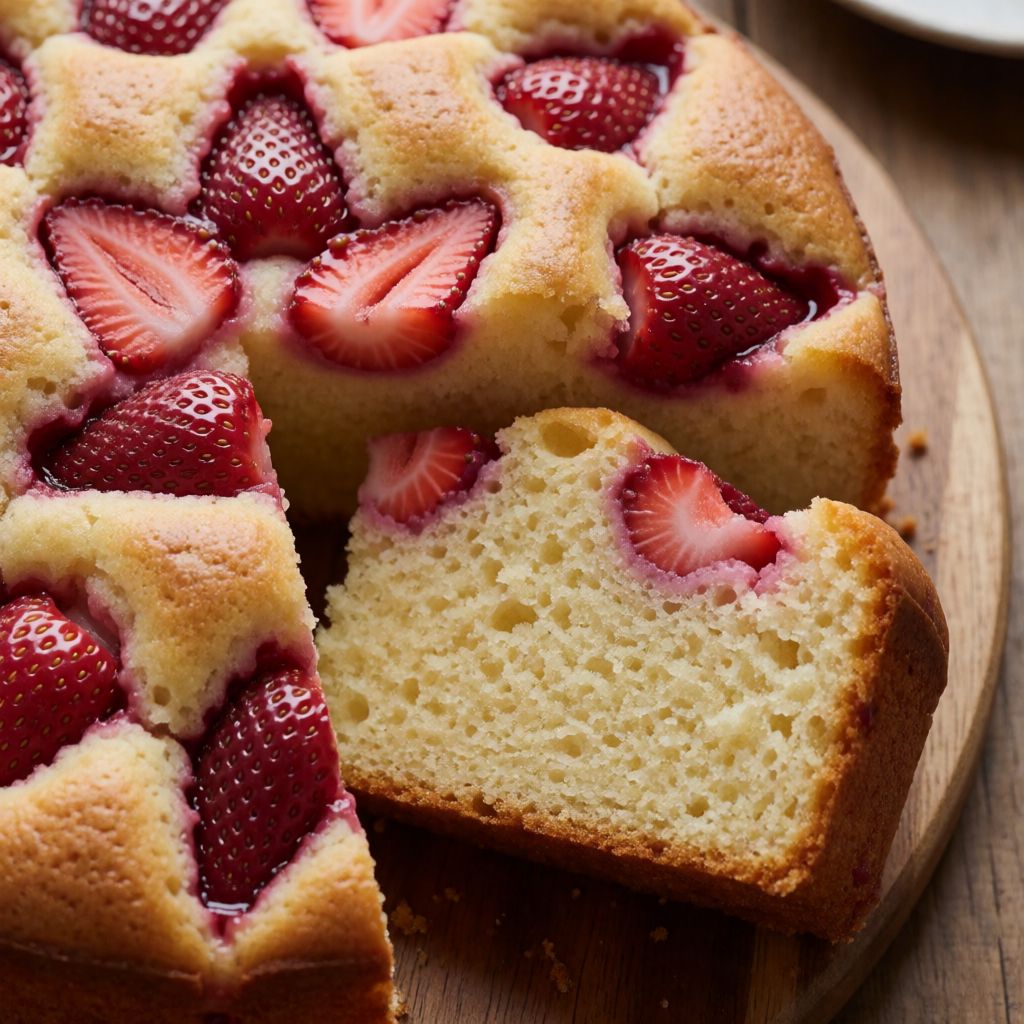
 AI photo
Gluten-Free Strawberry Cake
A gluten-free strawberry cake made with rice flour and potato starch, topped with a few reserved berries.
Labels are worked out automatically from the ingredients and can be wrong. Check the packaging if it matters to you.
Ingredients
- 200 g Strawberries
- 130 g Sugar
- 3 pcs Egg whites
- Salt a pinch
- 150 g Rice flour
- 50 g Potato starch
- 100 ml Vegetable oil
- 150 ml Water
- 1 pcs Lemon zest
- 16 g Baking powder
- Icing sugar to taste








Steps
Wash the strawberries and cut them into small pieces, setting a few aside for decoration.
In a separate bowl, separate the egg whites, add a pinch of salt and whisk with an electric mixer until thick and stiff.
In another bowl, mix the sugar, water and oil, add the lemon zest and stir with the mixer.
Add the sifted rice flour, potato starch and baking powder, and mix until smooth and lump-free.
Add the chopped strawberries and mix.
Gently fold in the whisked egg whites with bottom-to-top movements, to keep the mixture airy.
Pour the batter into a 22 cm tin lined with baking paper and smooth with a spatula.
Decorate the top with the reserved strawberry pieces, arranging them as you like.
Bake in a preheated oven at 180°C for about 40 minutes, checking for doneness with a wooden skewer towards the end.
40 minRemove the cake from the oven, let it cool for a few minutes, dust with icing sugar, slice and serve.
This is a cake built on two separate engineering problems solved in two separate bowls. Rice flour and potato starch have no gluten, which means no elastic net to trap air — so the lift here isn't coming from the flour, it's coming from whipped egg white, folded in at the last second. Get that fold wrong and you have a flat, dense, slightly gritty biscuit. Get it right and you have something that rises properly despite having nothing in it that "should" be able to hold a bubble.
What decides whether this works is temperature discipline on the whites and restraint on the fold. Egg whites whip because the proteins unwind and link up around air bubbles — warm whites unwind too fast and collapse, so cold eggs from the fridge (not room temperature, despite what every baking book tells you about cakes in general) give you a sturdier foam here. The pinch of salt isn't seasoning, it's a mild disruptor that slows the protein bonding down just enough to stop you overwhipping into a dry, crumbly foam that won't fold into anything.
Folding "bottom to top" isn't fussiness, it's physics: you're trying to move the heavier starch batter underneath the lighter foam without crushing the bubbles already trapped. Stir normally and you knock the air back out — the exact air you just spent effort putting in. So fold, don't stir, and stop the moment you can't see white and yellow streaks anymore. A few streaks left is better than a flat cake.
Rice flour and potato starch are doing different jobs, and neither is a straight swap for wheat flour on its own — which is why this recipe uses both, not one or the other. Rice flour gives structure and a slight grain; potato starch is nearly pure starch with almost no protein, and it's there to keep the crumb light and a bit springy, since rice flour alone bakes dry and sandy. If you've only got cornflour in the cupboard, it'll do the starch's job reasonably — it's a thickener with no flavour of its own, same principle — but the texture will be a touch denser, so don't expect identical. Some say gluten-free baking is just "wheat flour minus the wheat" — no, because gluten is the thing doing the structural work in an ordinary cake batter (helped along by egg), and here you're replacing it entirely with whipped egg foam. That's a different mechanism, not a substitution.
The oil, not butter, is doing something specific too: it coats the starch granules evenly when stirred in liquid form, and because it stays liquid at room temperature, the crumb stays moist for longer than a butter version would once it's cool — butter solidifies as it cools and can make a gluten-free crumb go tighter and drier the next day. Use any oil with no strong smell of its own — sunflower, a mild rapeseed, a light vegetable oil — because this cake carries lemon and strawberry, and a heavily flavoured olive oil will fight both.
Baking powder at 16 g for this amount of flour is a fairly generous dose, and that's deliberate — it's compensating for the lack of gluten's own gas-trapping structure, giving you a second, chemical source of lift to back up the egg whites mechanically. Don't be tempted to cut it back because "that seems like a lot" — in a wheat cake it would be, here it's doing extra work.
The lemon zest is there for brightness against the strawberries' sweetness, not as a flavour on its own — zest only, no juice, because the juice adds water and acid you haven't accounted for in the starch ratio, and could leave you with a gummy centre.
On a UK domestic oven: 180°C fan or conventional makes a real difference here, since fan ovens run effectively hotter at the same dial setting — if yours is fan, you're safer at around 160–165°C for the same time, or you'll get a cake that's set and browning on top while the centre, dense with starch and strawberry juice, is still gluey. The skewer test matters more than the clock for exactly this reason: pull it from the centre, and if it's wet batter rather than a few moist crumbs, give it longer rather than trusting the 40 minutes blindly — that number is a floor, not a verdict. Let it sit a few minutes out of the tin before you dust it with icing sugar; a cake with no gluten scaffold is more fragile hot than a wheat cake, and slicing it too early is how you get a wedge that collapses rather than cuts.