
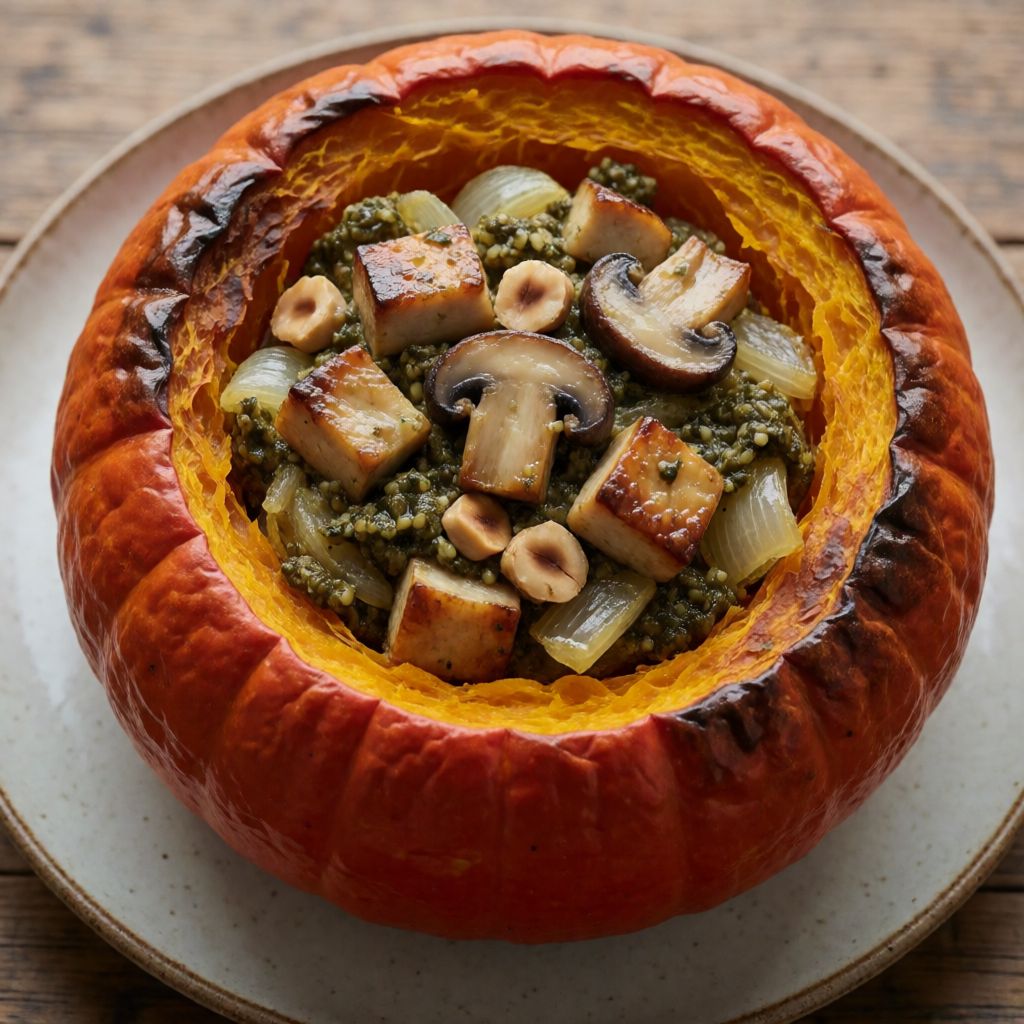
 AI photo
Stuffed Baked Hokkaido Pumpkin
A small Hokkaido pumpkin filled with mushrooms, hazelnuts and pesto, baked until soft.
Labels are worked out automatically from the ingredients and can be wrong. Check the packaging if it matters to you.
Ingredients
- 1 pcs Pumpkin small, Hokkaido variety
- 2 tbsp Hazelnuts finely chopped
- 1 pcs Onion finely chopped
- 2 clove Garlic finely chopped
- 350 g Mushrooms finely chopped
- 2 tbsp Pesto to taste
- 1 tbsp Olive oil
- 100 ml Parsley finely chopped, plus a little extra for serving
- 1 pinch Nutmeg freshly grated
- Salt to taste
- Black pepper to taste, freshly ground
- 125 g Mozzarella diced








Steps
Wash the Hokkaido pumpkin thoroughly, cut off the top and scoop out the seeds and flesh with a spoon. If needed, trim a small slice off the base so it stands steady.
5 minToast the hazelnuts in a dry hot pan, stirring, until the skins start to loosen. Rub off the skins with a cloth and chop the nuts finely.
5 minHeat the olive oil in a pan and fry the onion, garlic, mushrooms and hazelnuts over medium heat until the onion is soft.
10 minAdd the pesto and parsley, mix well, and season with nutmeg, salt and black pepper. Spoon the mixture into the pumpkin together with the mozzarella.
5 minBake the pumpkin in an oven preheated to 175°C with fan, for about 45–60 minutes, until soft.
52 minSprinkle the pumpkin with finely chopped parsley and serve on a platter, carving at the table.
2 min
A Hokkaido pumpkin, hollowed and refilled with its own kind of stuffing, baked whole until it goes from vegetable to vessel. The whole point is that the skin stays edible — unlike a butternut, Hokkaido's shell softens into something you can fork straight through, so this isn't really "stuffed vegetable, scrape and discard the shell" cooking, it's a self-contained bowl you eat down to the last wall. Choose a small one for a reason: a big pumpkin takes longer to cook through than the filling can tolerate, and you end up with a raw-ish core wrapped in collapsed filling.
What decides whether this works is the wall thickness and the water content of what you pack inside. Mushrooms in particular throw off liquid as they cook — if you don't drive that off in the pan first, you're not baking a pumpkin, you're steaming one, and the filling turns to soup inside a shell that's still too firm. The fry stage isn't a formality; it's the step that stops the inside becoming a swamp.
Some say pumpkin always needs peeling before cooking — no, because Hokkaido's skin is thin and genuinely softens in the oven, which is exactly why it's the variety chosen here and not, say, a thick-skinned Crown Prince. That's not folklore, it's just skin thickness and pectin.
The other thing deciding success is heat distribution in your oven, not the clock. "45 to 60 minutes" is a bracket, not a target — the pumpkin is done when a knife goes into the flesh at the base with no resistance, the way it should slide into a roast potato once it's properly cooked, not when a timer rings.
Start with the pumpkin itself. Hokkaido (also called red kuri) is small, squat, and has a shell that bakes soft rather than staying leathery — that's the whole reason it's picked for stuffing-and-eating-the-container. If you can't get one, a small onion squash behaves similarly; a butternut will work for flavour but you'll likely need to scoop the baked flesh out and serve it alongside rather than carve the shell at the table, because butternut skin stays tougher. Don't reach for a carving-pumpkin from the Halloween aisle — it's bred for shape, not texture, and bakes dry and stringy.
The hazelnuts are there for crunch and a background toastiness, not bulk — toasting them yourself and rubbing off the skins matters because the skin carries a bitter, papery note that dulls the nut flavour; shop-bought ready-skinned hazelnuts are a fine shortcut if you don't want to stand over a hot pan rubbing nuts in a tea towel. Any other nut with a similar oiliness and no competing strong flavour works as a substitute — walnuts or pecans, roughly chopped.
Mushrooms are the bulk and the savoury backbone. Chop them finely and don't crowd the pan — too many mushrooms release water faster than it can evaporate, and that water is exactly what makes the filling wet rather than dense. Chestnut mushrooms give more depth than plain white button, but any mushroom with enough flesh to hold a dice works; just chop evenly so they cook at the same rate and you're not left with raw cores in some pieces and mush in others.
Onion and garlic are the aromatic base — fry them until the onion goes soft and turns from raw white-and-sharp to translucent and sweet; that colour-and-texture shift is the cue, not a stopwatch. Pesto brings salt, oil, basil and a hit of parmesan-like savouriness in one spoonful — it's doing the work that would otherwise take three or four separate seasonings, which is exactly why it's "to taste": a shop jar varies hugely in saltiness, so taste before you add the parsley and nutmeg rather than after.
Nutmeg, freshly grated, is a classic pairing with pumpkin and mushroom because its slight sweetness rounds off the earthiness of both — pre-ground nutmeg loses that top note within weeks of grinding, so a few passes of a whole nutmeg on a fine grater does noticeably more here than the jar version, even though it looks like a small gesture.
Mozzarella, diced rather than grated, is there to melt into pockets of gooeyness through the filling rather than coat it in a uniform cheese sauce — if you only have a hard cheese like cheddar, grate it finely so it still melts through rather than sitting in unmelted lumps.
On the oven: 175°C with fan is a genuinely moving-air temperature, which matters for a whole pumpkin because fan ovens cook more evenly around an irregular shape than a static oven, where the near side can scorch while the far side lags. If you only have a conventional (non-fan) oven, push it up roughly 10–15°C to compensate for the lack of air movement, and check a little earlier rather than trust the top end of the time bracket. Either way, the test stays the same: a knife through the thickest part of the base, no resistance, that's done — the clock only tells you when to start checking.