
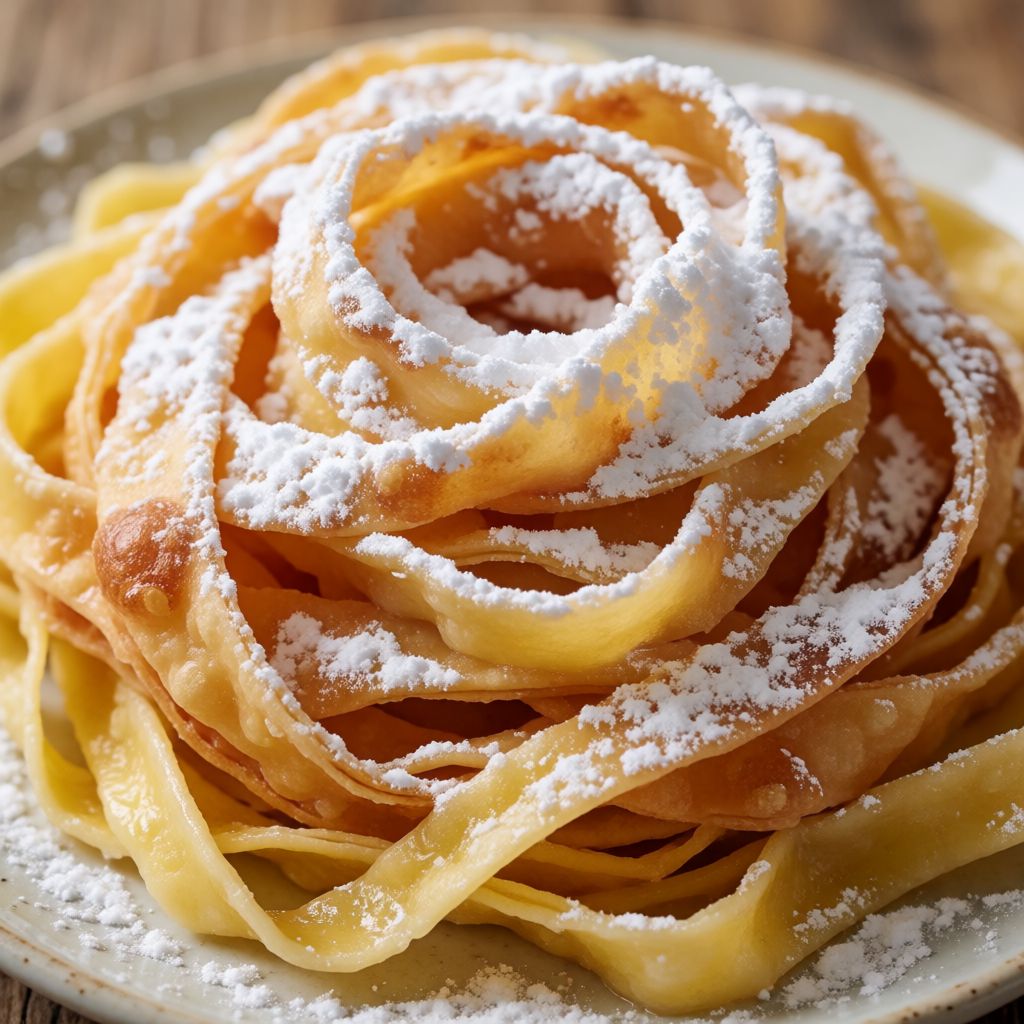
 AI photo
Sweet Carnival Tagliatelle
Crisp sweet pasta ribbons rolled with citrus zest and sugar, fried golden for Carnival celebrations.
Labels are worked out automatically from the ingredients and can be wrong. Check the packaging if it matters to you.
Ingredients
- 300 g Plain flour
- 20 g Caster sugar
- 1 pinch Baking powder
- 1 pinch Salt
- 80 g Rum or another liqueur
- 2 pcs Eggs
- 2-3 tbsp Water
- Peanut oil to taste, for frying
- 1 pcs Lemon zest
- 0.5 pcs Lemon juice
- 1 pcs Orange zest
- 80 g Brown sugar











Steps
Pour the flour into a mound, make a well in the centre, and add the sugar, salt, baking powder and eggs. Beat the eggs, pour in the rum and knead into a dough.
Wrap the dough in cling film and let it rest in the fridge.
120 minRoll out the dough on a floured surface into a rectangular sheet.
Mix the lemon zest, orange zest, brown sugar and lemon juice, and spread over the sheet of dough.
Roll the sheet into a log, starting from the short side.
Cut the cylinder into rounds about 2 cm wide.
Heat the peanut oil in a frying pan and fry the tagliatelle in small batches until golden.
Lift the cooked tagliatelle onto paper towel, then transfer to a plate or rack.
Serve the sweet tagliatelle warm and crisp.
This isn't pasta pretending to be a pudding — it's fried carnival dough cut into ribbons, and the "tagliatelle" is a joke about the shape, nothing more. It belongs to the family of fritters that turn up at Carnevale and similar pre-Lent blowouts across Italy: chiacchiere, bugie, cenci — different names, same idea. Flour, egg, a slug of booze, roll it thin, fry it fast, dust it. The rum here isn't flavour, it's chemistry — alcohol evaporates and steals heat from the dough as it does, which keeps the crust from setting too hard before the inside has had a chance to blister into those crisp little bubbles. Skip it and you get something closer to a biscuit than a fritter.
What decides whether this works is two things: how thin you roll, and how hot the oil is before anything goes in. Roll it too thick and you get a chewy, doughy coil no amount of frying will fix — the inside steams instead of crisping. The oil has to be hot enough that the dough hits it and immediately throws up a lively fizz of bubbles round the edge; if it just sits there going pale, the dough will drink oil instead of frying, and you'll end up with something heavy and greasy rather than light and shattering.
Some say you can skip the fridge rest and roll straight away. No — because gluten that's just been kneaded is tight and springs back the moment you try to roll it thin; it'll fight you, shrink back after every pass, and you'll never get the sheet fine enough. The rest lets the gluten relax, so the dough stretches instead of resisting.
Flour: plain, nothing fancy. You want low protein here, not bread flour's chew — this dough has to roll thin and fry crisp, not stretch like pizza dough. If all you've got is strong bread flour, cut it with a bit of cornflour or just accept a slightly tougher ribbon; it won't ruin the dish, just blunt it a little.
Sugar and baking powder in the dough are both doing small, specific jobs — the sugar for a faint sweetness and better browning, the baking powder for a little lift so the fried ribbons aren't flat and leathery. A pinch means a pinch; this isn't a cake, and too much raising agent will make the fritters puff and go soft rather than crisp.
The eggs bind the dough and give it the structure to hold a spiral shape once rolled and cut — without them you'd have something closer to a cracker dough, dry and prone to cracking when you try to coil it. The rum, as above, is about moisture and evaporation at the fryer, not getting anyone tipsy — any spirit with some proof to it will do the same job: brandy, grappa, even a dry white wine will stand in, though wine won't give you quite the same fast evaporation. Water is just there to adjust the dough to a workable softness if the eggs and rum haven't given you enough.
Peanut oil for frying because it has a high smoke point and almost no flavour of its own — any neutral oil with no smell behaves the same: sunflower, groundnut by another name, rapeseed if that's what's in the cupboard. Don't use olive oil here; its own flavour will fight the citrus, and its lower smoke point means it'll start breaking down before the dough's properly crisp. In a British kitchen, a wide, deep frying pan with a couple of centimetres of oil does the job fine — you don't need a dedicated fryer, just enough depth that the rounds aren't scraping the bottom of the pan.
Lemon and orange zest, lemon juice, brown sugar — this is the whole flavour of the dish, so don't skimp or substitute wildly. Zest only, not the white pith, which is bitter. Brown sugar rather than white because it brings a faint caramel note that plays better with citrus oils once it hits hot fat; if you've only got white sugar, it'll still work, just flatter.
A word on the fridge rest and the frying both: this dish punishes impatience in two separate places. Rush the rest and the dough won't roll thin. Rush the fry — crowd the pan, or pull the rounds out pale because you're hungry — and you lose the crackle that's the entire point of eating something called carnival pastry. Fry in small batches, as the recipe says, and let the paper towel actually do its job before you plate anything: oil left on the surface turns crisp back to soft within minutes, especially in a cool British kitchen where nothing sits "warm" for long once it leaves the pan. Eat these the way you'd eat Sunday roast potatoes — straight away, while they still have their nerve.