
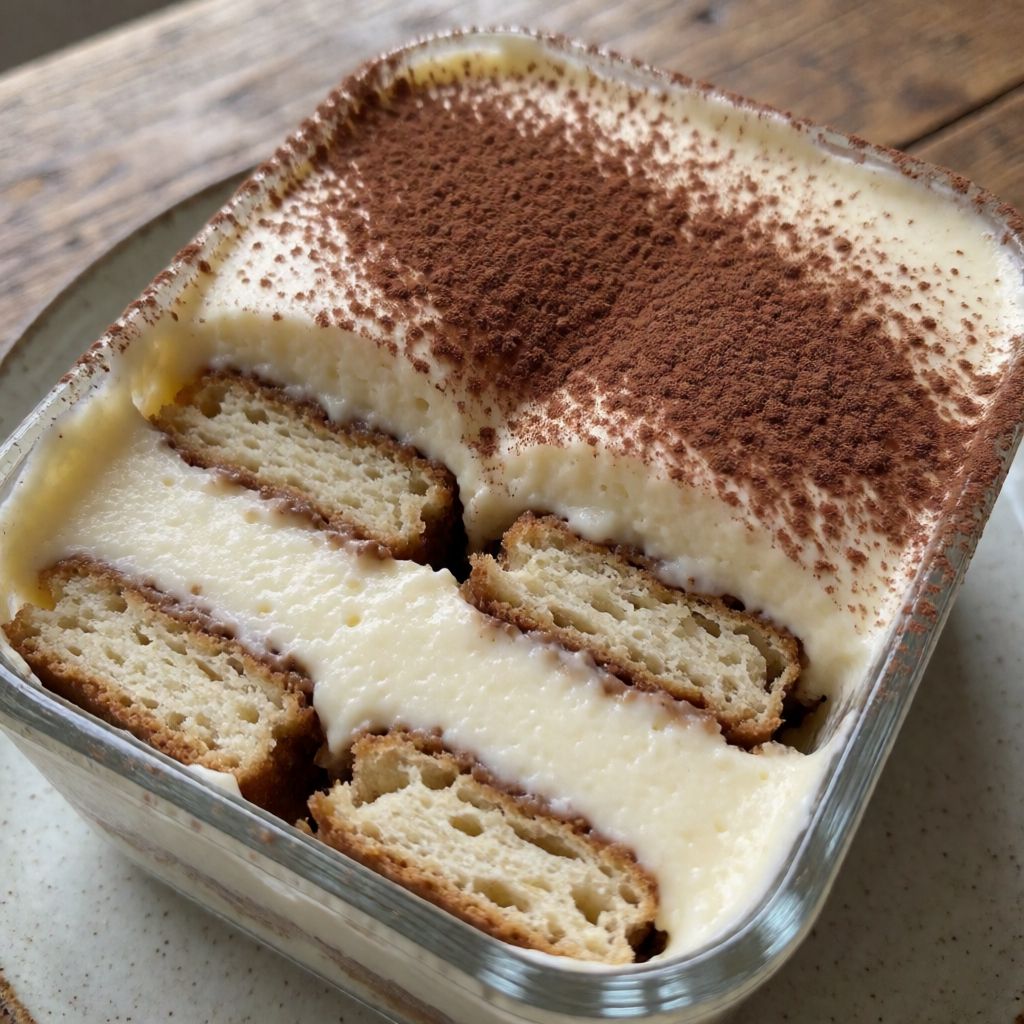
 AI photo
Tiramisu with Ricotta (No Mascarpone or Eggs)
A lighter version of tiramisu made with ricotta and yogurt instead of mascarpone and eggs.
Labels are worked out automatically from the ingredients and can be wrong. Check the packaging if it matters to you.
Ingredients
- 350 g Ricotta
- 200 g Natural yogurt
- 50 g Icing sugar
- Savoiardi or pavesini biscuits to taste
- 1 pcs Coffee a large pot, warm
- 1 pcs Maraschino liqueur a small glass
- Cocoa powder to taste
- 1 pcs Dark chocolate a bar, about 100g








Steps
In a bowl, mix the ricotta and icing sugar. Whisk by hand or with an electric mixer until smooth and fluffy.
Add the yogurt and keep whisking until the mixture is smooth.
Grate the dark chocolate and stir it into the cream until evenly combined.
In a separate bowl, mix the warm coffee with limoncello or maraschino liqueur and set aside.
Take a baking dish. Quickly dip the savoiardi or pavesini biscuits into the coffee and liqueur mixture.
Arrange a first layer of biscuits in the bottom of the dish, then spread a layer of the cream over it.
Repeat the layering until all the ingredients are used, finishing with a layer of cream.
Sift the cocoa powder evenly over the top of the tiramisu.
Cover the dessert with cling film and refrigerate overnight.
480 min
This is tiramisu with the dangerous bits removed and the expensive bit swapped out. No raw egg, no mascarpone — instead ricotta loosened with yogurt. Same architecture as the classic: biscuit, coffee, cream, repeat, cocoa on top, a night in the fridge to become itself. Call it a cousin, not an impostor.
What decides whether it works has nothing to do with which biscuits you buy or which cheese you can find. It's how wet your ricotta is, how long each biscuit stays in the coffee, and whether you actually give the thing its night. Get those three right and the rest forgives you.
Some say you should soak the biscuits until they go soft, so the layers are already plump when you build them. No — because a savoiardo is a sponge, and a sponge you drown collapses; you want the surface wet and the centre still a little chalky when you lift it out, because the fridge finishes the job by morning through nothing but capillary action, moisture crawling from damp biscuit into dry cream until the two are the same texture. Do the soaking for the fridge, not for yourself.
That overnight wait isn't about flavours getting friendly, though they do. It's structural. Cut this at the two-hour mark and you get rubble — loose cream, biscuit still gritty in the middle. Cut it after the night it's asked for and a slice stands up on the plate. Patience here is not a virtue, it's an ingredient, and it's the one people skip because the recipe only takes twenty minutes of actual work and they mistake that for the whole job.
Ricotta is doing the job mascarpone usually does — body — but it starts from a different place. Mascarpone is basically cultured cream, almost all fat, no graininess. Ricotta is whey cheese, lower fat, naturally a bit curdy and often wetter than you'd like straight from the tub. The test is simple: it should mound on a spoon and hold its shape, not slump back down. If yours is wet, tip it into a sieve lined with a paper napkin over a bowl and let it sit while you do everything else — the twenty minutes of prep is enough to lose a surprising amount of water. Any fresh, mild, slightly grainy curd cheese that's been drained will stand in for it — well-drained cottage cheese blitzed smooth works, quark works, as long as it's had the chance to shed its liquid first.
Yogurt's job is to loosen that ricotta into something spreadable and give it the faint sourness that mascarpone and raw egg yolk would otherwise supply between them. Use it plain, unsweetened, full-fat if you can — low-fat yogurt is mostly water with ambition, and it'll thin your cream past the point where it holds a layer. If you've only got soured cream, it'll do the same job, just sharper, so ease back on the icing sugar a touch to keep the balance.
The icing sugar has to be the fine, powdery kind, because nothing in this recipe gets heated. Granulated sugar needs warmth or a long whisk to dissolve; icing sugar is already ground past the point where your mixture needs to do any work — it folds in and disappears.
Savoiardi and pavesini are built dry on purpose — egg, flour, sugar, baked until they've lost almost all their moisture, which is exactly why they used to turn up in larders that had no fridge to protect anything else: a biscuit with no water in it doesn't go off. Soaking them back to life with coffee is the whole trick, and it's older than any fridge — using up stale bakery stock by wetting it is a pattern you'll find in bread puddings and trifle sponges too, not a secret belonging to one kitchen. If you can't get Italian biscuits, any dry sponge finger sold for trifle behaves the same way — the only requirement is that it doesn't turn to paste the second it touches liquid.
Coffee goes in warm, not hot, because hot coffee attacks the outside of the biscuit faster than it can travel to the middle — you end up with a soggy shell around a dry core. Warm coffee has time to move evenly through before the structure gives way. "A large pot" isn't really a measurement so much as a reminder: you want enough to dip six portions' worth of biscuit generously, not a bath to drown them in — each biscuit touches the liquid for a second or two, not a swim.
The liqueur — maraschino here, limoncello named as fair game too — isn't there for anyone to get tipsy on, a small glass across a whole dish wouldn't manage that anyway; its job is to cut through all that sugar and fat with something aromatic and a bit bitter, so the dessert doesn't sit flat on the tongue. Some say it has to be rum or Marsala to be a real tiramisu — no, because the job is cutting, not tradition, and any spirit with real aroma does the cutting; skip alcohol altogether and a good squeeze of lemon in the coffee does something similar.
Grated dark chocolate inside the cream and sifted cocoa on top are doing two different jobs, even though they come from the same bean. The grated chocolate gives you something to bite into — small, slightly resistant flecks against all that smoothness. The cocoa dusted over the top is pure bitterness, there to argue with the sugar underneath it; use the unsweetened kind, not drinking-chocolate powder, which just adds more sugar exactly where you don't want it. Sift it rather than spoon it on, because cocoa clumps the moment it meets any moisture in the air above a cold, damp dessert, and a clump tastes like chalk.
Cling film over the top before the fridge isn't fussiness. A domestic fridge is a crowded, smelly place — cheese, onions, the last of Sunday's roast — and an exposed cream surface will happily take on all of it overnight, plus a dry skin that feels wrong in the mouth. Cover it properly and what you taste in the morning is coffee, chocolate, and cheese, not the inside of your fridge.