
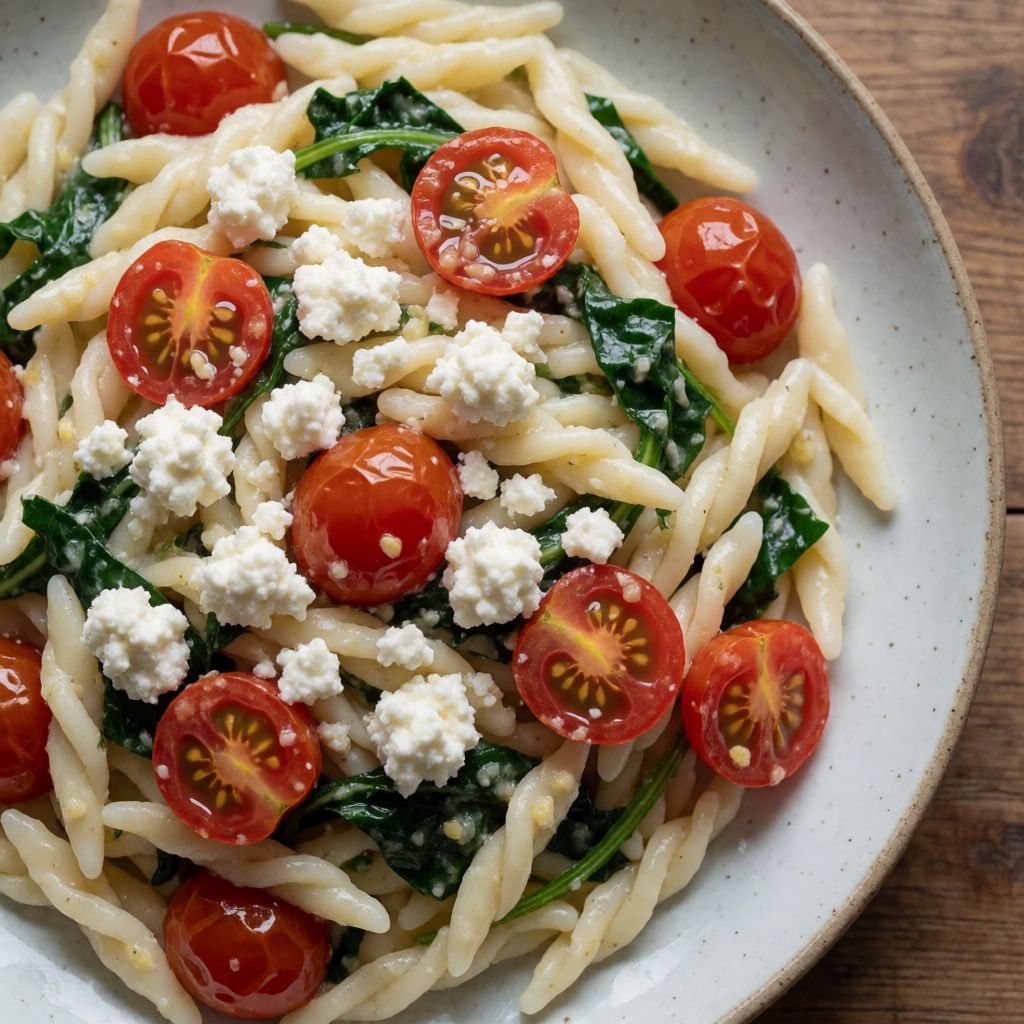
 AI photo
Trofie with Cherry Tomatoes and Rocket
A simple pasta dish with trofie, sweet cherry tomatoes, peppery rocket and ricotta salata.
Labels are worked out automatically from the ingredients and can be wrong. Check the packaging if it matters to you.
Ingredients
- 500 g Trofie
- 150 g Cherry or baby plum tomatoes
- 1 bunch Rocket
- 150 g Ricotta salata or a mature hard cheese
- 2 clove Garlic
- Olive oil to taste
- Salt to taste
- Black pepper to taste
- Chilli flakes to taste






Steps
Wash the cherry or baby plum tomatoes and cut them in half.
In a pan, fry 2 crushed garlic cloves in olive oil, then add the tomatoes, salt, black pepper and a pinch of chilli flakes.
Cover with a lid and simmer over medium-high heat until a good sauce forms.
Meanwhile, cook the trofie in salted boiling water until tender.
Transfer the cooked trofie to the sauce, toss together, and stir in the rocket.
Spoon onto plates and finish with a few shavings of ricotta salata.
What was changed
Cherry or baby plum tomatoes because they are not commonly found in British shops.
This is a tomato sauce built entirely in one pan, with pasta and raw greens pulled into it at the last minute. The whole dish is really three small mechanisms stacked together: garlic giving its flavour to the oil, tomatoes breaking down into sauce under a lid, and rocket wilting in residual heat rather than being cooked. Get those three right and the rest — tossing, cheese on top — looks after itself.
What decides whether it works is the tomatoes. You want them to collapse, not dissolve: skins split, juice pools, the whole thing thickens just enough that it coats rather than floods. The lid matters here — it traps steam so the tomatoes soften from the inside as much as from the pan, instead of drying out on top while staying hard underneath. "A good sauce forms" is not a time, it's a look: the red deepens, the oil at the edges turns a shade more orange, and the tomatoes have given up their shape without turning to paste.
The second decision point is the rocket, and it's the one people get wrong because the instinct is to treat it like spinach — cook it down. Don't. It goes in off the heat, or on the lowest residual warmth the pan has left, just long enough to lose its stiffness. Rocket's peppery bite comes from compounds that break down with sustained heat; cook it properly and you get something limp and bitter instead of fresh and sharp. The whole point of adding it after the pasta, not with the tomatoes, is to keep that bite.
Trofie themselves are worth a word, because the shape isn't decorative. It's a Ligurian pasta, traditionally hand-rolled with no egg — flour, water, and the heel of someone's hand twisting each piece into a short spiral. That's peasant economics: egg was for things you sold, not things you fed your own family. The twist isn't fashion either — it gives the pasta a ridged, uneven surface that grips a thick sauce, which is why trofie is famous with pesto and works just as well here. If you can't find it, the criterion is simple: any short, twisted or ridged dried pasta — casarecce, gemelli, strozzapreti. A smooth strand shape like spaghetti will just slide the sauce off the fork instead of carrying it.
Cherry or baby plum tomatoes are chosen for the same reason bakers choose certain apples for pies — ratio. A small tomato has more skin and more concentrated sugar relative to its watery flesh than a big one, so it collapses into sauce faster and with more flavour, rather than needing a long simmer to cook off excess water. If the ones in front of you in a British supermarket in January taste of nothing — and they often do, out of season — don't fight it: a tin of good cherry tomatoes, or a spoon of tomato paste stirred in with them, will rescue the flavour the sun didn't put there.
Garlic goes in crushed, not minced, because the point is to flavour the oil, not to eat strands of garlic later. Crushing breaks more cell walls and releases more of the oil-soluble compounds that actually carry garlic flavour into the fat. Some say golden garlic means burnt garlic, and that garlic should go in last to avoid it — no. Garlic burns because of sugar and protein reactions that happen at a certain point regardless of when you add it; what matters is colour, not order. Pale gold, sweet. Dark brown, bitter, and no amount of tomato will cover that taste once it's there.
Ricotta salata is not the soft, spreadable ricotta sold in tubs here — it's the same cheese pressed, salted, and dried until it's firm enough to shave with a peeler. That distinction matters: fresh ricotta would simply melt into the sauce and disappear, doing nothing. If you can't find ricotta salata, the criterion is a dry, salty cheese that holds its shape in shavings rather than softening — pecorino romano is the closest relative, an aged hard cheese like a mature Lancashire or a well-aged Cheddar will do the job differently but honestly, just don't reach for anything soft or young.
For the oil, use one you'd happily eat raw and undiluted, because here it isn't hiding behind much — it's the base the garlic flavours and the thing that coats every strand of pasta at the end. Rocket is rocket — wild rocket bites harder than the cultivated bags, so choose by how much pepper you want on the plate, not by any rule.
One more honest note on quantity: 500g of pasta for two people is a generous, almost Sunday-roast-sized portion — the usual Italian measure runs closer to 100g a head. Nothing wrong with it, just know you're either feeding two very hungry people or planning lunch for tomorrow, and plan your pan size accordingly — this needs a wide pan at home, not a deep pot, so the tomatoes have room to spread out and cook in a layer rather than steam in a heap.