
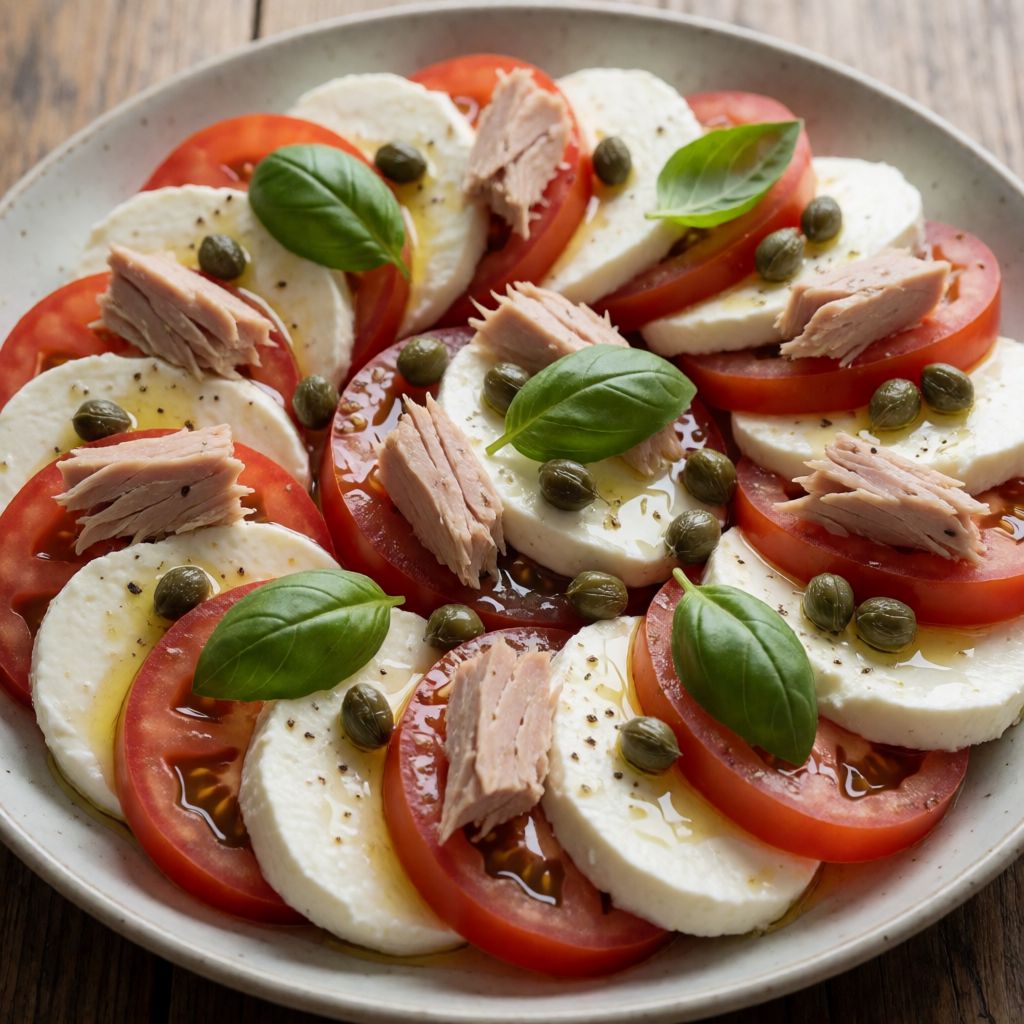
 AI photo
Caprese Salad with Tuna
A fresh Italian-style salad of tomato and mozzarella topped with tuna and capers, finished with olive oil.
Labels are worked out automatically from the ingredients and can be wrong. Check the packaging if it matters to you.
Ingredients
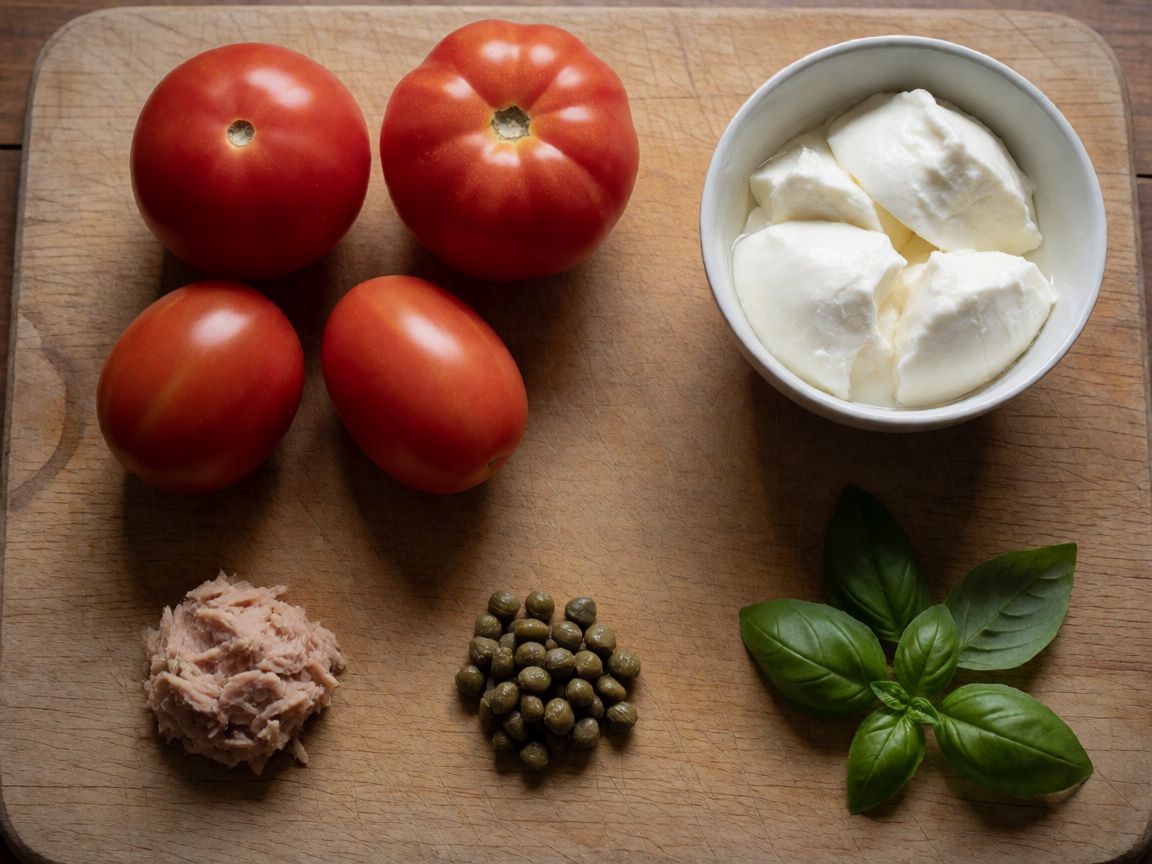
- 5-6 pcs Tomato
- 400 g Buffalo Mozzarella at room temperature
- 160 g Tuna in Olive Oil
- 2 tbsp Capers
- 3 tbsp Olive Oil
- Basil to taste
- Salt to taste
- Black Pepper to taste







Steps
Rinse the capers under cold water to remove excess salt, drain and finely chop.
Wash the fresh basil leaves thoroughly, then gently pat them dry with a clean towel or kitchen paper.
Wash the tomatoes, remove the stem, dry them and slice into rounds about 1 cm thick.
Take the mozzarella out of the fridge in advance and slice it into pieces about 1 cm thick.
25 minDrain excess oil from the tuna, mash it with a fork and mix with the chopped capers.
Arrange the tomato slices on a large plate, preferably without overlapping.
Place a slice of buffalo mozzarella on each tomato slice, then top with the tuna and caper mixture.
Season with salt and black pepper to taste, then garnish with basil leaves.
Drizzle with a thin stream of olive oil and let it rest in the fridge for at least 30 minutes.
30 minTake the dish out of the fridge 10 minutes before serving.
10 min
This is not cooking, it's construction. Nothing here gets heat, so nothing can hide behind heat — no browning to cover a tired tomato, no reduction to rescue a flat oil. What decides whether it works is decided before you touch a knife: the ripeness of the tomato, the true room temperature of the mozzarella, the freshness of the basil leaf. Four raw things sit on a plate and either taste of themselves or they don't.
Some say mozzarella is best straight from the fridge, cold and firm, easier to slice. No — because cold mozzarella is rubber with no voice. The fat that carries its flavour sets hard in the cold and won't release anything until it warms. That's why the recipe pulls it out ahead of time: not for safety, for flavour. Give it the twenty-five minutes.
And some say a salad like this should be eaten the second it's built, otherwise it "goes soft." No — the rest in the fridge is where the dish actually gets made. Salt pulls juice out of the tomato; that juice meets the olive oil already sitting there; together they become a thin dressing that never existed in any bottle, it only exists because you waited. Skip the thirty minutes and you have four stacked ingredients instead of a salad. Patience is the only cooking this dish gets.
The common fault — a watery, sliding plate — doesn't come from the tomato being too juicy. It comes from salting too early, before the layers are even built, or from not draining the oil off the tuna. Either way the plate floods before the flavours have had a chance to meet properly. Drain, assemble, salt last, then wait.
Tomato is the base and the one thing you can't fix with technique, so choose with your nose, not your eyes — a tomato that smells of nothing at the stalk end will taste of nothing on the plate, however red it is. British supermarkets sell plenty that are firm, uniform and flavourless; look instead for ones with a little give, a slight irregularity, the kind sold as vine-ripened or on-the-vine. If you're caught in the dead of winter with only the hard pale sort, you're better off with good tinned plum tomatoes, well drained and sliced thick — odd to say for a salad, but true: flavour beats freshness when freshness has none.
Buffalo mozzarella earns its place for its higher fat and moisture — it's wetter, richer, and that's what turns into dressing once it warms and meets the salt. If you can't get buffalo, use fior di latte, the cow's-milk fresh mozzarella, not the shrink-wrapped block sold for grating on pizza — that one is pressed dry on purpose, built to melt, not to be eaten cold and whole. The criterion is simple: it should still be sitting in its own whey when you buy it.
Tuna in olive oil isn't just protein here, it's a second seasoning — the oil it sits in is part of the dish's logic, so drain it but don't despise it; a spoon of it can go into the dressing instead of plain olive oil if you want the fish's flavour to carry further. Any oil-packed fish follows the same mechanism — mackerel or sardines in oil work the same way, just louder and oilier, good for a heartier version if tuna isn't to hand. Fish in water won't do the same job; there's no carried flavour, only dryness.
Capers are rinsed not because the caper is too salty to eat, but because you want to control the salt level of the whole dish yourself rather than let a jar decide it. Chopped, they turn from a garnish into a seasoning mixed right through the tuna. If you have none, the criterion is something small, sharp and salty — a chopped green olive gets you close, a diced pickled gherkin gets you the sharpness without quite the same punch.
Olive oil, unusually for a kitchen rule, is the one place you don't want something neutral. In frying you'd reach for any oil with no smell of its own; here, raw and uncooked, the oil's own character is the point — use one with actual olive flavour, because it isn't being asked to carry heat, it's being asked to taste of something on its own.
Basil has to be fresh — dried basil tastes of hay, fine once it's been simmered into a sauce for twenty minutes, useless raw on a cold plate. Pat the leaves dry properly; water clinging to a basil leaf dilutes the first thing people taste when they bite into it.
This feeds four as a starter — plan it before a Sunday roast rather than after one, since it wants a clear fridge shelf and a bit of patience before the main event, not after a long oven has taken over your kitchen's attention. An ordinary dinner plate does the job; nothing here asks for anything grander.