
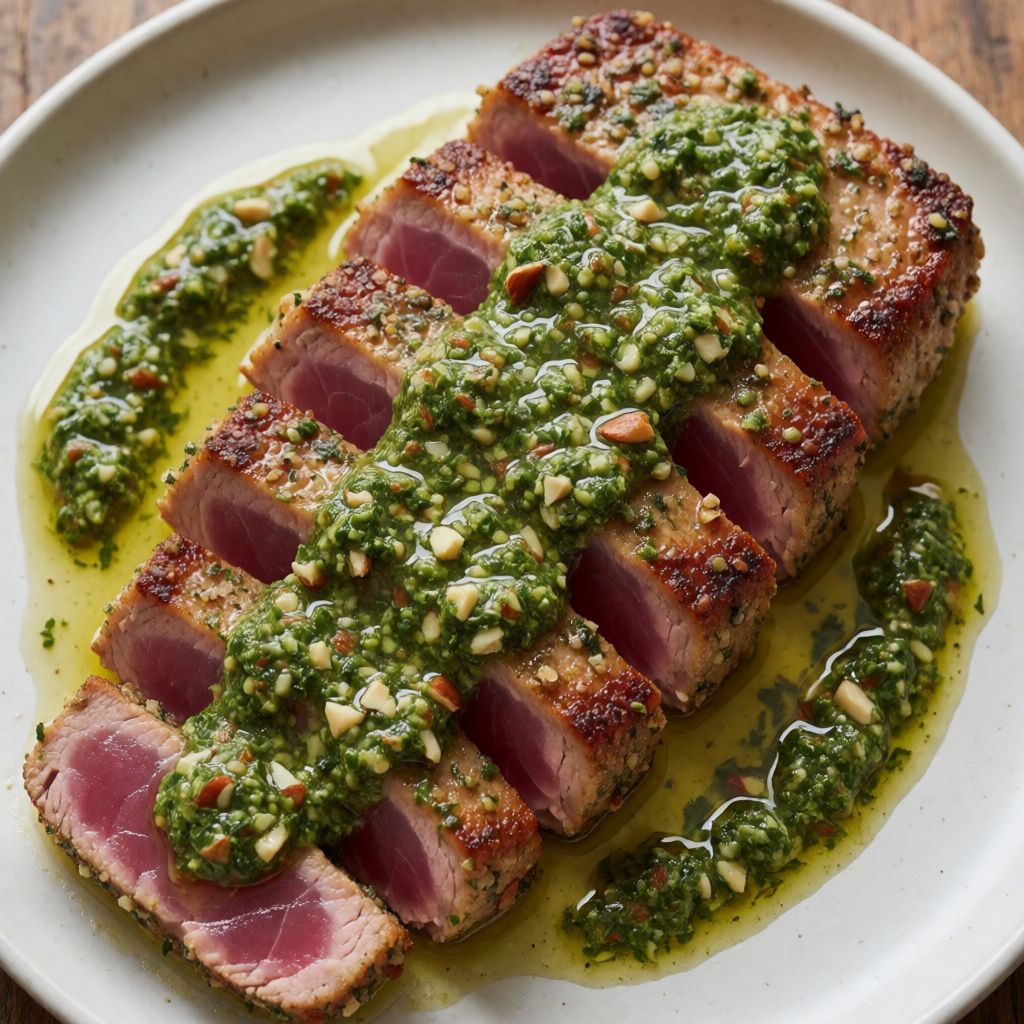
 AI photo
Tuna Fillet with Mint Pesto
Seared tuna fillet served with a quick mint and parsley pesto.
Labels are worked out automatically from the ingredients and can be wrong. Check the packaging if it matters to you.
Ingredients
- 800 g Tuna fillet
- Mint to taste
- 1 bunch Parsley
- 50 g Almonds
- 7 tbsp Olive oil
- 1 tbsp Apple cider vinegar
- 1 pinch Salt







Steps
Blend the washed and dried mint and parsley in a blender. Add the almonds, salt, olive oil and apple cider vinegar, and blitz until smooth to make the pesto.
Lightly salt the tuna fillet, heat a large non-stick frying pan and sear the tuna for 2 minutes on each side. It is ready when the thickest part reaches 63°C.
10 minWrap the tuna in foil and let it rest.
5 minSlice into pieces about a finger's width thick and serve with the mint pesto.
This is two temperatures sharing one plate: a fillet seared hard and fast, and a sauce that never sees heat at all. The pesto is made cold on purpose — herbs and oil whipped raw so the chlorophyll stays bright green and the oil keeps its own smell instead of turning into something stewed and flat. Put the two together and you get a contrast, not a blend: hot crust, cool green, rare-to-medium fish in the middle.
What decides whether it works is restraint at the pan. Tuna is a steak that happens to swim. Treat it like chicken — cook it through, turn it twice, poke it to check — and you get the dry, stringy result people associate with tins. The whole point of searing hard on the outside is that the heat has only seconds to travel inward before you pull it off; two minutes a side is a floor, not a clock to watch — what you're after is a crust that's gone from red-raw to brown and slightly crisp, while the core stays rosy. If you have a probe, 63°C is the line where the muscle fibres have just firmed up and are still holding their juice — push past that and the proteins start wringing themselves dry, which is the actual reason overcooked tuna turns pale and chalky, not some flaw in the fish itself.
Some say pesto has to mean basil, pine nuts, parmesan, or it isn't pesto at all. No — pesto is a method, not a fixed guest list: crush something green and leafy, bind it with a fat, sharpen it with acid, give it body with a nut. Mint and parsley instead of basil, almonds instead of pine nuts — same logic, different voice. Nothing here is a betrayal of anything.
Start with the fish, because it carries the whole dish. You want a thick fillet, ideally cut from the loin, with a tight grain and no connective lines running through it — those lines are what makes tuna fall apart into flakes under heat, which you don't want here since you're slicing it like a roast. If tuna isn't to hand or the price is wrong that week, any firm-fleshed fish that can be seared and left pink in the middle works on the same principle — swordfish, or a thick salmon fillet, though salmon's fat will behave differently at the edge of the pan.
Mint and parsley together do a job basil alone wouldn't: parsley brings a clean, slightly mineral base, mint cuts through the richness of the seared fish rather than just sitting next to it. Use a full bunch of parsley against mint "to taste" because mint is loud and uneven — some bunches taste of toothpaste, some barely register — so taste as you blend rather than trusting a fixed ratio.
The almonds aren't decoration, they're structure. A nut in a pesto does two things: it gives the sauce body so it clings to the fish instead of running off it, and its own fat helps the oil emulsify into something creamy rather than a thin green vinaigrette. Blanched, skinless almonds give the mildest flavour and the smoothest colour; with the skin on you'll get a slightly bitter, speckled result, which isn't wrong, just a different pesto. Any raw, unsalted nut with enough fat in it can stand in — cashews, walnuts, pine nuts if you've got deep pockets that week.
Olive oil here is doing the opposite of a neutral carrier — you want one with a smell of its own, because that smell is most of the pesto's flavour once it's raw and uncooked. Save your cheap, flavourless oil for frying something else; here it's the main voice, so buy the better bottle if you can. The apple cider vinegar's job is small but real: a little acid keeps the herbs tasting fresh rather than flat and greasy, and it slows the dulling, brownish oxidation that raw green herbs start the moment they're blitzed. Lemon juice does the same job if that's what's in the cupboard.
A non-stick pan matters more than it sounds — tuna's flesh is soft enough to tear on a surface that grips it, and a torn crust means the juices escape exactly where you need them sealed. Get the pan properly hot before the fish goes in — a drop of water should hiss and vanish, not sit there boiling gently — because the crust only forms if the surface protein cooks and browns fast, before the heat has time to crawl into the centre. A weak domestic ring struggling to get a wide pan properly hot is the most common reason people end up with grey, boiled-looking tuna rather than a crust: the fish just sits there losing moisture slowly instead of searing.
Wrapping the fillet in foil to rest afterwards is the same mechanic as resting a Sunday roast, just shorter — the heat trapped at the surface keeps travelling inward for a few minutes after the pan, evening out the colour from edge to centre, and the muscle relaxes enough to hold its juice when you cut it rather than letting it pool out onto the board. Skip this step and you'll see it immediately: a tuna steak sliced too soon bleeds its own juice all over the plate instead of keeping it. Five minutes is the low end — if your kitchen is cold, give it a minute or two more, foil holds heat but it isn't an oven.