
 AI photo
Twisted Cardamom Doughnuts (Klejner)
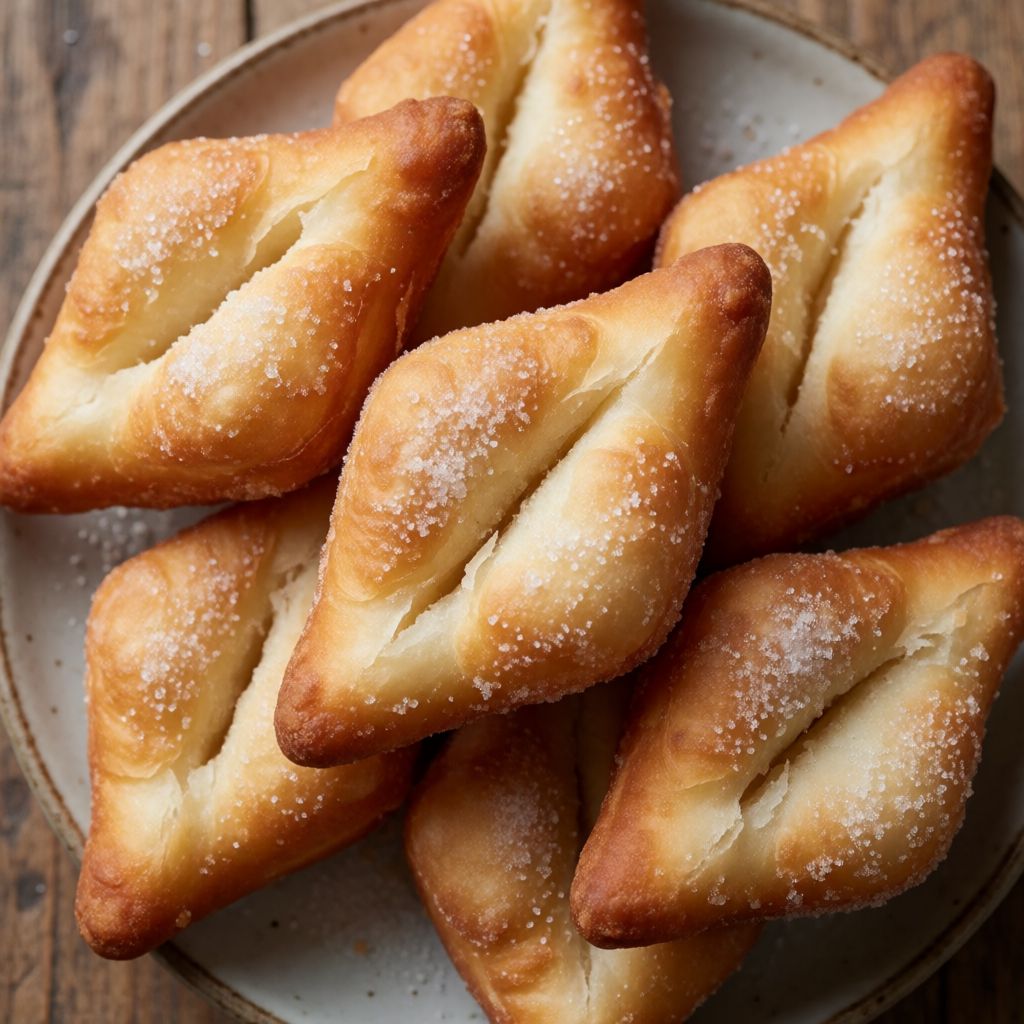
Crisp, lightly spiced fried pastry twists, each one slit in the middle and pulled through itself before frying.
Labels are worked out automatically from the ingredients and can be wrong. Check the packaging if it matters to you.
Ingredients
- 75 g Butter
- 90 g Caster sugar
- 25 g Double cream
- 1 pinch Vanilla powder
- 0.5 tsp Cardamom
- 1 pinch Salt
- 0.5 pcs Lemon 1 tsp juice and 1 tsp finely grated zest
- 1 pcs Eggs
- 0.5 tsp Baking powder raising agent
- 250 g Plain flour
- 1 l Vegetable oil
- 2 tbsp Plain flour for dusting











Steps
Beat together the butter, sugar, cream, vanilla powder, cardamom, salt and grated lemon zest in a bowl, then beat in the egg.
In a small bowl, dissolve the baking powder in the lemon juice and combine with the dough mixture.
Gradually work in the flour and knead the dough well.
Put the dough in the fridge in a clean, covered bowl.
60 minRoll out the dough on a floured surface into a rectangle about 40×25 cm.
Cut the dough into elongated diamond shapes about 8-10 cm long. Make a small slit in the middle of each one and pull one end halfway through the slit.
Heat the oil in a pan to 170°C.
5 minFry the doughnuts in small batches in the hot oil for about a minute until light golden brown.
1 minLift the hot doughnuts out with a slotted spoon and let them drain on a paper towel.
What was changed
Hartshorn salt is not sold in British shops, so Baking powder was used instead, as it gives the same raising effect.
Klejner are the Scandinavian branch of a family of fried, twisted biscuit-doughnuts that turns up all over Europe wherever people deep-fried dough for a feast day and called it a sweet. The twist in the middle isn't decoration — it's structural. A flat diamond of dough dropped in oil puffs unevenly and curls like a crisp; pulling one pointed end through a slit in the centre locks the shape so it fries evenly on both faces and holds its form instead of flopping. That's the whole trick of the shape, and it costs nothing but a kitchen knife.
What decides whether these work is the oil temperature, not the dough. Too cool and the dough sits there soaking up fat before it sets a crust — you get a pale, greasy, heavy biscuit. Too hot and the outside seizes and browns before the inside has cooked through, so you bite into raw flour. 170°C is the number where the crust sets in seconds and the inside still has time to cook before the outside burns — fast enough to seal, slow enough to finish. On a domestic hob without a thermometer, judge it by a dropped cube of bread: it should turn gold in about 15 seconds, no faster.
The other thing that decides success happens before any frying: the hour in the fridge. Cold butter and a rested dough mean the gluten relaxes and the fat firms up, so when you roll it thin it doesn't shrink back on you or tear at the slit. Skip the chilling and you'll be wrestling elastic dough that springs back every time you try to cut it — not a flavour problem, a handling one.
Butter here is doing a flavour job, not a structural one — it's a biscuit dough, not a bread dough, so you want it soft enough to beat smoothly into the sugar but still properly cold going into the fridge rest. Don't melt it to save time; melted butter gives you a greasy, flat dough instead of one with any short, crisp bite.
Cardamom and lemon zest are the two flavours that actually define klejner against every other fried twist — leave either out and you've made a generic doughnut. Cardamom loses its punch fast once ground, so buy pods and crush the seeds yourself if you can; tinned ground cardamom a year old will taste of not much. Vanilla powder is there for roundness, not for show — a short scrape of vanilla seeds or even a few drops of good extract added with the egg does the same job; don't go hunting for the powder specifically.
The egg and the cream are your binders — egg for structure, cream for a slightly tender crumb instead of a hard biscuit snap. If you're out of double cream, any cream with real fat content works; thin milk won't, the dough will be too wet and sticky to roll.
Baking powder dissolved in lemon juice isn't fussiness — it's making sure the raising agent is evenly distributed through a stiff dough before it ever meets flour, so you don't get one doughnut that puffs and its neighbour that stays flat because all the baking powder clumped in one corner. The lemon juice itself gives a little acid lift against the richness of the butter and cream; if you've no lemon, a splash of any sharp citrus juice stands in, though the zest is harder to replace — zest is where the real perfume lives.
Plain flour, not strong bread flour: you don't want gluten development here, you want a dough that rolls out and cuts cleanly without snapping back. The extra two tablespoons for dusting are just there to stop the rolled sheet sticking to your worktop and the knife — don't work it into the actual dough or you'll toughen it.
On vegetable oil: the only real criterion is that it has no flavour of its own and can take 170°C without smoking or breaking down — sunflower, rapeseed, or a plain vegetable oil off a UK supermarket shelf all do the job. A litre looks like a lot for forty small doughnuts, but that's the nature of frying in a domestic wide pan rather than a proper fryer or kazan: you need enough depth that the oil temperature doesn't crash the moment you drop cold dough in, and enough surface area that it's actually worth heating up. Skimping on the oil is the quiet cause of soggy, under-fried batches more often than people realise — not a flaw in the recipe, a flaw in trying to fry in a thin puddle.
Some say you need a deep-fat fryer with a thermostat to get this right — no, because a wide pan with enough oil depth and a bit of attention to the bread-cube test gets you the same 170°C, just with you doing the watching instead of a dial. That watching is the patience this recipe actually asks for: the hour of chilling, the small batches, the minute per side. None of it is hard. All of it needs you not to rush it.