
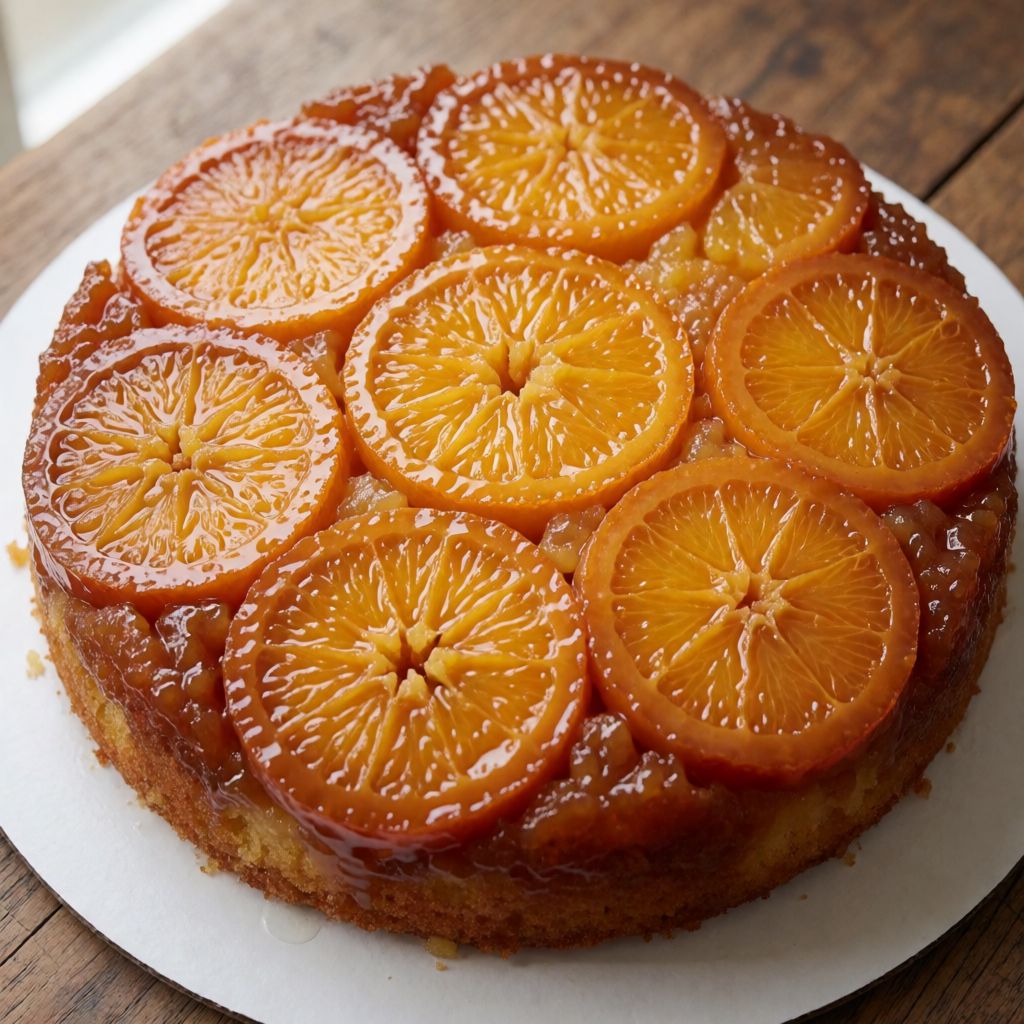
 AI photo
Upside-Down Orange Cake
A moist orange cake baked with caramelised orange slices on the base, then turned out so they form a glossy topping.
Labels are worked out automatically from the ingredients and can be wrong. Check the packaging if it matters to you.
Ingredients
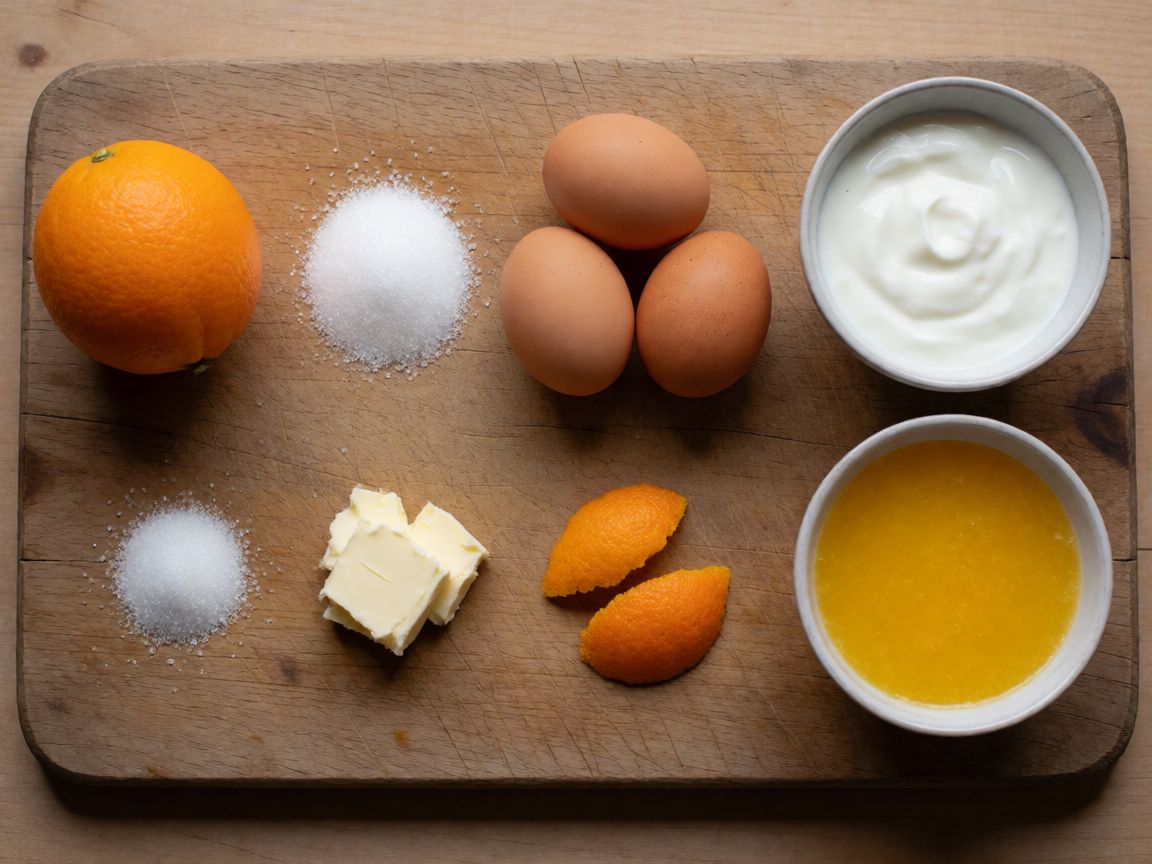
- 1 pcs Orange
- 130 g Caster sugar
- 50 ml Water
- 3 pcs Eggs
- 180 g Caster sugar
- 100 g Butter softened
- 125 ml Yogurt
- 80 g Orange juice
- 2 pcs Zest of 2 oranges
- 300 g Plain flour sifted
- 16 g Baking powder
- 1 pinch Icing sugar for dusting









Steps
Slice the orange into thin rounds, about 3 mm thick, peeling first if you like.
In a pan, mix 130 g caster sugar with the water and melt over medium heat into a syrup.
Add the orange slices and caramelise them, turning often with tongs, until the sugar starts to darken.
Arrange the slices over the base of a tin buttered and lined with baking paper.
In a large bowl combine the eggs and 180 g caster sugar; beat with a mixer until pale and creamy.
Add the softened butter, beating continuously.
Pour in the yogurt and orange juice, and flavour with the orange zest.
Gradually fold in the sifted flour and baking powder, mixing the batter well.
Pour the batter into the tin over the orange slices, smoothing gently with a spatula.
Bake on the fan setting at 170°C for 45–50 minutes.
50 minAlternatively, bake in a conventional oven at 180°C for 50–55 minutes.
Let the cake cool slightly, then carefully turn it out of the tin onto a serving plate.
Peel off the baking paper and dust with icing sugar.
This is a tarte tatin trick borrowed by a sponge cake: you caramelise fruit first, lay it in the tin, then drown it in batter and bake the whole thing upside down. When you flip it out, the caramel becomes the glaze on top instead of a layer you have to make separately. It's an old bit of kitchen economy — why build two things when the oven can build one for you.
What decides whether it works is the caramel on the orange slices, and that's a question of colour, not a clock. The sugar and water melt into a clear syrup, then the bubbles slow down and thicken, then the colour shifts from gold toward amber — stop near the amber, because a few seconds later it tips into bitter, and bitter caramel can't be fixed, only started again. Too pale and you get a wet, sliding layer that never sets; too dark and the topping tastes of smoke, not orange.
The second thing that decides it is the moment you turn the cake out. Do it too soon, while it's still hot through, and the sponge is too soft to hold its own weight — it'll tear and the oranges will slide. Wait until it's stone cold and the caramel has set hard against the paper like glue, gripping on for dear life — you'll fight the tin and lose half the topping to it. You want the middle ground: cake warm enough to still give a little, caramel cool enough to have firmed but not locked.
Start with the orange itself. You want one with reasonably thin skin — a navel or a blood orange works, not something waxed to a shine, because that wax coating can leave a faint off-taste when you cook the peel in sugar. Slice it thin and even, about the thickness of a pound coin, so the caramel soaks through evenly and no slice stays raw-tasting in the middle while its neighbour goes dark.
There are two separate batches of caster sugar here, and they're doing two different jobs, which is why you don't just dump it all in one bowl. The 130g melted with water becomes caramel — a simple syrup pushed past the point of just dissolving, into browning. Caster sugar is the right choice for this because it dissolves fast and evenly; granulated sugar, with its bigger crystals, is more likely to leave undissolved bits that scorch unevenly while the rest of the syrup is still clear. The 180g beaten into the eggs is doing something completely different — it's there to trap air. Beating eggs and sugar until pale and creamy isn't decoration, it's construction: every minute of beating folds thousands of tiny air bubbles into the mixture, and those bubbles are what gives the sponge its lift later, alongside the baking powder. Skip that beating stage or rush it, and you get a dense, close-textured cake no matter how much raising agent you throw at it.
Butter goes in softened, not melted, and that distinction matters more than it sounds. Soft butter beaten into an already-aerated egg mixture stays as tiny fat droplets suspended through the batter — an emulsion. Melted butter is a liquid, and a liquid added at this stage collapses the air you just worked to build in. If your butter's too firm, don't microwave it; leave it out of the fridge an hour, or grate it, so it softens without turning to liquid fat.
The yogurt and orange juice bring acidity and moisture together, and the acidity isn't incidental — it's there to react with the baking powder and push the rise along, which is also why this recipe uses a generous 16g of baking powder for 300g of flour: a batter this wet and heavy, loaded with yogurt, butter, and a layer of fruit syrup underneath, needs more lifting power than a plain sponge to stay light rather than sinking into a dense, damp crumb. If you have no yogurt, any soured, thick fermented dairy with real acidity — buttermilk, or soured cream loosened slightly — does the same job; sweet single cream will not, because it brings none of that acid reaction.
Zest carries flavour that juice can't. The aromatic oils that smell like orange live in the skin, not the flesh, which is why you zest two oranges separately rather than relying on the juice alone to flavour the crumb — juice gives you sourness and moisture, zest gives you the actual orange smell. Grate it finely and only the coloured skin, avoiding the white pith underneath, which is bitter and adds nothing you want.
Flour goes in sifted and folded gradually rather than all at once and beaten hard — the point of that caution is gluten. Flour develops gluten strands the more it's worked once it's wet, and strong gluten is exactly what you don't want in a tender sponge; it's what you do want in bread. Fold gently, in stages, just until no dry flour shows, and you keep the crumb soft. In an ordinary flat kitchen, a loose-bottomed springform tin is tempting because it's what most people own, but caramel is a liquid before it sets, and a loose base will let it seep out under the oven's heat — go for a solid-based cake tin, well buttered and lined, and you won't be mopping burnt sugar off your oven floor. The fan-oven temperature in this recipe runs ten degrees cooler than conventional for a reason worth knowing in general: moving air transfers heat faster, so a fan oven at the same actual temperature as a still one will cook harder and faster — the ten-degree drop is there to bring the two into line, not a random fiddle.