
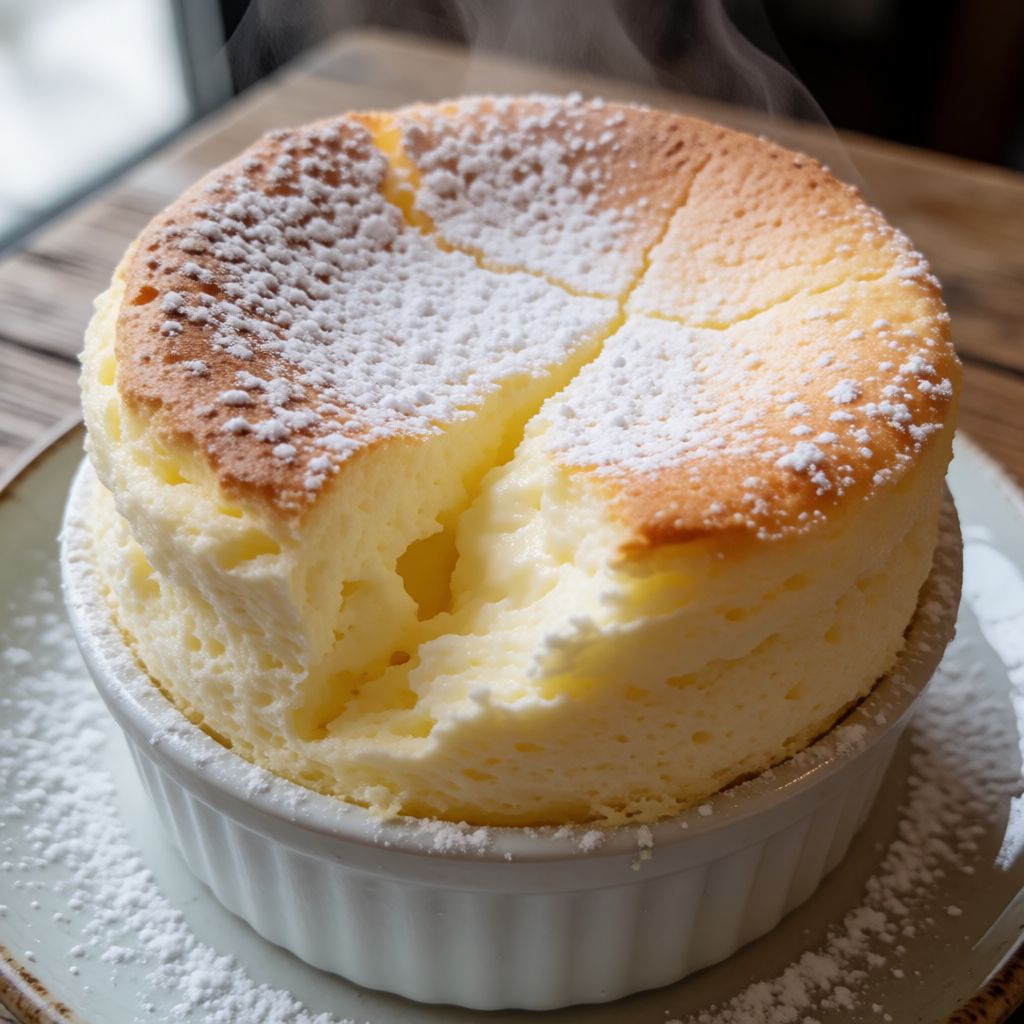
 AI photo
Vanilla Soufflé
A light and airy vanilla soufflé, baked until golden and dusted with icing sugar.
Labels are worked out automatically from the ingredients and can be wrong. Check the packaging if it matters to you.
Ingredients
- 500 ml Milk
- 130 g Caster Sugar
- 75 g Caster Sugar for the ramekins
- 160 g Butter
- 130 g Plain Flour
- 6 pcs Egg Yolks
- 1 tsp Vanilla Extract
- 1 pcs Lemon Zest zest of 1 lemon
- Icing Sugar to taste, for dusting








Steps
In a saucepan, mix the milk with 130g of the caster sugar and bring to the boil.
In a separate pan, melt the butter, add the flour and cook for a few minutes.
Gradually pour in the hot milk, stirring constantly, and cook until the mixture thickens.
Let the custard cool slightly, then stir in the egg yolks and vanilla extract.
Add the lemon zest to the mixture and stir until smooth.
Grease individual ramekins with butter and dust with the remaining 75g of caster sugar.
Using a teaspoon, fill the ramekins with the mixture.
Bake the soufflés in an oven preheated to 180°C for about 25 minutes.
25 minLet the soufflés cool slightly, then dust with icing sugar before serving.
What was changed
Vanillin was swapped for Vanilla Extract, which is more widely available in UK kitchens.
Call this what it is first, because the name misleads: a soufflé, in the classic sense, rises because you whip egg whites into foam and fold them in gently, trapping air that expands in the oven. There is no egg white here — only six yolks. So this is a baked custard, thickened by a roux, that puffs because steam trying to escape a set custard has nowhere else to go but up. It climbs less dramatically than a true soufflé and it is far more forgiving, which is exactly why a home cook should like it.
The whole mechanism hangs on three moments of heat control, not three steps to tick off. First, butter and flour cooked together until the raw-flour smell disappears — this is a roux, and if you skip the cooking, the finished custard will taste of wallpaper paste, not vanilla. Second, hot milk poured in gradually, stirring, so the starch swells evenly instead of seizing into lumps around a few lucky grains of flour. Third, the custard cooled before the yolks go in — pour yolks into something still boiling and you get sweet scrambled egg, not custard, because yolk proteins set hard well before 100°C.
The sugar dusted inside the ramekins is not decoration. It gives the rising custard something to grip as it climbs the sides — smooth butter alone is too slippery, the mixture would just slide back down. That sugar caramelises faintly in the oven too, so the outer wall of each soufflé has a thin crust against a soft inside, which is the actual pleasure of eating one.
Milk and the first portion of sugar go in together and come to the boil as one liquid — this is just dissolving the sugar fully before it meets starch, because sugar crystals sitting undissolved inside a thickened custard show up later as grit on the tongue. Whole milk is normal here; if you only have semi-skimmed, the custard will be a touch thinner and less rich, not a disaster, just a different soufflé.
Butter does two jobs and needs two different qualities. In the roux, you want it simply for fat — any unsalted butter works, and margarine will technically melt and thicken too, but it brings a flatness that has no business near vanilla. For greasing the ramekins, you want butter soft enough to coat evenly without tearing the sugar layer you dust on top of it; cold butter scraped on thin leaves bald patches where the custard will stick and tear on the way out.
Flour is the whole structural engine. Plain flour gives a custard with body but still some give — cornflour, if that's all you have, thickens faster and sets firmer, closer to a milk pudding than a soufflé, because it lacks the gluten proteins that give the structure some stretch. Either way, the flour must be cooked in fat before the milk arrives, which is the only real defence against a lumpy, pasty custard — skipping that step is the single most common reason this dish fails.
Six egg yolks are doing the work that whipped whites do in a classic soufflé, minus the air: they thicken further, they carry fat-soluble flavour, and they give the custard its pale gold colour and silk. Don't throw out the whites — meringue, a glaze for the Sunday roast, scrambled with the leftovers, anything; wasting them is the one genuinely needless cost in this recipe.
Vanilla extract and lemon zest are not interchangeable but they do work together: vanilla gives warmth, zest gives a clean edge that stops the butter and yolks from sitting too heavy on the tongue. No extract — split a vanilla pod and infuse it in the hot milk instead, it's stronger and nothing is lost. No lemon — an orange zest does the same cutting job with a softer character.
Caster sugar, not granulated, for the ramekins and the custard both — the smaller crystal dissolves faster in the milk and sits finer against the ramekin wall, so the crust it forms in the oven is a crust and not a scatter of hard specks. Icing sugar at the end is pure finishing, dust it only once the soufflés are out of the oven and the violent heat has passed, because sugar that fine will simply melt and vanish if it lands while they're still roaring hot — a small point, but it's the difference between a dusting you can see and one you can't.