
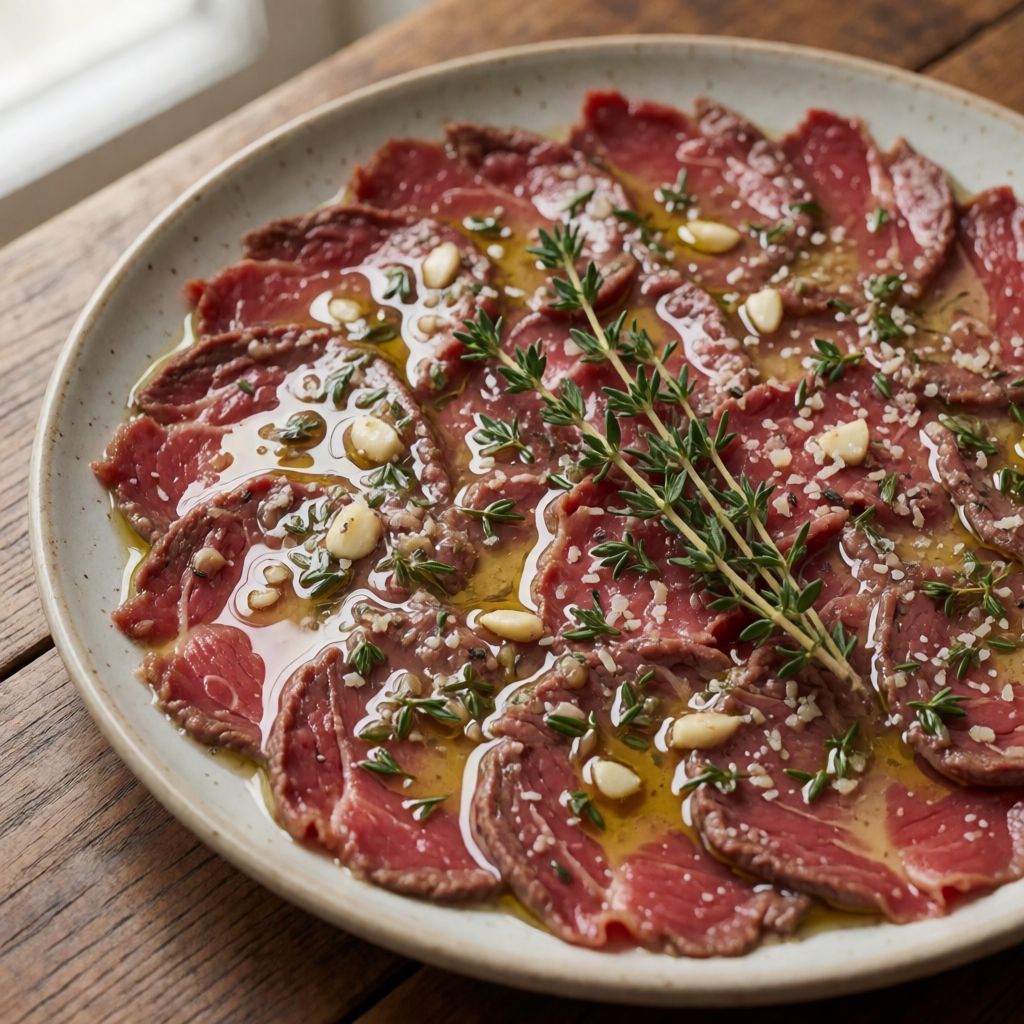
 AI photo
Piedmontese Veal Carpaccio
A simple Piedmontese-style raw veal dish dressed with garlic, lemon juice, olive oil, and shaved Parmesan.
Labels are worked out automatically from the ingredients and can be wrong. Check the packaging if it matters to you.
Ingredients
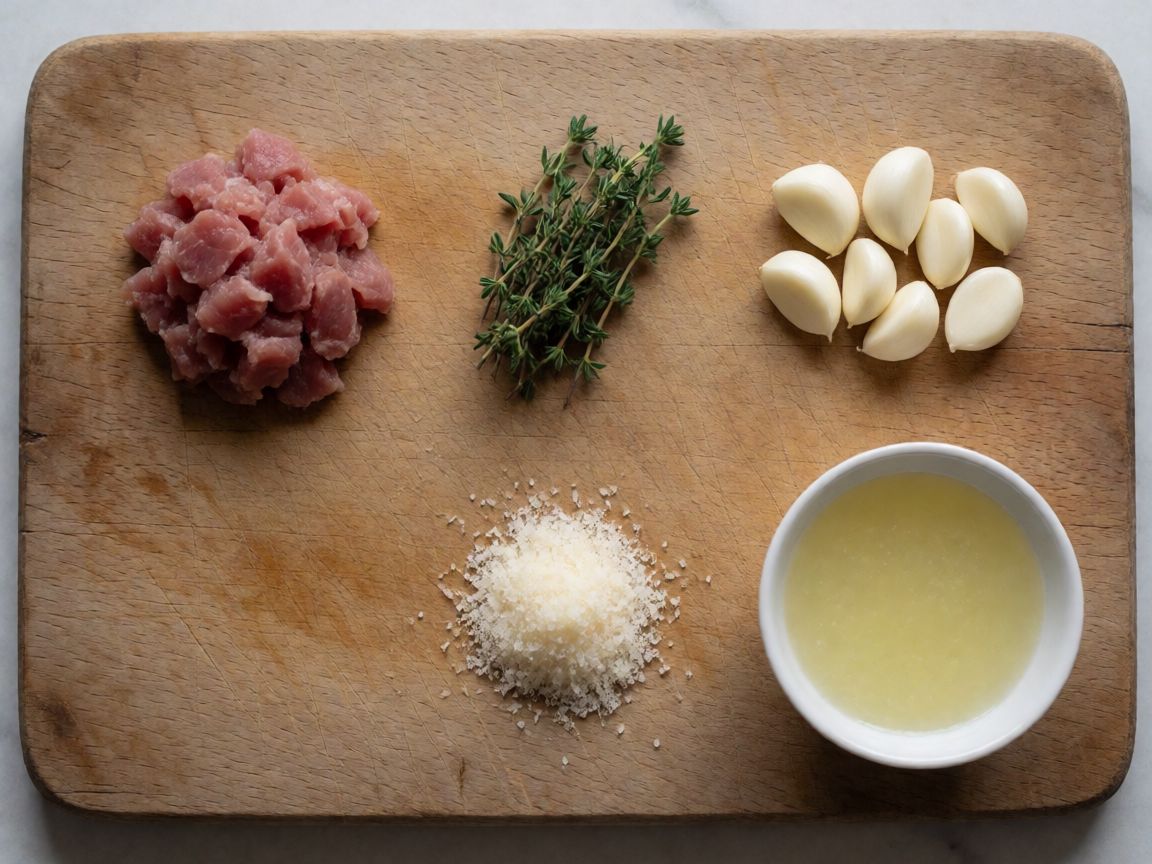
- 500 g Veal
- 1 bunch Thyme a few sprigs
- 6 clove Garlic
- 3 tbsp Olive oil
- 50 g Parmesan shaved
- 2 tbsp Lemon juice
- 1 pinch Salt
- 1 pinch Black pepper







Steps
Trim the veal of any fat and connective tissue, then finely chop it with two knives on a board, as for a classic battuta, and place it in a bowl.
Crush the garlic cloves whole and add them to the meat in the bowl.
Add salt, black pepper, lemon juice, and olive oil, and mix well.
Remove the garlic cloves from the bowl and slice the Parmesan into thin shavings.
Arrange the meat on a plate using a cooking ring.
Sprinkle with a pinch of black pepper and garnish with a sprig of thyme and Parmesan shavings.
Serve immediately.
This is raw veal, finely knife-chopped, dressed with lemon, oil and garlic-scented fat, finished with parmesan shavings. There is no cooking step here — the whole dish is built on the idea that heat is unnecessary if the ingredients and the knife are doing their job properly. That's the mechanism: freshness plus mechanical fineness plus a short dose of acid, nothing more.
What decides whether it works has nothing to do with timing in the usual sense, because there's no fire to misjudge. It comes down to two things: how fresh and well-trimmed the meat is, and how cleanly you cut it. There's no oven to rescue a mistake later — whatever flaw goes into the bowl stays on the plate.
Some say carpaccio means paper-thin slices, pounded flat or run through a slicer, Venetian style. Not this one — no. This is Piedmont's own tradition, carne cruda, chopped by hand with two knives into something coarser, with real bite left in it. The name travelled from Venice in the 1950s, when a restaurateur there invented a sliced raw-beef dish and named it after the painter Carpaccio, because the red and white reminded him of the man's canvases. Piedmont had been eating raw meat with a knife long before that, under its own name — the two traditions got folded together later under one borrowed label.
Start with the veal itself. What you're buying for, really, is trust — a cut lean enough to have almost no fat or sinew running through it, from an animal young enough that the meat is naturally tender without any cooking to soften it. In Piedmont that's usually Fassona cattle, bred specifically for lean, fine-grained meat eaten this way. Veal is harder to find in a British shop than it used to be — welfare campaigns decades back pushed much of the trade toward beef instead, so the economics of your high street are different from Turin's. A well-trimmed piece of beef fillet from a butcher you'd happily eat raw at their counter is the honest substitute; it won't be quite as delicate, but it follows the same logic — buy for freshness and trust, not for the label on the cut.
Trimming matters more here than in almost any cooked dish, because there's no heat coming later to melt fat or break down connective tissue. Leave either in and it stays exactly as it is on the plate — waxy fat, rubbery sinew, no softening, ever. Do the trimming with the meat cold from the fridge, not at room temperature: cold fat holds its shape under the knife instead of smearing, and that's what lets the two-knife chop stay clean rather than turning everything to paste.
On chopping by hand rather than running it through a mincer or processor: a spinning blade heats as it works, however briefly, and that small heat bruises the meat and starts oxidising it before it even reaches the bowl — you'll see it as a dull grey tinge instead of the proper red. Two knives rocking across a board keep the temperature where it should be and leave a texture with actual structure to it, not a uniform mush.
The garlic goes in whole, just cracked open, not minced — you want its oil-soluble aroma to move gently into the olive oil and lemon while it sits, without the sharp raw bite that chopped garlic gives and that only cooking would normally mellow. Since no cooking is coming, the clove is pulled back out before serving. If you want even less presence, rub a cut clove around the inside of the bowl instead of dropping whole ones in.
Salt, pepper, lemon and oil go in together and get mixed through just before the meat is shaped and plated, because salt draws moisture and lemon firms the surface — between them they're quietly cooking the meat in their own slow way. Too much time between mixing and eating, and that process keeps going past the point you want, leaving the meat tired and damp instead of fresh. This is also why the quantities of lemon are modest: more acid doesn't mean more flavour, it means a shorter window before the texture turns.
For the parmesan, you want a piece aged enough to be hard and dry, so it shaves into clean curls rather than crumbling — pre-grated won't do this at all. Any well-aged hard cheese that holds together under a peeler works on the same principle; an aged pecorino will give you more bite if that's what you're after. The ring mould is there because loosely chopped meat has no structure of its own to hold a shape — pack it into the ring evenly, without rushing, or it collapses the moment you lift the ring away. No ring in the house is no disaster: a scone cutter, a bottomless tin, even a well-oiled glass pressed down firmly will do the same job.