
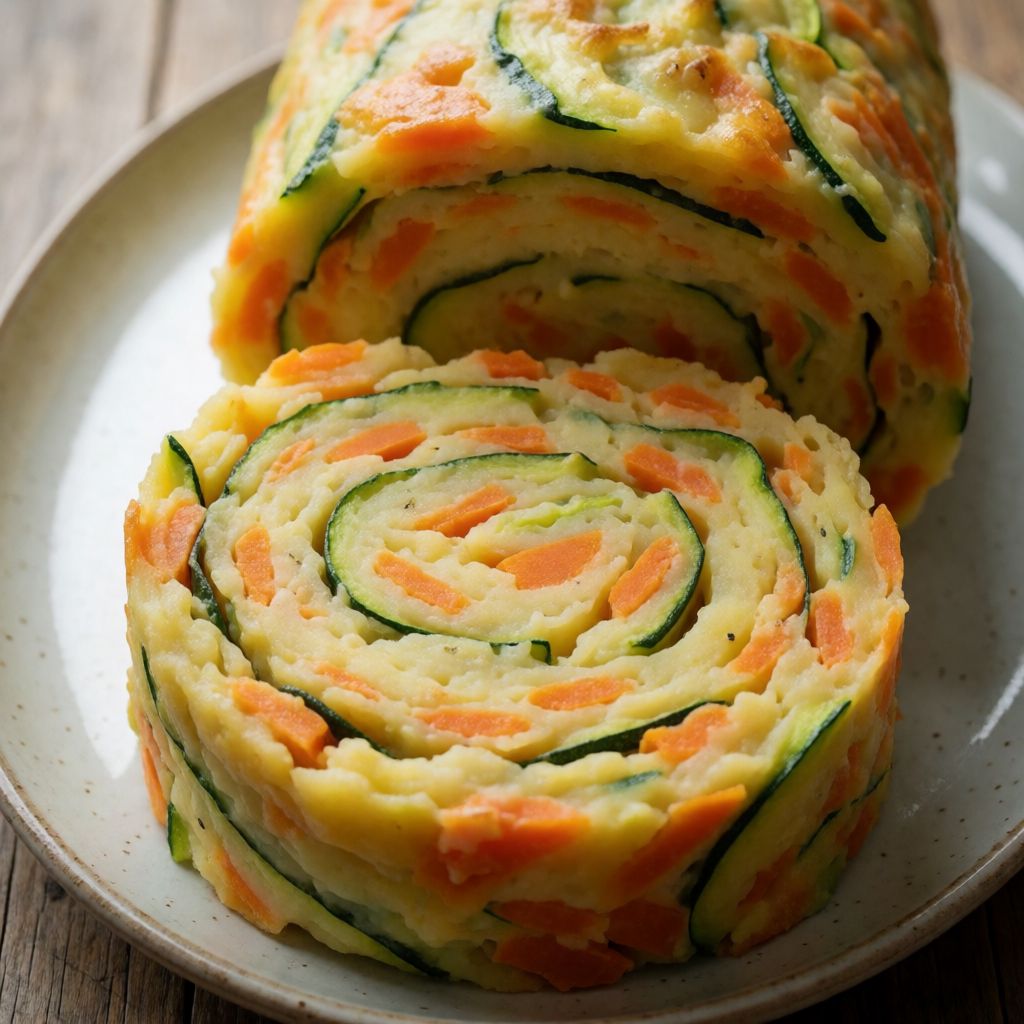
 AI photo
Vegetable Roulade
A savoury roulade of mashed potato and sautéed vegetables, rolled with cheese and baked until golden.
Labels are worked out automatically from the ingredients and can be wrong. Check the packaging if it matters to you.
Ingredients
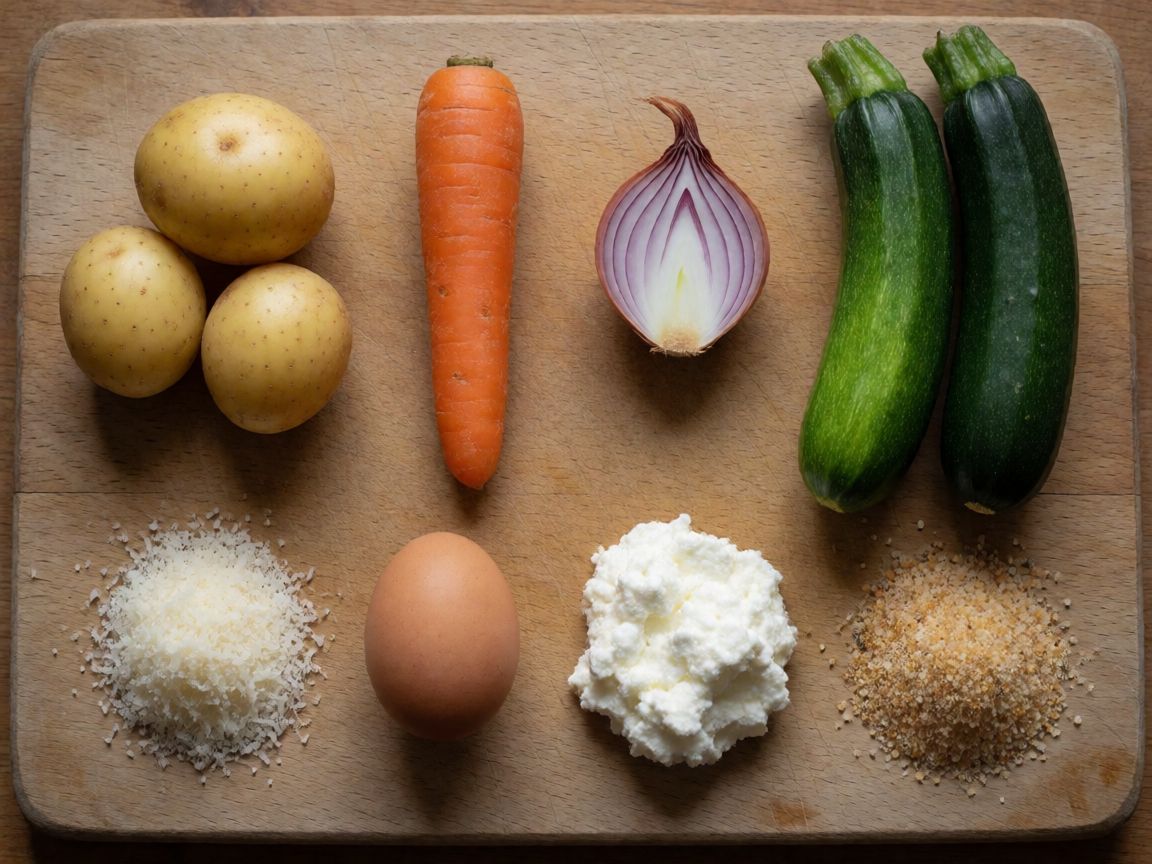











Steps
Boil the potatoes in salted water until tender.
23 minDice the carrot and courgette finely and sauté in a pan with olive oil and the chopped shallot, stirring occasionally.
15 minTransfer the vegetables to a blender and blitz until smooth.
Mash the potatoes, place in a large bowl, add the egg and season with salt, black pepper and nutmeg to taste.
Add the ricotta and mix well.
Stir in the Parmesan, the blended vegetables and the breadcrumbs, and mix thoroughly.
Transfer the mixture onto a sheet of baking parchment dusted with breadcrumbs, shape it into a cylinder, sprinkle the surface with breadcrumbs and drizzle with olive oil.
Roll the parchment up tightly and place the roulade into a loaf tin.
Bake in a preheated oven at 170°C fan or 180°C conventional.
42 min
This is mashed potato trying to be a terrine. Not a roulade in the French sense — nothing is rolled around a filling and sliced to show a spiral. The "roll" is a shaping trick: you use parchment to pack a loose, wet mash into a tight cylinder, because mash on its own has no spine and will just slump. Think of it as a vegetable-studded potato loaf that happens to be born in a tube of paper.
What decides whether it holds together, not how it tastes — the flavour is a given with Parmesan, nutmeg and ricotta in the mix, that part looks after itself. The real question is moisture. Potato, courgette and ricotta are all mostly water wearing a solid disguise. Breadcrumbs, egg and Parmesan are the only things in the bowl doing structural work. Get the ratio wrong and you don't get a roulade, you get a very polite potato soup in a loaf tin.
So the courgette sauté matters more than it looks. Courgette weeps water the moment it meets heat — that's not a flaw, that's the plant releasing cells it no longer needs intact. Sautéing it with the carrot before blitzing drives some of that water off as steam instead of leaving it to dilute your mash later. Skip this step, or rush it, and you're adding a vegetable purée that's secretly 90% liquid straight into a mixture that already can't afford it.
Potato is the base and the binder, and it's doing both jobs because starch, once it's been boiled and mashed, glues itself together as it cools — this is why the mash goes in warm but the shaping and baking firm it up rather than it setting like a jelly. Some say you must use a specific "mashing potato" variety or it falls apart. No — any potato that isn't deliberately waxy (new potatoes, salad potatoes) will mash and bind fine; waxy potatoes resist breaking down and leave lumps, which is a texture problem, not a structure one. A floury, all-purpose potato — Maris Piper, King Edward, the stuff already in most UK kitchens for a Sunday roast — is exactly right here, no detour needed.
Carrot and courgette are there for colour and a gentler, sweeter vegetable note against all that cheese and starch — the carrot also doesn't release nearly as much water as the courgette, so it's more of a passenger in this particular problem, just along for sweetness and colour. The shallot is a quieter onion: less sulphurous bite, so it melts into the sauté without announcing itself the way a big onion would in a dish that's meant to taste of potato and cheese first.
Ricotta and Parmesan split one job between them. Ricotta is wet, mild, soft — it loosens the mash and carries the nutmeg's warmth without fighting it. Parmesan is dry, salty, and full of glutamate — it's doing seasoning and, because it's a hard aged cheese with very little free water, it's quietly helping the mixture hold rather than loosen it further. If you've no Parmesan, any hard, dry, salty grating cheese works — the test isn't the name on the wedge, it's whether it grates into dry shards or slumps into a paste.
Breadcrumbs appear three times — in the mix, dusted on the parchment, sprinkled on the surface — and each one is solving a different leak. In the mix, they're mopping up excess moisture so the loaf sets rather than seeps. On the parchment, they stop the mash gluing itself to the paper, which otherwise tears the cylinder apart when you try to unwrap it after baking. On the surface, with the olive oil drizzled over, they're there to brown and crisp in the oven — bare mash under heat just dries and cracks, it doesn't colour nicely, so the crumb-and-oil layer gives it something to actually turn golden. Any dry crumb will do this job — dried bread, crushed crackers, even oats blitzed fine — the requirement is dryness, not identity.
The egg is the other binder, doing for protein what the breadcrumbs do for starch: as it cooks it sets solid and locks the structure, rather than relying on cooling alone to hold the shape. One egg for a kilo of potato plus all that cheese is a light hand — enough to help it set, not so much that it turns rubbery or tastes eggy.
On the oven: 170°C fan is simply the lower, gentler setting on a domestic fan oven, because fan ovens circulate air and cook faster and drier than they claim to — treat the dial number with suspicion and watch the loaf instead. Doneness here isn't a timer going off, it's the surface going from pale and damp-looking to golden and slightly crackled, and the loaf no longer wobbling like liquid when you nudge the tin. Give it the 42 minutes as a floor, not a finish line, and let your eyes have the final word.
Patience matters twice in this one — once while the sautéed vegetables cool a little before they meet the egg and ricotta, so you're not accidentally starting to cook the egg early, and once at the end, letting the roulade sit a few minutes in its tin before you unwrap and slice it, so the structure you worked for doesn't just slump back into mash the second you cut it.