
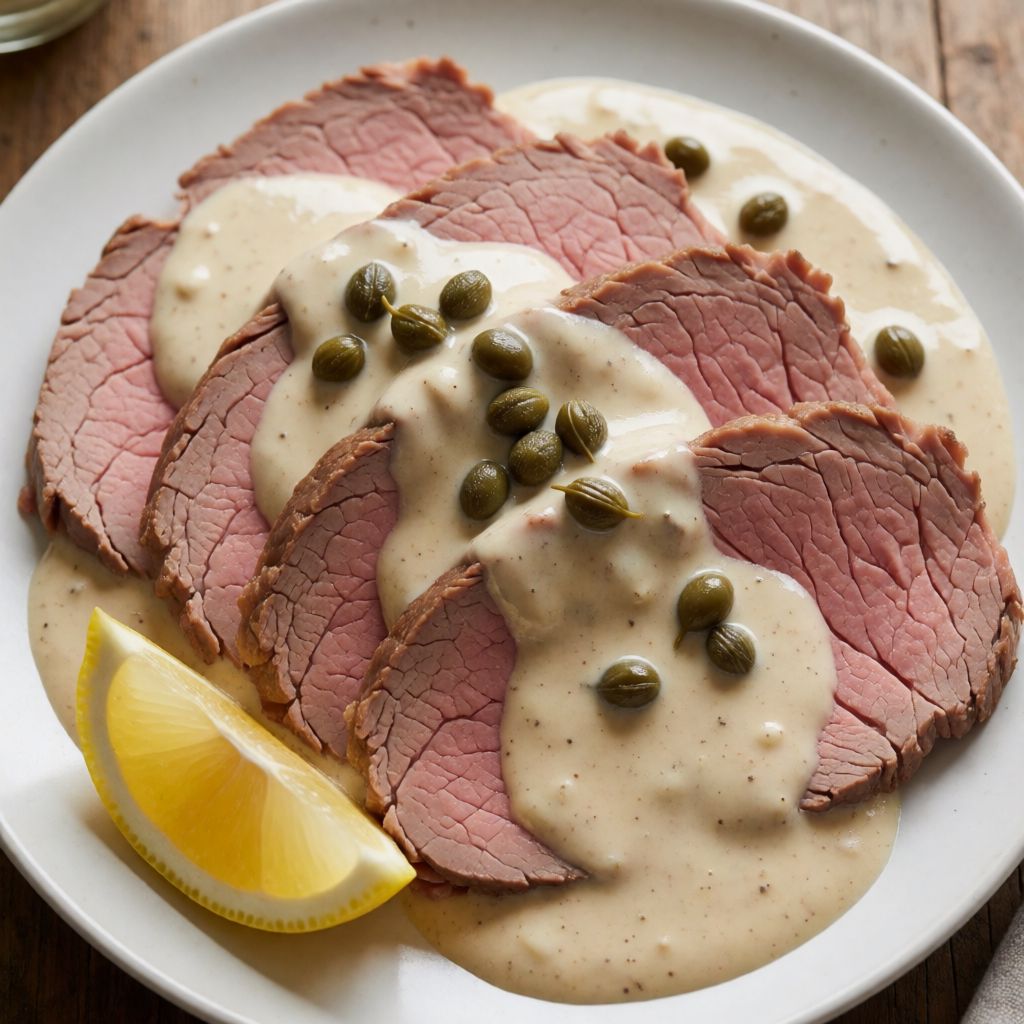
 AI photo
Vitello Tonnato
Thin slices of cold roast beef served with a creamy tuna sauce, salad and pesto.
Labels are worked out automatically from the ingredients and can be wrong. Check the packaging if it matters to you.
Ingredients
- 400 g Roast Beef cold, cooked, thinly sliced (rump)
- 2 can Tuna drained
- 100 ml Mayonnaise
- 100 ml Crème Fraîche
- 4 tbsp Capers
- ½ pcs Lemon juice only
- 100 ml Pesto
- 125 g Salad Mix
- ½ pcs Cucumber sliced
- 3 tbsp Caper Berries whole
- 1 tbsp Olive Oil
- Salt to taste
- Black Pepper freshly ground, to taste












Steps
Whisk together the tuna, mayonnaise, crème fraîche, capers, lemon juice, salt and pepper until smooth. Adjust the seasoning to taste.
Spread each slice of roast beef with the tuna sauce and roll it up, then drizzle with a little pesto thinned with olive oil.
Arrange on plates with the salad mix, cucumber, caper berries, the remaining tuna sauce and extra pesto.
Vitello tonnato is not a recipe you cook, it's a recipe you assemble in the right order from things that are already done. The name means "veal in tuna," and in Piedmont it was a Sunday dish — a thin cold slice of meat under a sauce that tastes of the sea, built to use what the house already had: the butcher's veal and the tin from the cupboard. Here the veal becomes roast beef, and that's not a shortcut, it's the same logic moved north. A Sunday roast that leaves cold slices behind is as ordinary in a British kitchen as a boiled veal joint was in a Piedmontese one the day after.
What decides whether this works is not heat — there's none here — but texture and balance. The meat has to be sliced thin enough to roll without splitting, and properly cold so it holds its shape against a wet sauce instead of going limp. The sauce has to be an emulsion that stays smooth: tuna broken down fine enough to disappear, mayonnaise and crème fraîche giving it body, lemon cutting through so it doesn't sit heavy and fishy on the tongue. Get either wrong — meat too thick, sauce too rich or too loose — and you get a stack of cold roast beef with tinned fish spooned on top, not the dish doing its actual job: coating, not drowning.
Roast beef: pick rump or another lean cut that's been rested properly and chilled through, not just cooled on the counter. Warm meat tears when you try to slice it paper-thin; cold meat, properly firm, slices clean. This is the patience part of the dish — do the roast the day before if you can, let it sit in the fridge overnight. A knife that's actually sharp matters more than any gadget; you haven't got a meat slicer in a flat kitchen, and you don't need one, you need ten quiet minutes and a cold joint.
Tuna, drained: drained because the oil or brine it came in would thin the sauce in the wrong direction and push the salt too far — the capers are already doing salt duty. Tuna in brine works if you prefer a leaner sauce, just taste before you add more salt anywhere else. The tuna's job is to flavour the sauce, not to be visible in it — whisk or blitz it fine enough that nobody's biting into a flake.
Mayonnaise and crème fraîche: this pairing is the mechanism of the sauce. Mayonnaise is already a stable emulsion — egg yolk holding oil and water together — and it carries the tuna without splitting. Crème fraîche loosens that mayonnaise-heaviness and brings its own sharp edge, so the sauce coats rather than sits like a dollop. If you've got neither to hand, the criterion is: something with fat and something with tang, whisked together — thick natural yoghurt and soured cream will do the same work, just taste and adjust the lemon accordingly, since yoghurt is often sharper than crème fraîche.
Capers and caper berries: same plant, two jobs. The small capers get chopped into the sauce for brine and bite you taste in every spoonful; the whole caper berries go on the plate so you get one deliberate, sharp pop now and then instead of brine everywhere. Don't skip either and swap in the other — a sauce full of whole caper berries is unpleasant to eat, and a plate with no whole ones loses its only bit of surprise.
Lemon juice: this is the ingredient that stops the dish being heavy. Mayonnaise, crème fraîche and tinned fish are all rich or oily in their own way; without acid cutting through, the sauce tastes flat and a bit greasy after the second bite. Squeeze it in gradually and taste — you're looking for brightness, not sourness.
Pesto thinned with olive oil: pesto on its own is a paste, and a paste sits in a blob and doesn't drizzle. Thinning it with a splash of olive oil isn't decoration, it's what turns it from something you'd have to spread with a knife into something you can pour thinly over a roll of meat so every bite gets a thread of it, not a clump. Use any oil with a flavour you actually want here, since this one isn't hiding — proper olive oil, not a neutral one.
Salad mix and cucumber: not garnish, they're the crunch the rest of the plate doesn't have. Everything else — rolled meat, two creamy sauces — is soft and rich. Without something raw and cold on the plate, you're eating a very one-note texture, however good the sauce is. Salt and pepper go in last and lightly — tuna, capers and caper berries already carry a fair amount of salt between them, so season the sauce by tasting, not by habit.