
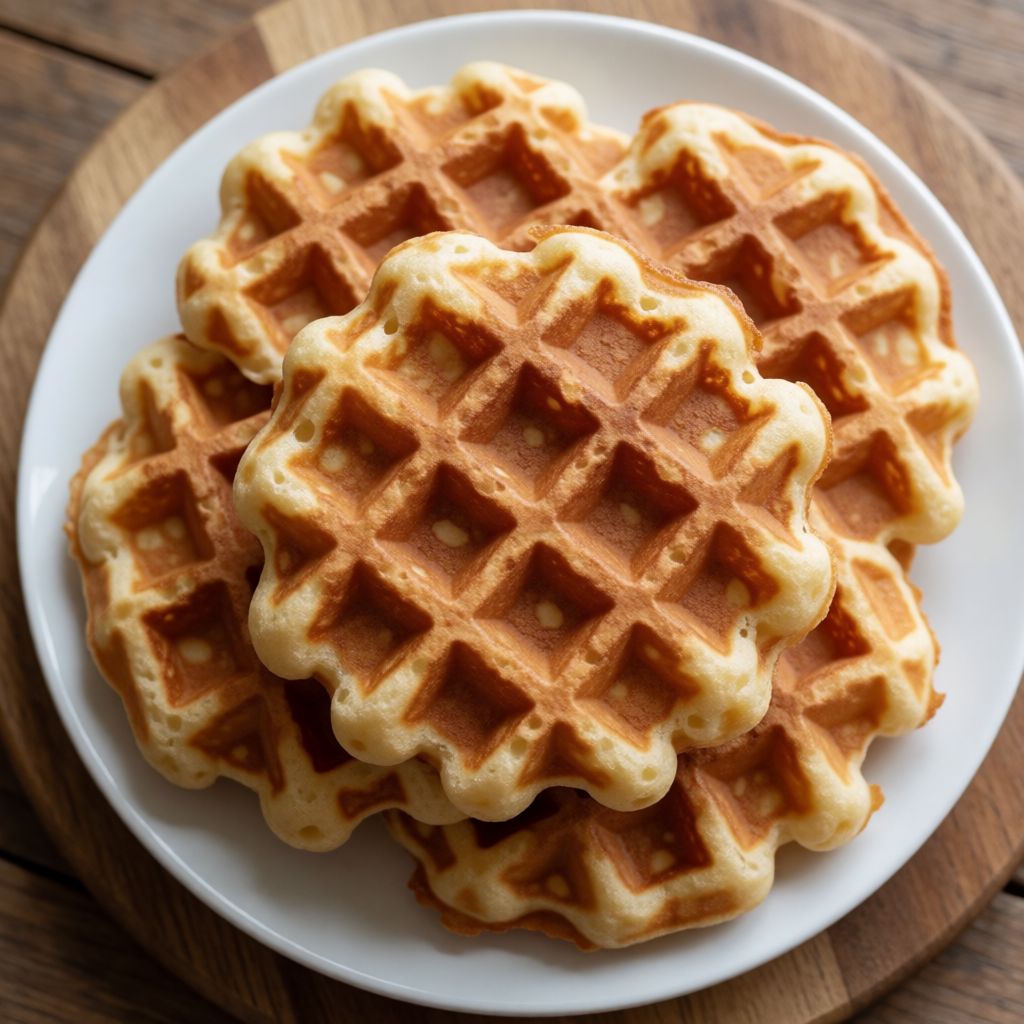
 AI photo
Quick and Simple Waffles
A quick, simple waffle batter made at home with a waffle iron.
Labels are worked out automatically from the ingredients and can be wrong. Check the packaging if it matters to you.
Ingredients
- 300 ml Milk
- 200 g Plain flour sifted
- 50 g Potato starch
- 70 g Butter melted and cooled
- 70 g Caster sugar
- 2 pcs Eggs
- 8 g Baking powder
- 1 pinch Salt
- Vanilla extract to taste








Steps
Plug in and heat up your waffle iron.
Crack the eggs and separate the whites from the yolks.
Beat the yolks with the sugar until light and fluffy.
Add the melted and slightly cooled butter and the vanilla extract.
Pour in the milk, add the baking powder, a pinch of salt, the sifted flour and the potato starch.
Mix thoroughly until smooth and thick.
Beat the egg whites until stiff and firm.
Gently fold the beaten egg whites into the batter in small portions.
Once the waffle iron is hot, brush the plates with a little butter and wipe away any excess once melted.
Pour an even, thin layer of batter onto the plate.
Close the waffle iron and cook for about 5 minutes until golden.
5 minRepeat until all the batter is used.
A waffle is really two batters wearing one coat: a yolk-sugar-fat mixture carrying flavour, and a cloud of whipped egg white carrying air. Whether these waffles turn out light and crisp or flat and chewy is decided at the point where you fold those two together — not at the heat, not at the timer.
Potato starch alongside plain flour isn't decoration. Flour alone, once it meets liquid and gets stirred, builds gluten — long elastic strands that are wonderful in bread and terrible in a waffle, because they turn it tough and bready instead of short and crisp. Starch has no gluten to build. Swapping a fifth of the flour for it keeps the structure from setting too firm, so the waffle shatters a little under your teeth instead of bending.
Some say you can skip separating the eggs and just lob them in whole to save on washing-up — no, because the whole point of beating whites separately is trapping air in a form stable enough to survive folding and baking. Whisked into the yolk mix from the start, that air never gets organised into bubbles; it just dissolves back into the liquid. Separate eggs aren't fussiness, they're the only way this batter gets a rise without baking powder doing all the work alone.
The fold itself is the fragile moment. You're not stirring, you're persuading: cut down through the batter, turn, lift, and the egg-white cloud settles in without losing its structure. Stir like you would mix tea and you knock the air straight back out — you'll get a waffle that's dense, pale, more pancake than waffle.
Milk here is just the liquid that lets starch and flour hydrate and lets the batter pour thin and even across the plate — it's not doing flavour heavy lifting, so whole milk versus semi-skimmed won't make or break it, though whole gives a touch more richness. If you're out, a splash of water with a spoon of the butter you're already melting will get you through, though the result is leaner.
The butter is melted and cooled on purpose, not just for convenience. Melted butter coats flour particles in fat early, which is part of what keeps gluten development down — fat gets between the flour proteins before water does, so they can't link up into the long chains that toughen a waffle. Cooled, because hot butter dropped straight into egg yolks will start cooking them at the edges, giving you little flecks of scrambled egg in your batter instead of a smooth one. Any neutral oil with no smell of its own will do the same fat-coating job if you're out of butter — sunflower, vegetable — you just lose the dairy flavour butter brings.
Caster sugar beaten with the yolks isn't only for sweetness. The beating itself whips air into the yolks and thickens them, giving you a head start on lightness before the egg whites even enter the picture — this is why the recipe asks for "light and fluffy," not just "mixed." Caster dissolves faster than granulated because the crystals are smaller, so it won't leave grit; if you only have granulated, beat a little longer and it'll get there.
Baking powder is your insurance, not your main lifting mechanism — it's there for the lift the whipped egg whites can't finish alone, filling the gaps once the batter hits the hot plates and the trapped air and the raised carbon dioxide both expand together. Eight grams against 200g flour is a modest dose; it's backup, not the engine.
Salt and vanilla are both about contrast, not presence — salt sharpens the sugar so the sweetness doesn't sit flat and one-note, vanilla rounds the eggy edge off the batter. Neither should announce itself; if you can taste the salt as salt, you've gone too far.
On an ordinary domestic waffle iron rather than a professional one, "hot" means the indicator light telling you it's ready, or a drop of batter sizzling and setting at the edges the instant it touches the plate — not a number, because every machine's dial lies a little differently. Brushing and wiping the butter matters for the same reason you grease a cake tin: too much and the waffle fries rather than bakes, leaving a greasy crust instead of a crisp one; too little and it tears the surface coming off the plate. And the five minutes given is the lower bound, not a deadline — colour is the real signal. Golden means ready; pale and you'll get a waffle that's cooked through but limp, because it never spent long enough letting its surface sugars brown into that crisp shell. Patience at the iron — resisting the urge to peek and lift too early — is as much an ingredient here as the eggs.