
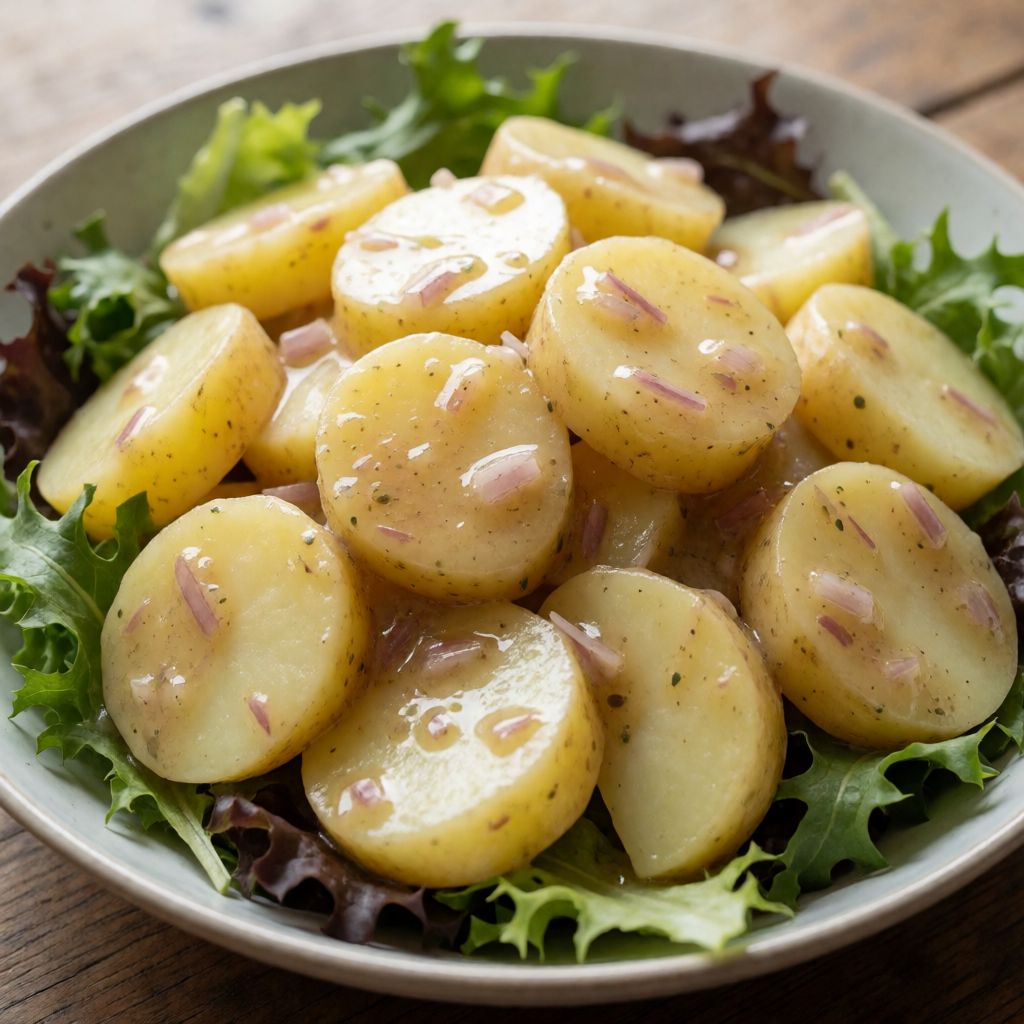
 AI photo
Warm Potato Salad
A warm potato salad with shallots in a tangy mustard and vinegar dressing, finished with fresh chives.
Labels are worked out automatically from the ingredients and can be wrong. Check the packaging if it matters to you.
Ingredients
- 800 g Potato
- 4 pcs Shallot thinly sliced
- 100 ml Water
- 50 ml Apple cider vinegar
- 1 tbsp Sugar
- 1 tsp Dijon mustard
- 40 g Butter
- Salt
- Black pepper freshly ground
- 1 bunch Chives finely chopped









Steps
Peel the potatoes and boil them in lightly salted water until tender.
Drain and let the potatoes cool completely in the fridge, then slice them.
Fry the shallots in butter over low-medium heat for 15–20 minutes, until soft and lightly caramelised.
20 minAdd the water, apple cider vinegar, salt and pepper to the pan.
Add the sliced potatoes and gently warm everything through.
Adjust to taste with sugar, Dijon mustard, salt and pepper as needed.
Serve sprinkled with finely chopped chives.
This is not the cold, mayonnaise-logged potato salad you get in a tub from the supermarket. It's built the way German and Alsatian cooks have made it for two centuries — potato dressed in a sweet-sour pan liquor while everything is still warm, no mayonnaise at all, because mayonnaise is a 19th-century convenience and this dish is older than that. What decides whether it works is not the dressing — the dressing is forgiving — it's what happens to the potato before the dressing ever meets it, and what happens to the shallot while you wait.
First mechanism: you boil the potatoes, then you let them go properly cold before slicing. Some say you should dress potato while it's hot, straight out of the pot, because hot potato 'drinks' the dressing better. No — a hot potato is full of swollen, waterlogged starch cells with soft walls; slice it now and you tear those cells open, and what you get under the knife is wet crumble, not a slice. Give it time in the fridge and the starch tightens back up — the same process that makes yesterday's boiled potato firmer than today's — and now the knife goes through clean, with a slice that holds its edge. Only then do you warm it back up in the dressing, gently, so it absorbs flavour without falling apart a second time.
Potato is the one ingredient here where variety actually changes the outcome, and it's a very British thing to get wrong, because the shop shelf doesn't sort them by behaviour. You want a waxy potato — new potatoes, Charlotte, Maris Peer, anything the bag calls 'salad potato' — because waxy varieties are low in starch and hold a clean slice after boiling. A floury one, Maris Piper or King Edward, the roast-potato kind, is exactly wrong here: it's bred to collapse, which is why it makes a brilliant Sunday roastie and a disappointing sliced salad. If floury is all you have, boil it a touch less than 'tender all through' and handle it like glass.
Shallot earns its place for one reason: it's higher in sugar than onion, and sugar is what caramelises. An onion will get there too, just slower and with more raw bite left in it even at the end, so if you're substituting, slice it thinner and give it a few extra minutes, tasting as you go rather than trusting the clock. Either way, what you're frying in butter is sugar turning brown, and butter helps because its milk solids brown alongside the shallot and add a nutty note oil can't. If you need it dairy-free, the rule for the substitute is simple: any oil with no smell of its own — sunflower, a mild rapeseed, nothing that announces itself — and maybe a pinch more sugar in the dressing to make up what the butter was quietly contributing.
Apple cider vinegar is doing the sour half of sweet-sour, and it's chosen for being gentler than white vinegar — less raw acid, more fruit behind it — but any light vinegar with no aggressive smell of its own will do the job: a mild white wine vinegar, even malt vinegar cut with a touch more water and sugar if that's what's in the cupboard, since Britain is a malt-vinegar country. Sugar's job is to balance that acid, not to make the dish sweet — taste the dressing before you add the potato and it should make you wince slightly on the sour side, because the potato will mellow it.
Dijon mustard is small in quantity but doing real work: it's an emulsifier, so it helps the butter fat and the vinegar-water hold together as one dressing instead of separating into oily beads on a sour pool, and it coats the potato slices rather than pooling under them. If you don't have Dijon, any smooth mustard with some sharpness works — just skip sweet American-style mustard, which fights the sugar you've already got in the pan.
Chives go on at the very end, raw, finely chopped, for one reason: everything else in this dish is cooked allium — soft, sweet, caramelised. Chives are the only sharp, grassy, uncooked note in the whole plate, and that contrast is the point, not a garnish for the photo. 800 g of potato across four people is a side-dish portion, which tells you what this is for — it sits next to a roast rather than carrying a meal on its own, and it's better served while there's still faint steam coming off it than stone cold from the fridge, because cold is where it turns dense and tired. Patience here isn't a virtue word, it's literal: the cooling of the potato and the slow colour change in the shallot pan are both steps you cannot shortcut without the dish telling on you later.