
 AI photo
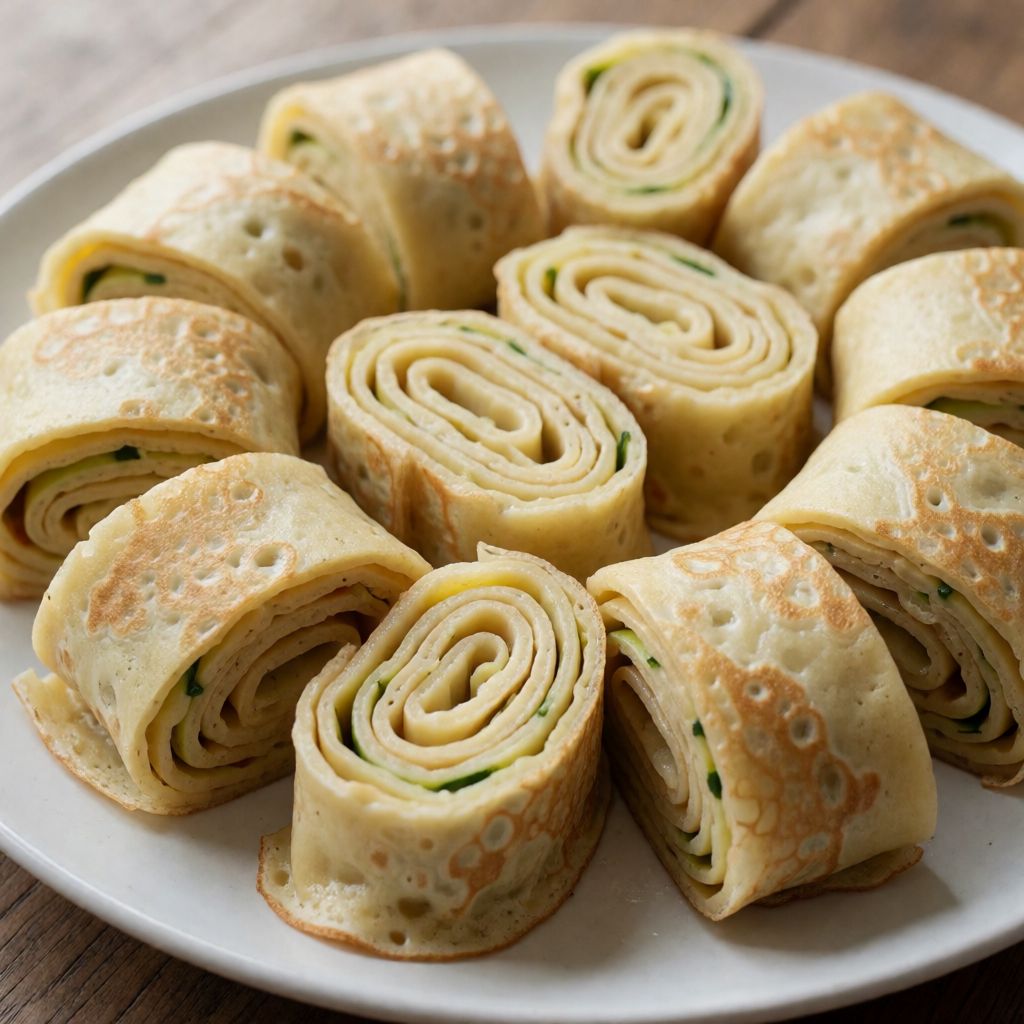
Courgette Crêpe Roll
Savoury crêpes rolled with courgette, ricotta and cheese, baked and finished under the grill.
Labels are worked out automatically from the ingredients and can be wrong. Check the packaging if it matters to you.
Ingredients










Steps
Mix the flour, milk and eggs beaten with salt; stir from the centre outwards until smooth
Cover the batter with a towel and let it rest in a cool place
20 minAdd the melted butter and mix the batter vigorously
Heat a greased non-stick pan, pour in a ladle of batter and spread it evenly
When the crêpe is golden, carefully flip it over; repeat until all the batter is used
Grate the washed courgettes on the coarse side of a grater
Combine the béchamel, grated courgette, ricotta, Emmental, eggs and half the Parmesan; mix well
Lay the crêpes overlapping on baking paper to form a rectangle
Spread the filling evenly over the crêpes
Roll the crêpes up using the paper to help; wrap in the paper
Place the roll in a baking dish and bake at 180°C
30 minCut the roll into slices about 2 cm thick, sprinkle with the remaining Parmesan and dot with butter
Place under the grill
5 minServe the crêpes hot, garnished with chopped parsley if desired
What was changed
Ricotta romana was swapped for plain ricotta Ricotta, which is easy to find in British shops.
This is a crêpe roulade — a Swiss-roll logic applied to a savoury lunch. You lay crêpes flat like tiles, spread them with a courgette-and-cheese filling, roll the whole sheet up, and bake it so the roll sets into something you can slice like a terrine. The trick is that the crêpe is doing a job pasta usually does: it's a wrapper for sauce, not a food in its own right. That's why it's filed under "pasta" even though there's no durum wheat in sight — the mechanism is the same as a cannelloni, just unrolled flat instead of tubed.
What decides whether it works is moisture control. Courgette is almost entirely water held in cell walls, and raw grated courgette dumped straight into béchamel will weep that water out slowly in the oven, turning your filling into soup under a crêpe skin that can't hold it. Some say you must salt and squeeze courgette before using it — no, because here the béchamel itself is thick enough to absorb a fair bit of released liquid, and the real guard is baking the roll wrapped tight in paper first: the paper holds the shape while the béchamel's flour matrix firms up around the extra water as it sets. You're not preventing the water, you're giving it somewhere to go that isn't the plate.
Flour, milk, eggs: that's the crêpe, and the ratio here (250 g flour to 500 ml milk, three eggs) gives a batter loose enough to spread thin with a ladle and a tilt of the pan — this isn't pancake batter, it should run like single cream. If it's thicker than that, the crêpe tears when you try to flip it, because a thick batter sets unevenly, crisp at the thin edges before the middle's even cooked through. Add a splash more milk rather than force it.
The melted butter stirred in at the end isn't for flavour so much as it's a release agent built into the batter itself — fat coats the gluten strands and stops the crêpe gluing itself to the pan, which matters more than people think on a domestic non-stick pan that's lost a bit of its coating over the years. Use a neutral butter or, if you're dairy-shy, any oil with no smell of its own — sunflower, not olive, because olive oil's flavour fights the delicate eggy batter.
For the pan: on a UK hob you won't get a wide flat crêpe pan going at a steady, even heat the way a gas ring in a French kitchen does. Use your widest non-stick frying pan, and judge heat by the batter, not a dial: drop a teaspoon in and it should set at the edges within a few seconds without smoking. Too hot and you get brown lace before the centre cooks; too cool and the crêpe stays pale and slightly tacky, which means it'll tear later when you try to roll the whole sheet.
Courgette: choose firm, glossy, small-to-medium ones — the big watery ones from an allotment glut have spongier flesh and more seeds, more water to manage. Grate coarse rather than fine; fine grating turns it to mush and releases water faster than the béchamel can take up. If courgette's out of season or you've only got marrow, same principle applies, just expect to drain it in a sieve for ten minutes first, because marrow is wetter still.
Ricotta and Emmental do different jobs: ricotta loosens the filling and keeps it soft rather than rubbery once baked, Emmental melts and binds, giving you the stretch when you cut a slice. If you've no Emmental, any mild melting cheese with low moisture works — Gruyère, a mild Cheddar — the criterion is a cheese that melts smooth rather than splitting into oil and curd, which is what a very mature, hard cheese tends to do under heat. The eggs in the filling are there to set it on baking, the same logic as a quiche filling — without them, the roll holds together while warm and collapses into wet shreds once it cools and you try to slice it.
The final grill isn't about more cooking — the roll's already done at 30 minutes in the oven, you know because it feels firm when you press it, not springy and wobbling. The five minutes under the grill is purely for the Parmesan and butter on top to colour and go savoury-bitter at the edges, the Maillard browning a closed oven at 180°C won't give you fast enough. Watch it, don't time it blind — grills in home ovens vary wildly in strength, and the difference between gold and burnt is under a minute.
Patience here is mostly the crêpe stage — making six or eight thin crêpes one at a time in a single pan takes longer than the actual filling and rolling. Don't rush by cranking the heat to speed it up; you'll just burn through butter and crêpes faster than you perfect them. Feeds six as a light lunch alongside a green salad, not as the main event of a Sunday table — it's closer to a bistro starter in spirit, sized up.