
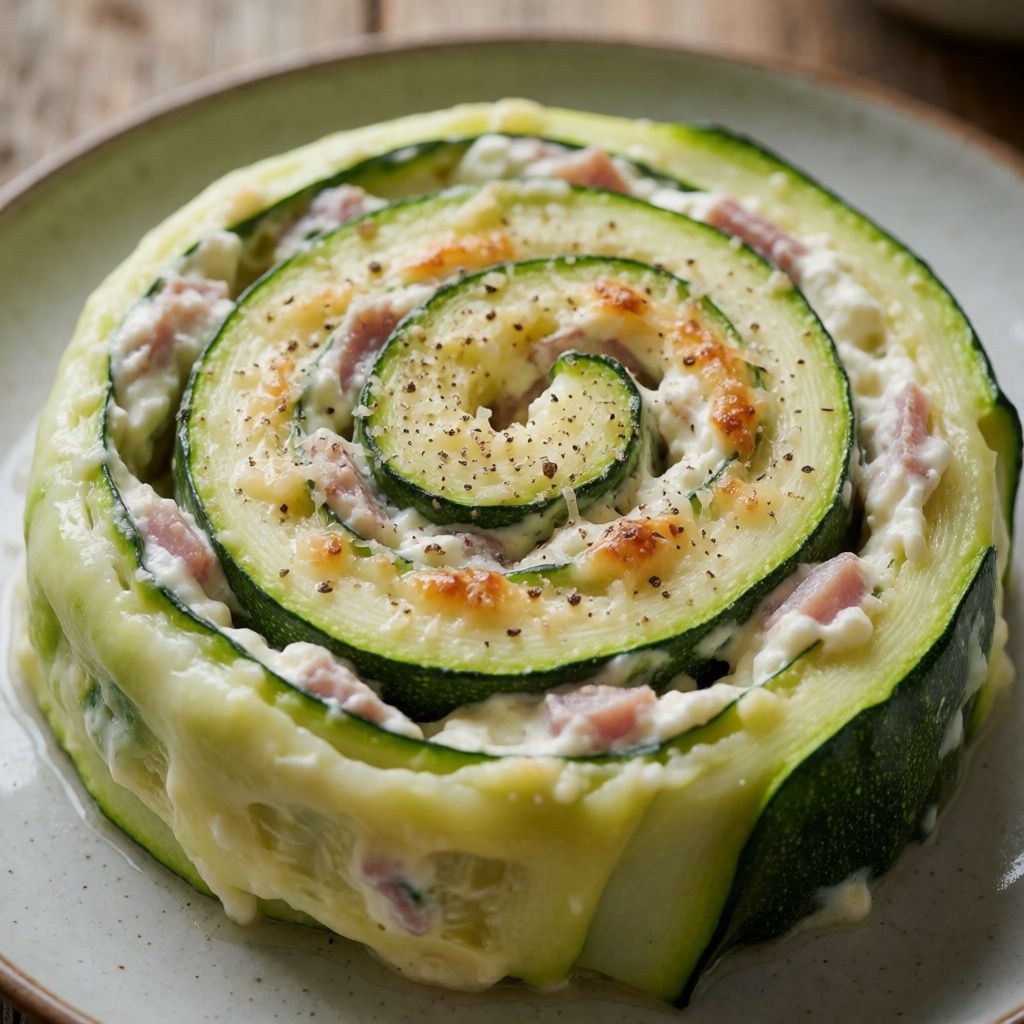
 AI photo
Courgette Roll with Cheese and Ham
A soft courgette sheet rolled with creamy stracciatella and ham slices, served as a savoury roll.
Labels are worked out automatically from the ingredients and can be wrong. Check the packaging if it matters to you.
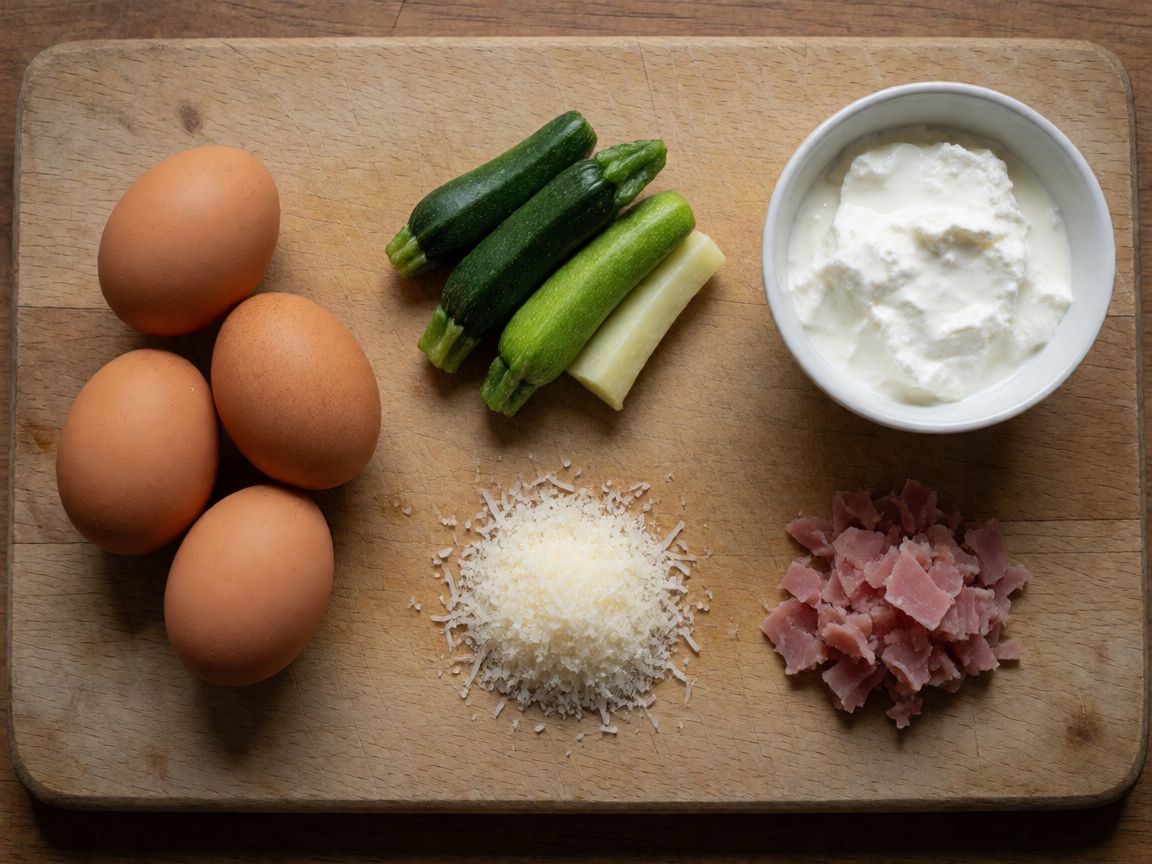
Ingredients







Steps
Thoroughly wash the courgettes under running water, dry them, and grate using the large-holed side of a grater.
In a separate bowl, mix the eggs, a pinch of salt, and the Parmesan. Whisk with a balloon whisk or electric mixer until smooth.
Add the grated courgette and stir with a spoon.
Pour the mixture onto a baking tray lined with parchment paper, about 36x25 cm, and bake at 200°C for at least 15 minutes.
15 minRemove the baked sheet from the oven and let it cool slightly.
Spread the stracciatella evenly over the surface, then lay the ham slices on top.
Roll up the sheet, using the parchment paper to help, then place it in the refrigerator to set for 30 minutes.
30 minTransfer the roll to a plate, slice, and serve.
This is a savoury roulade — the same logic as a Swiss roll, just dressed for a starter table instead of a tea tray. You bake a thin sheet of egg, courgette and Parmesan, spread it with cheese and ham while it still has some give, and roll it while the paper does the hard work. Six slices, served cold or cool, good as an antipasto before the actual meal rather than instead of it.
What decides whether it works is thickness and temperature, not time. The egg-courgette mixture has to go onto the tray thin — think 36x25cm for this amount, roughly the size of a standard oven tray — because a thin layer sets through before it dries out, and lets the courgette's water escape upward as steam instead of pooling underneath as a wet patch that never cooks. Pour it thick in a smaller tin and you get a vegetable omelette that cracks the moment you try to roll it, because the middle stays damp and spongy while the edges go leathery.
Some say you must salt and squeeze courgette before cooking it, to get the water out. Not here, and for a reason: once it's grated fine, mixed wet into egg, and spread thin over a hot tray, the water has nowhere to go but up and out as steam in the fifteen minutes it bakes. Pre-squeezing would just make the mixture too dry to bind. The 200°C does the drawing-out for you — it sets the egg protein on the surface fast enough that the sheet holds shape while the water underneath cooks off, rather than leaving you with a soggy base.
Eggs are the only true structure here — five of them whisked hard with the Parmesan until smooth, because that's what sets into a sheet you can actually pick up and roll, rather than a crumble of baked courgette. The whisking matters more than people think: beaten eggs trap a little air, and that air is what keeps the sheet from baking into something dense and crackery. No eggs on hand that are fresh enough to whisk properly — use what you've got, but don't skip the whisking stage to save five minutes, because an unbeaten mix bakes flatter and tears more easily when rolled.
Courgette (zucchini, if the bag says that) is grated on the coarse side of the grater on purpose. Fine grating turns it to mush, releases more water than the thin bake can handle, and you lose the bit of bite that tells you you're eating a vegetable and not just an egg sheet. Any mild, high-water vegetable that grates and cooks fast would do the same job structurally — grated carrot works, but it brings its own sweetness and colour, so you're making a different dish, not a substitute for this one. The point of courgette specifically is that it's bland and wet in roughly the right proportion for this method; that's its whole job here.
Parmesan goes into the batter, not onto the filling — it's there for salt and a bit of savoury weight, and because its low moisture means it won't add more liquid to a mixture that's already managing plenty. Any hard, dry, aged cheese with real salt to it does the same work — Grana Padano, a mature Pecorino if you want more bite. A soft or high-moisture cheese in that spot would just dilute the structure you're trying to bake.
Stracciatella is the filling, and it's worth knowing what it actually is before you go hunting for it in a UK supermarket: it's the shredded curd and cream left over from making mozzarella — soft, loose, spreadable without being runny. If you can't find it, the honest substitute is mascarpone loosened with a little cream, or torn burrata, used for its texture rather than any specific flavour. Ricotta will work in a pinch but it's grainier and drier, so expect a less luxurious mouthful, not a fault — just a different one.
Ham here means a cooked, mild ham sliced thin enough to roll without stiffening the structure underneath it — a standard deli ham from any UK counter is exactly right, no need to chase down Italian prosciutto cotto by name. The thinness matters more than the pedigree: a thick slice creates a stiff line inside the roll that the egg sheet can't bend around, and that's where your crack starts.
The thirty minutes in the fridge at the end isn't decoration — it's the step that lets the stracciatella's fat firm up just enough that the roll holds its round shape when you cut it, instead of spreading flat on the plate the second the knife goes in. Skip it and you'll still eat it; you'll just be eating it with a spoon. That's patience doing the one job no amount of clever ingredients can do for you.