
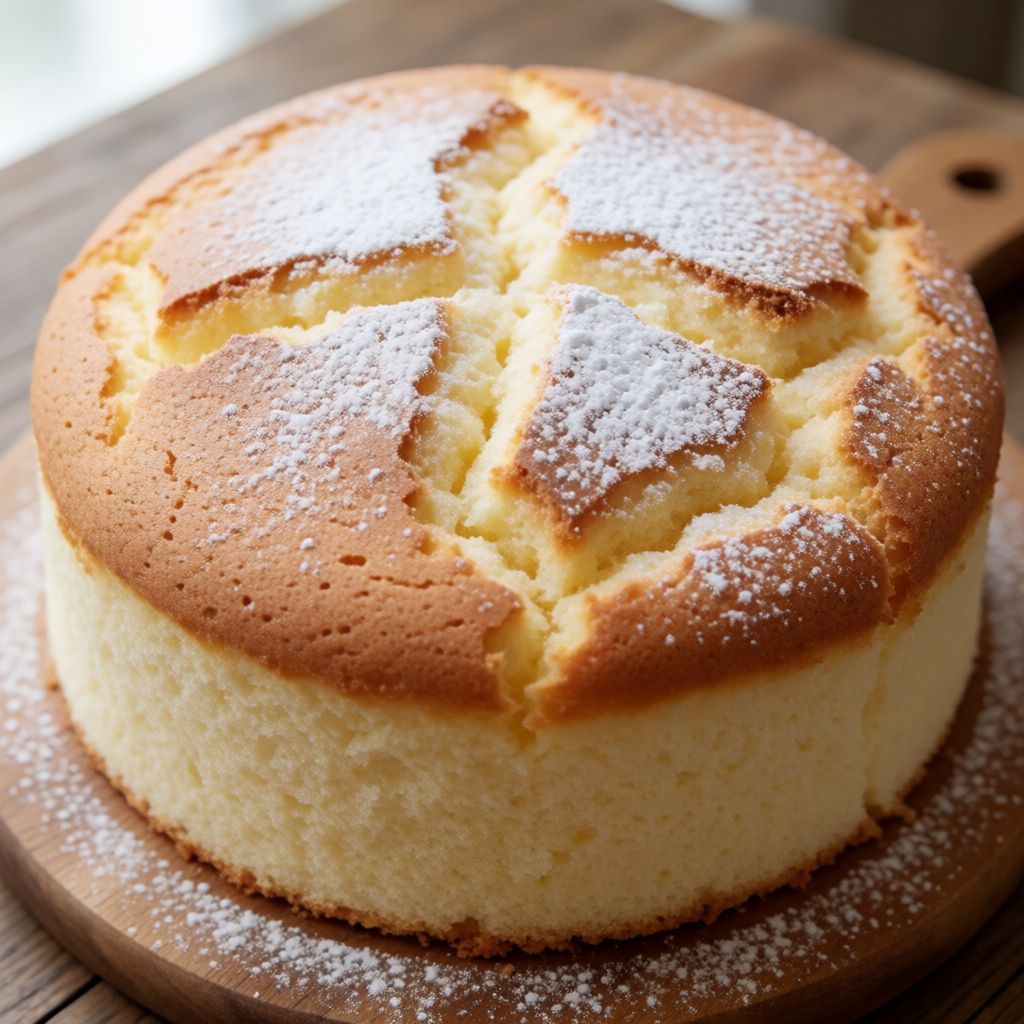
 AI photo
Light and Fluffy Almond Cake
A light, fluffy almond cake with a hint of saffron, finished with a dusting of icing sugar.
Labels are worked out automatically from the ingredients and can be wrong. Check the packaging if it matters to you.
Ingredients
- 170 g Caster sugar
- 100 g Ground almonds
- 80 g Plain flour
- 4 pcs Eggs
- 170 g Butter
- 80 g Potato starch
- 1 pcs Saffron
- 1 pcs Baking powder
- pinch Salt a pinch
- Icing sugar to taste










Steps
Blitz the sugar in a blender for about 30 seconds.
Add the ground almonds.
In a separate bowl, mix the eggs and saffron well.
Pour the egg mixture into the blender and blend for another minute.
1 minAdd the butter in pieces, the plain flour and the sifted potato starch, and blend for a further 30 seconds.
Add the sifted baking powder and the salt.
Grease a baking tin with butter and pour in the batter.
Put into a cold oven and turn it on to 180°C, baking for 30 minutes.
30 minDust with icing sugar before serving.
Forget the word "cake" for a second — this is closer to a Swedish almond torte crossed with a financier, and the whole trick is in the starch. Half the flour here is potato starch, not wheat, and that is what gives you "light and fluffy" rather than "dense and eggy". Wheat flour builds gluten, gluten builds structure, structure is exactly what you don't want in something that's supposed to collapse softly under a fork. Potato starch has no gluten to build. It thickens, it sets the crumb, but it never toughens it.
What decides whether this works is the almonds doing double duty as both flavour and flour. A hundred grams of ground almonds is fat and protein, not starch, so it can't rise on its own — it needs the eggs (four of them, whipped into the sugar-almond mix until the blender genuinely changes the texture, not just "mixes it") to carry air into the batter. That air is your only leavening until the baking powder joins in at the very end. Lose the air at the whisking stage and no amount of baking powder saves you.
Saffron here is not a flavour you're meant to taste loudly — it's there the way it is in a good paella, more for colour and a background perfume than a punch. One pinch, steeped into the eggs before anything else goes in, so it has time to bleed its colour through the liquid rather than sit as orange threads in a yellow cake.
Butter: 170 g, added in pieces rather than melted. Cold-ish pieces, cut small, go into the blender with the flour and starch already in. The point is that the blender's friction softens and emulsifies the butter into the batter without you ever fully melting it — melted butter separates fat from everything else and you end up with greasy pools instead of an even crumb. Use a proper butter here, not a spread; spreads carry water that unbalances the starch's job of setting the structure. If you're out of butter, a neutral solid fat works in theory but you lose the flavour this cake is actually built around — almond and butter are doing a duet, don't mute one half of it.
Ground almonds: buy them, don't grind your own unless you have a proper processor, because home-ground almonds release oil unevenly and clump. Shop-bought ground almonds are dry and consistent, which is what the blender needs to fold them smoothly into sugar and egg. No almonds in the cupboard, no real substitute — ground hazelnuts will give you a different, heavier cake, not a worse version of this one. Don't confuse this with almond essence; that's a flavouring, this is the actual bulk of your "flour".
Potato starch: this is the structural decision of the whole recipe, discussed above, and it's worth knowing cornflour (cornstarch) does a similar job if you can't find potato starch in a UK shop — both are pure starch with no gluten, both set without toughening. They're not identical in water-binding, but for 80 g in this batter you won't notice the swap.
Plain flour: only 80 g, there purely to add a little gluten back in — just enough that the cake holds a slice when you cut it, rather than crumbling the second a fork touches it. This is why you don't skip it and go all-starch: zero gluten means zero cohesion, and you'd be eating cake with a spoon out of the tin.
Caster sugar: blitzed first, alone, for 30 seconds — that's not a flavour step, that's a texture step. Caster sugar is already fine, but a few seconds in the blender before anything else goes in means the crystals are properly broken down before they meet fat and egg, so they dissolve into the batter instead of sitting as grit. Some say you can just stir sugar straight in — no, because undissolved sugar crystallises again as the cake bakes, and you get a faintly crunchy top instead of the smooth crumb this cake is named for.
Eggs: four, whole, no separating whites from yolks here — this isn't a soufflé-style sponge where whipped whites do the lifting. The air comes from blending whole eggs into sugar and almonds long enough (about a minute) that the mixture visibly thickens and lightens in colour. That change you're watching for — pale, slightly ribbony — is doneness at the mixing stage, the same principle as the carrot that bends: don't trust the clock, trust what you see in the bowl.
On the oven itself: 180°C is where egg proteins set and sugars start to properly caramelise at the surface, giving you that faint golden top rather than a pale, sweaty one. A domestic oven running a cold start to 180°C will take some minutes just to reach temperature, and that's built into your 30 minutes, not extra. Don't open the door to check — in a small home oven, losing heat mid-rise is how centres sink. Patience here isn't poetic, it's load-bearing: an underbaked centre and a cracked top are both just you rushing a cake that wanted to be left alone in a warming box. Icing sugar at the end is cosmetic and should go on close to serving — dust it too early and the cake's own moisture will dissolve it into nothing.