
 AI photo
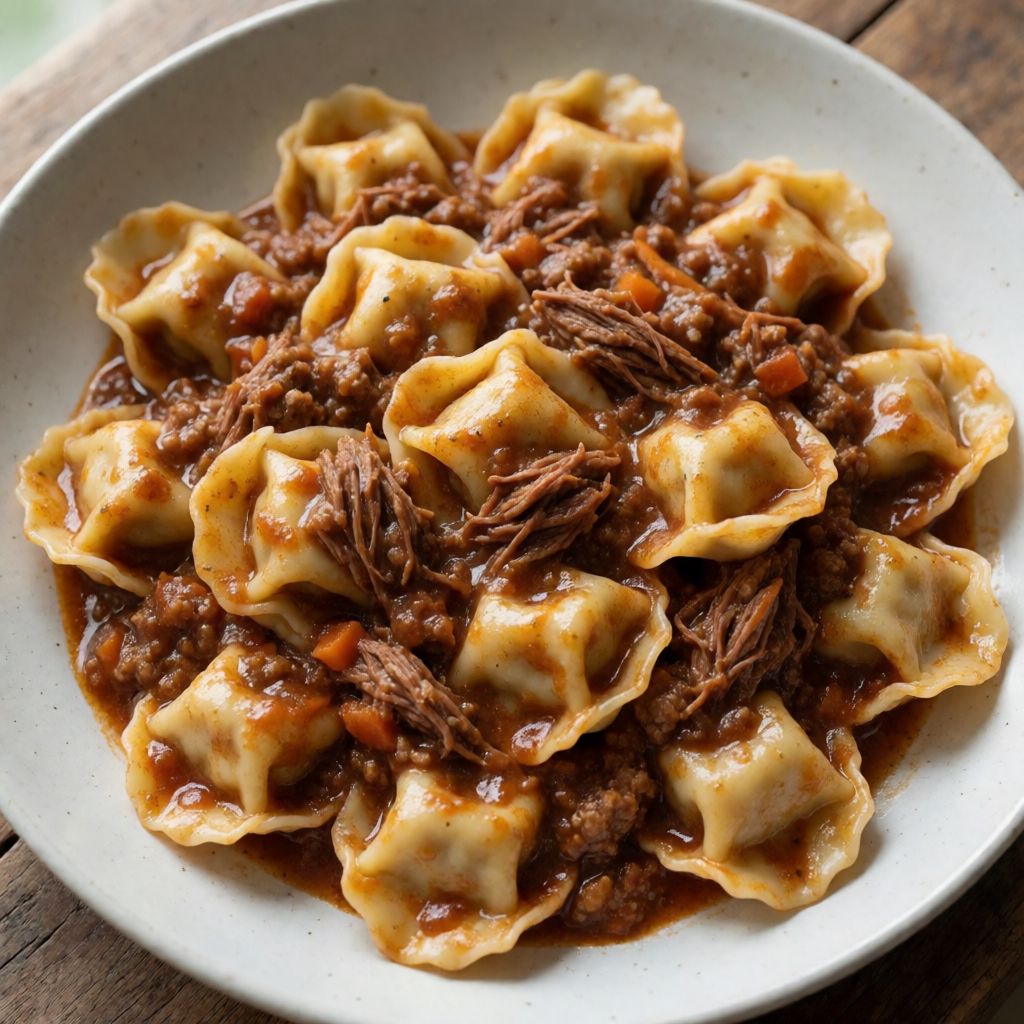
Agnolotti with Stufato Sauce
Agnolotti filled with slow-braised beef and sausage, served in their own rich braising sauce.
Labels are worked out automatically from the ingredients and can be wrong. Check the packaging if it matters to you.
Ingredients
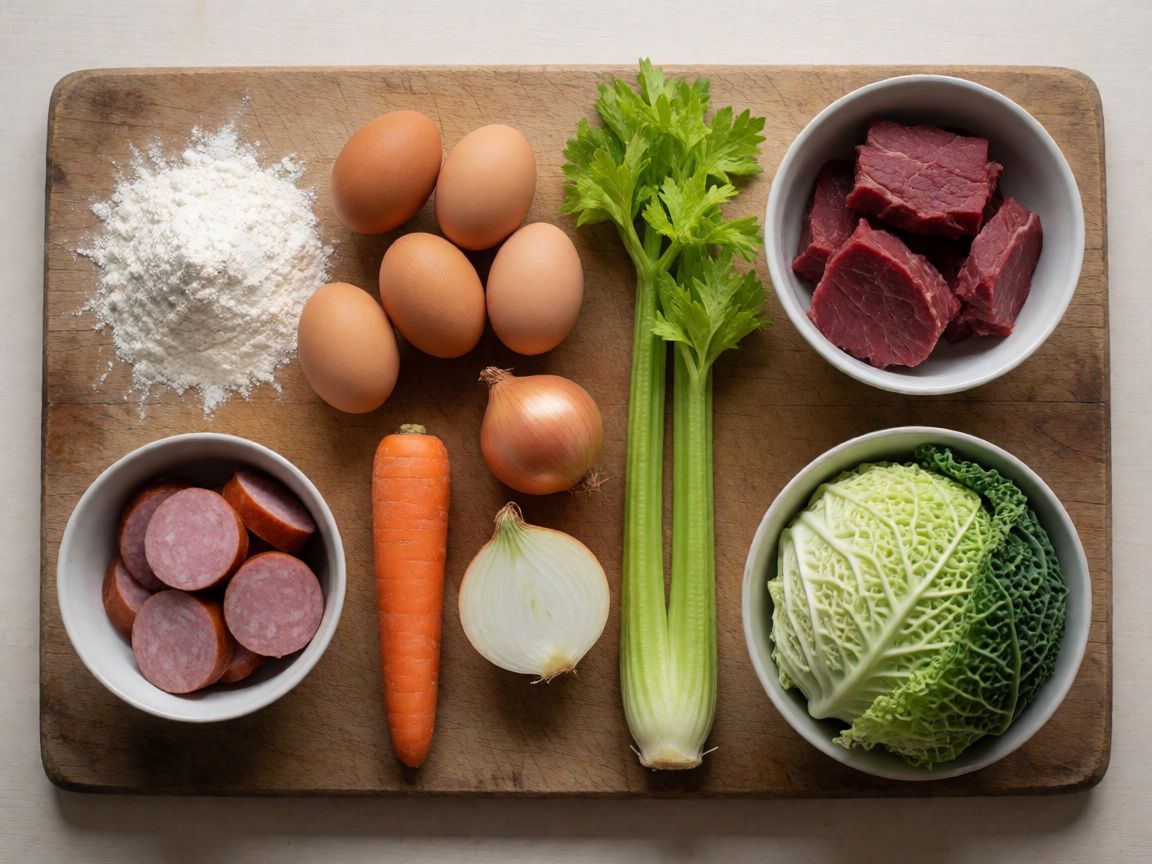
- 500 g Plain flour
- 5 g Salt
- 5 pcs Eggs
- 350 g Beef
- 200 g Sausage
- 1 pcs Carrot
- 0.5 pcs Onion
- 1 pcs Celery stick
- 100 g Savoy cabbage
- Vegetable stock as needed
- Olive oil to taste
- 120 ml Red wine
- 15 g Parmesan
- Nutmeg to taste











Steps
Dice the carrot, celery and onion, and sauté in olive oil in a saucepan.
Cut the beef and sausage into pieces, add to the vegetables and brown for a few minutes.
Pour in the red wine and let it evaporate.
Add the vegetable stock, stir and braise for about 1 hour, topping up with more stock if needed.
60 minShred the savoy cabbage, add to the meat and cook until done.
Tip the flour onto a work surface, form a mound, add the salt and eggs.
Gradually work in the flour, then knead more vigorously until the dough is smooth and elastic.
Form a ball, wrap in cling film and leave to rest in the fridge for about 1 hour.
60 minTake out about 3/4 of the cooked meat, drain off the liquid and blend it.
Transfer to a bowl, add the parmesan, a pinch of salt and a little nutmeg, and mix.
Transfer the filling into a piping bag.
Roll out the dough in small batches, passing it through a pasta machine several times until very thin.
Cut two equal long rectangles from the dough and brush one with a little water.
Pipe the filling in small, evenly spaced portions, cover with the second sheet of dough and press firmly together.
Use a fluted pasta cutter to trim the edges and cut the agnolotti.
At this stage the agnolotti can be frozen or cooked straight away.
Bring a pot of water (or stock) to the boil, season with salt and cook the agnolotti for 3-4 minutes.
4 minBlend the remaining meat with its liquid to make the sauce.
Drain the agnolotti and dress them with the sauce.
This is Piedmont's answer to leftovers — agnolotti del plin, born on farms where Sunday's roast became Monday's pasta filling. "Plin" means pinch, the actual motion that seals each little parcel, and that motion is the whole technical heart of the dish: you're not folding a pocket, you're pinching a ridge of dough shut around a ball of filling, which is why the shape ends up squarish and crimped rather than the smooth crescent of a tortellino. Everything else — the braise, the wine, the cabbage — exists to produce a filling with enough body and savour to survive being squeezed through a piping bag and bitten through two layers of raw pasta.
What decides whether it works is the stufato, not the pasta. "Stufato" just means stewed, from the same root as our word stove — low, wet, enclosed heat, the opposite of a roast. You brown beef and sausage hard after the vegetables have gone from white to translucent to lightly golden — that colour change, onion losing its rawness, carrot losing its snap, is your real cue, not a clock — then you deglaze with wine and let it cook down slowly until meat that was tough enough to need an hour-plus of braising falls apart with a spoon. If it doesn't fall apart, it isn't ready; topping up the stock is there precisely so the pan never runs dry and the meat never catches, which is the actual enemy here, not undercooking.
The beef gives structure — it's the long-cooked protein that turns to gelatine and body, the reason the filling holds together when piped rather than crumbling. Any stewing cut that needs an hour-plus to soften will do; shin, chuck, the cheaper cuts your Sunday roast never uses, because economically that's the whole point of this dish — it was built to use what a roast leaves behind, not to compete with it. The sausage isn't there for bulk, it's there for fat and seasoning the lean beef doesn't have on its own; a coarse Italian-style pork sausage without added herbs that'll clash is the target — if you can't get one, a little minced pork shoulder with a pinch of fennel gets you close.
The carrot, celery, onion trio is soffritto by another name, and its job is sweetness and aromatic base, not texture — which is why it gets diced small and cooked gently before the meat goes in, so it softens rather than fights the braise for an hour. The wine isn't for flavour so much as acid — it lifts the browned bits off the pan (that's deglazing, not decoration) and that acidity cuts through the richness of two meats and parmesan later. Letting it evaporate matters: raw wine flavour is harsh and sour, cooked down it's just depth.
Savoy cabbage going in near the end, not with the soffritto, is deliberate — it cooks fast and turns bitter and grey if it stews for an hour with everything else; you want it added once the meat's nearly done so it just wilts into the sauce, still with a little texture, not disintegrated. If savoy's not to hand, any loose-leafed cabbage or even kale shredded fine behaves the same way — the criterion is a leaf that collapses quickly, not a tight hard cabbage like white or red that needs real time.
Parmesan and nutmeg in the filling are doing what they do in ragù generally — parmesan for salt and savoury depth, nutmeg for a warm background note that lifts meat without announcing itself. Nutmeg's a small quantity for a reason: too much and the filling tastes like bread pudding, not pasta. If you've no parmesan, any hard aged cheese with a similarly sharp, salty bite stands in — a mild cheddar won't, it hasn't got the intensity to carry through the dough.
The split at the end — three-quarters of the meat blended smooth into filling, the rest blended with its braising liquid into sauce — is the clever economy of the dish: one braise, two jobs. The filling needs to be dense and spreadable from a piping bag; the sauce needs to be loose enough to coat. Keep that ratio roughly as given and you won't end up short on either end.
Patience is the ingredient nobody weighs in grams. The hour of braising, the hour of dough resting, the slow pass after pass through the pasta machine to get the sheet thin without tearing it — none of that compresses. Rush the braise and the meat's still tough when you blend it, grainy instead of silky. Rush the dough rest and it springs back on the machine no matter how hard you roll. There's no shortcut here, only an honest hour, twice.