
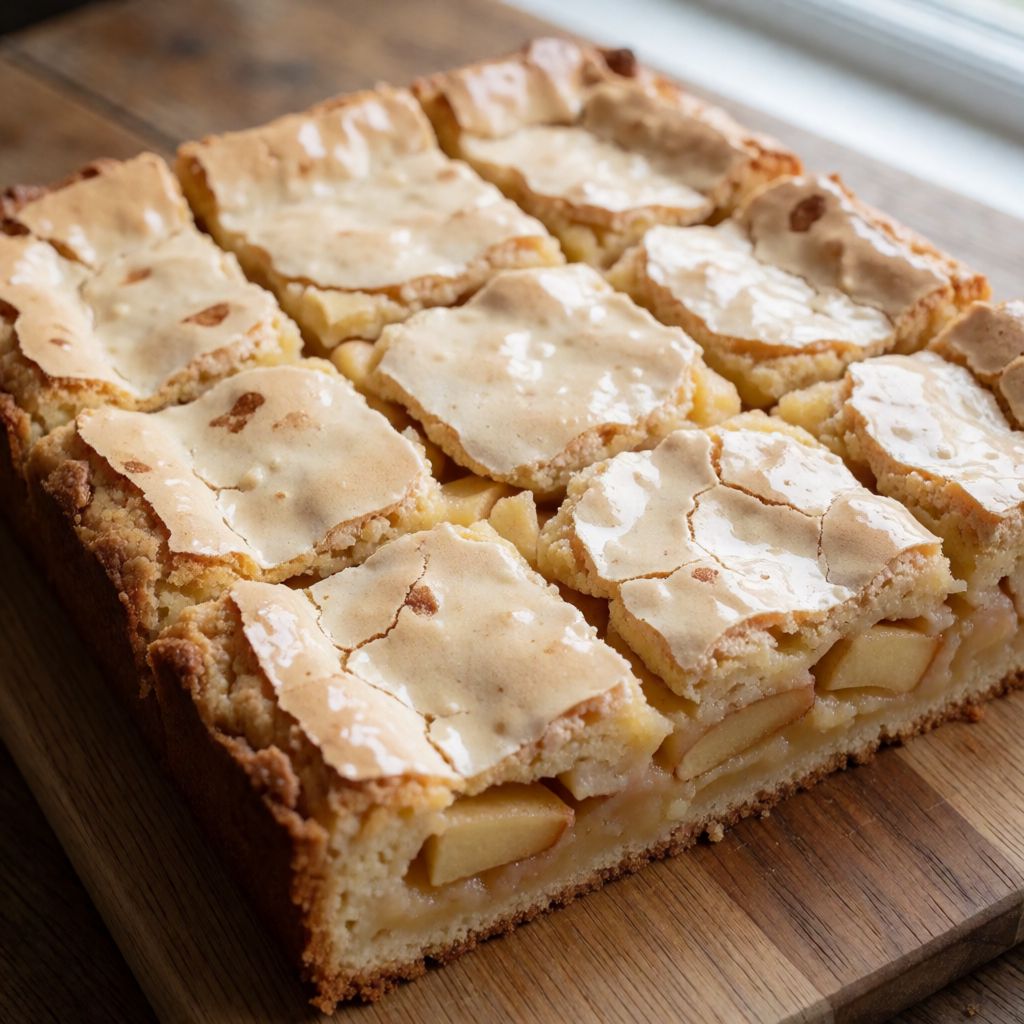
 AI photo
Apple and Almond Traybake
A buttery shortcrust base topped with chilled apple compote and a light almond macaroon layer.
Labels are worked out automatically from the ingredients and can be wrong. Check the packaging if it matters to you.
Ingredients
- 200 g Apple peeled and diced
- 25 g Caster sugar
- 1 tsp Vanilla sugar
- 50 ml Water
- 150 g Marzipan coarsely grated
- 3 pcs Egg whites
- 250 g Icing sugar
- 240 g Plain flour
- 50 g Icing sugar
- ½ tsp Vanilla sugar
- 120 g Butter cold
- 1 pinch Salt
- 1 pcs Eggs








Steps
Put the diced apples and water into a saucepan and bring to the boil over medium heat.
Simmer uncovered for about 10-15 minutes, stirring occasionally so it doesn't catch.
Add sugar to taste once the puree is thick and well cooked.
Chill the apple puree in the fridge.
Put all the ingredients for the almond macaroon mixture into a bowl and mix well until smooth.
Put the plain flour, icing sugar, salt and butter into a food processor and pulse quickly until combined into a fine mixture.
Tip into a bowl and bring together into a dough with the beaten egg.
Roll out the dough between two sheets of baking paper.
Remove one sheet of baking paper and prick the dough with a fork in several places.
Bake in a preheated oven at 160°C (fan) for about 12-15 minutes.
Spread the now-chilled apple puree over the baked base, then spoon the almond macaroon mixture on top without mixing it into the puree.
Bake in a preheated oven at 200°C (fan) for about 15 minutes, until the almond macaroon topping is a good golden colour.
Let the traybake cool slightly on the tray, then cut into slices.
This is three things stacked, each doing one job. A shortbread base that has to stand up on its own before anything goes on it. A spoonful of cooked-down apple sitting on it like jam, not like fruit salad — because wet raw apple would turn your base to porridge. And on top, a macaroon paste of ground almond, sugar and egg white that puffs and cracks and goes the colour of a good scone while the apple steams quietly underneath it, sealed in.
What decides whether it works is restraint at two points. First: the apple puree has to be properly thick and properly cold before it touches the pastry — a hot, loose puree is the enemy here, it will soak straight into a par-baked base and you'll get a soggy bottom no amount of extra baking fixes, because by the time the top is golden the base is long past rescuing. Second: you don't stir the almond layer into the fruit. Spoon it on, leave gaps if they happen, let it sit as its own layer. Some say you should "blend it through for more flavour in every bite" — no, because the whole trick of this bake is contrast: a soft hot fruit layer under a dry, crisp, nutty crust, and mixing them gives you one mushy thing instead of two good ones.
Patience is the actual ingredient that makes the apple layer taste of anything. Fifteen minutes of a low, steady simmer, stirred now and then, is what turns watery fruit into something concentrated enough to hold its own under a hot oven blast — rush it and you've just got warm apple, not apple that tastes like more apple than it is.
Apple: you want one that holds its shape and has some acidity — a Bramley-type cooking apple collapses to mush almost on contact with heat, which is actually what you want here, since you're making a puree, not keeping diced apple whole. If all you've got is an eating apple, like a Gala, it'll take longer to break down and the puree will be sweeter and less sharp — taste it before you add the sugar and hold some back, because a flat, sugar-only apple layer under a sweet almond top makes the whole slice cloying.
Marzipan is the engine of the top layer, and the reason for it is economic as much as anything: ready-made marzipan is just ground almond, sugar and egg bound together already, so grating it into the macaroon mix gives you that dense almond flavour without weighing out raw ground almonds and extra sugar separately and hoping the ratio's right. If you only have ground almonds, you can rebuild it — almonds, icing sugar, a little egg white, worked into a paste — but marzipan exists precisely so you don't have to do that every time.
Egg whites in the macaroon mix aren't there for lift in the way a meringue uses them — there's no whisking to soft peaks here, just mixing to smooth. Their job is to loosen the stiff marzipan-sugar paste into something spoonable and to let it dry into that cracked, slightly chewy macaroon crust in the oven rather than staying a solid lump of almond paste. Use the whites at room temperature if you can — cold egg white resists blending into the dense marzipan and you'll be fighting lumps.
The pastry base is a sweet shortcrust, and the method — rubbing cold butter into flour in the processor until it's fine, then bringing it together with egg rather than water — is what keeps it short rather than tough. Overwork this dough, or bring it together with warm hands, and the butter melts into the flour instead of staying in separate cold specks; those specks are what create the little gaps as it bakes that give you a crisp, sandy bite instead of a dense biscuit. Cold butter straight from the fridge, cut into pieces first, is non-negotiable — soft butter here is a different, worse pastry.
Rolling the dough between two sheets of paper is a domestic-kitchen trick worth keeping: no extra flour worked into the dough at the rolling stage, which would toughen it, and no dough sticking to a worktop or pin. Pricking it with a fork before the first bake stops it puffing up into blisters and bubbles as the butter's steam tries to escape — small thing, real reason.
Two ovens, essentially, in one bake: the base goes in at a gentler heat first, on its own, to firm up enough to carry a wet topping without flour and butter still being raw underneath. The second, hotter blast is for the top layer specifically — almond paste and egg white need that higher heat to colour and set quickly rather than slowly drying out and going tough, and by then the base is already cooked, so it's just holding steady underneath while the top does its work. A domestic fan oven runs more evenly than a kazan or a wood oven ever would, which is exactly why you can trust a number here at all — judge the actual finish by colour and firmness at the edges, not by the clock alone, since every oven's idea of 200°C fan drifts a little.