
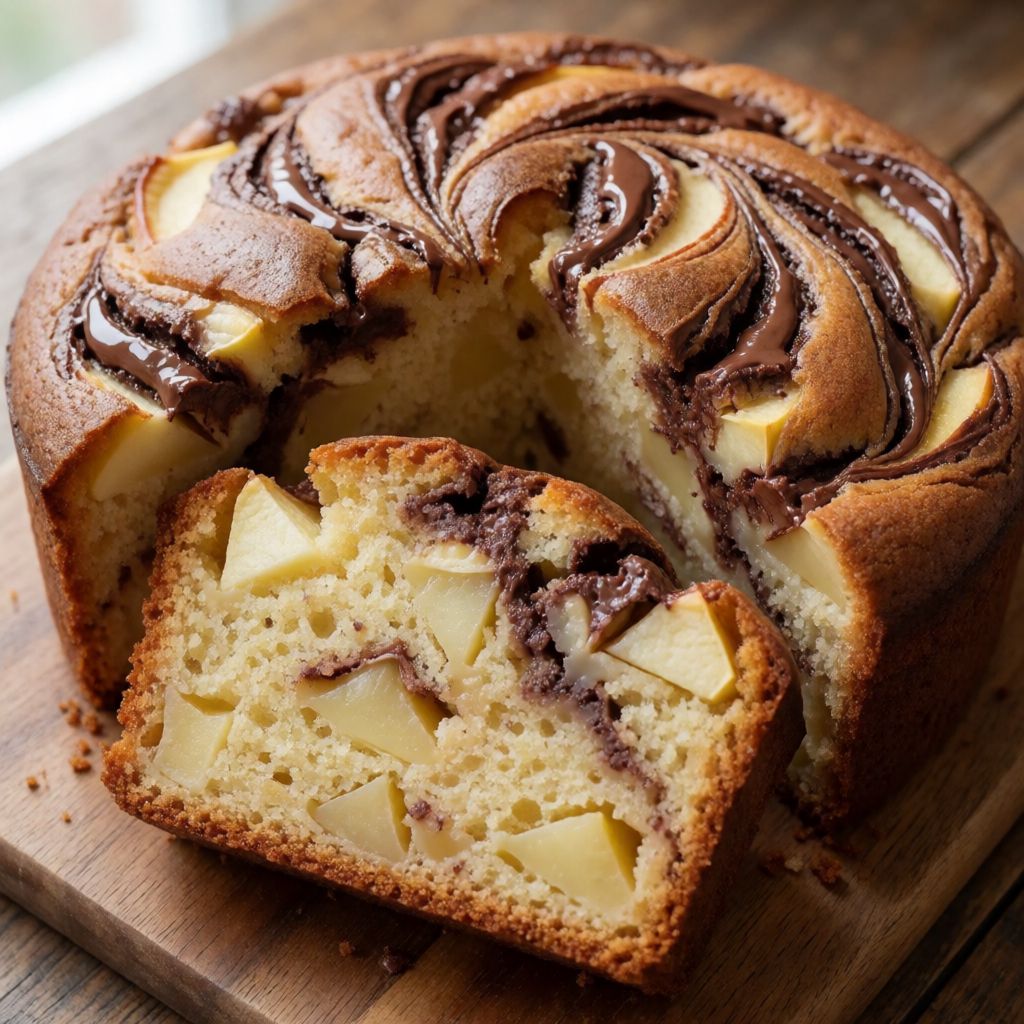
 AI photo
Apple and Nutella Cake
A soft apple cake with a layer of Nutella, baked until golden and finished with a dusting of icing sugar.
Labels are worked out automatically from the ingredients and can be wrong. Check the packaging if it matters to you.
Ingredients
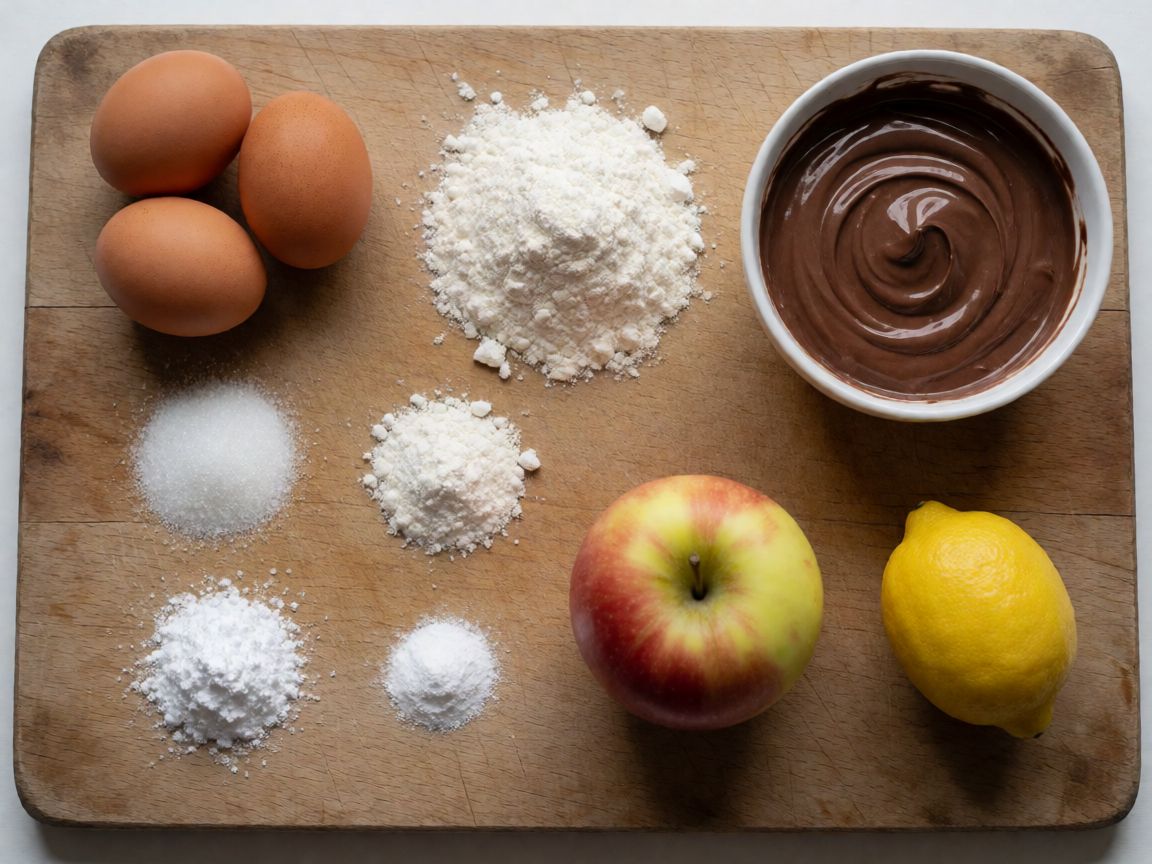
- 3 pcs Eggs
- 140 g Sugar
- 100 g Vegetable oil
- 300 g Plain flour
- 15 g Baking powder
- 400 g Apple
- 200 g Nutella
- 1 pcs Lemon
- 1 pinch Icing sugar to taste, for dusting









Steps
Beat the eggs with the sugar using a mixer until light and fluffy.
Add the vegetable oil and mix, then sift in the flour and baking powder and fold through.
Peel and finely dice the apple, drizzle with lemon juice, fold into the batter and mix well.
Transfer the batter into a 22cm tin greased with butter and dusted with flour.
Spread the Nutella over the surface and arrange thin apple slices on top in a sunburst pattern.
Bake in a preheated fan oven at 180°C for 58 minutes.
58 minCheck it is done with a wooden skewer, leave to cool and dust with icing sugar before serving.
This is a plain sponge that got ambitious: egg-and-oil batter underneath, a layer of hazelnut chocolate spread and apple fanned out on top like a sundial. What decides whether it works is not the Nutella, it's the batter underneath it, and whether you treat the fruit on top as decoration or as part of the engineering.
The batter is built the ordinary way — eggs and sugar whipped until the mixture holds a ribbon, oil folded in, flour and baking powder folded in last. That order matters more than people think. Beat the eggs with sugar first and you're trapping air in a liquid; add flour too early and you knock half of it straight back out. The air you save here is the only lift this cake gets besides the baking powder, so don't rush that first stage — a pale, thick foam that falls off the whisk in a slow ribbon is what you're waiting for, not a number of minutes.
The apple does two jobs and most people only notice one. Diced and folded into the batter, it's moisture and acidity working inside the crumb as it bakes, keeping the middle from going dry. Sliced thin and fanned on top under the Nutella, it's water sitting on a cake that's trying to set — which is exactly why the centre of this cake is slower to cook than the edges, and why a skewer, not a clock, has the final word.
Some say lemon juice on the apple is there for flavour. It isn't, not mainly. Cut apple browns because an enzyme in it meets air; the acid in lemon juice slows that enzyme down. You're buying yourself time and a paler, more honest-looking slice, not seasoning the fruit.
Eggs: three, and they're doing structural work, not just richness — the protein sets the crumb, the yolks carry fat and colour. Take them out of the fridge a while before you start if you can; cold eggs whip to a smaller, less stable foam, and a smaller foam means a flatter cake. No great substitute here; this isn't a recipe that forgives egg replacers.
Sugar, 140g, dissolved into the eggs rather than added to flour — this is what lets it do double duty as a whipping aid and a sweetener. Any granulated white sugar works; caster dissolves a touch faster and is worth using if you have it, but it's not a reason to go shopping.
Vegetable oil instead of butter is not laziness, it's chemistry working in your favour. Butter is solid at room temperature and so is a cake made with it — the crumb firms up and dries out as it cools. Oil stays liquid at room temperature, so the crumb stays moist a day later too. The criterion for the substitution is simple: any oil with no smell of its own — sunflower, rapeseed, light grapeseed. Not olive oil; its flavour fights the Nutella rather than staying out of its way.
Flour and baking powder: 300g plain flour needs the full 15g of baking powder here because there's no egg white whipped separately and no other source of lift — this cake rises once, on the bubbles you built in step one and the gas the baking powder makes in the oven, and that's it. More baking powder will not get you more rise, only a bitter, metallic edge and a crumb that's dry because it's full of holes instead of batter. Sift it in with the flour so it's spread evenly, not clumped where it'll leave a sour patch.
Apple: 400g, something that holds its shape under heat rather than collapsing to mush — a firm eating apple, Braeburn or Cox-type, works better here than a soft cooking apple that's built to fall apart. Lemon, one, mostly for its juice over the apple to slow browning, as above; the zest isn't called for, but a little grated into the batter is a reasonable thing to do with the rest of the fruit if you don't like waste.
Nutella, 200g, spread as a middle layer rather than mixed through, sits as a barrier between batter and apple slices as they bake — it keeps the top of the cake from drying into a crust before the middle has set, and it's why you check doneness with a skewer pushed well down, wiped clean of raw batter but allowed to come out faintly dark and sticky from the chocolate layer; that's not underbaked, that's correct. Any hazelnut-and-chocolate spread, or even a thinned jam if that's genuinely all you have, will do the same physical job — just know the flavour changes with it.
On the tin and the oven: a 22cm tin is a small, specific size, and it's not arbitrary — go bigger and the layer of batter under the apple and Nutella thins out, cooks faster at the edges, and you'll pull it at 58 minutes with a raw middle because you trusted the clock instead of the skewer. A fan oven at 180°C circulates heat evenly round the tin rather than radiating it from one side, which is exactly why this bake can afford a flat, even top instead of one side catching before the other — if your oven doesn't have a fan, expect it to take longer and to need turning halfway, and judge it by the skewer regardless. Icing sugar goes on only once the cake is properly cool; dust it onto anything still warm and it melts into sugar syrup, and you've spent effort on a decoration that disappears in ten minutes.