
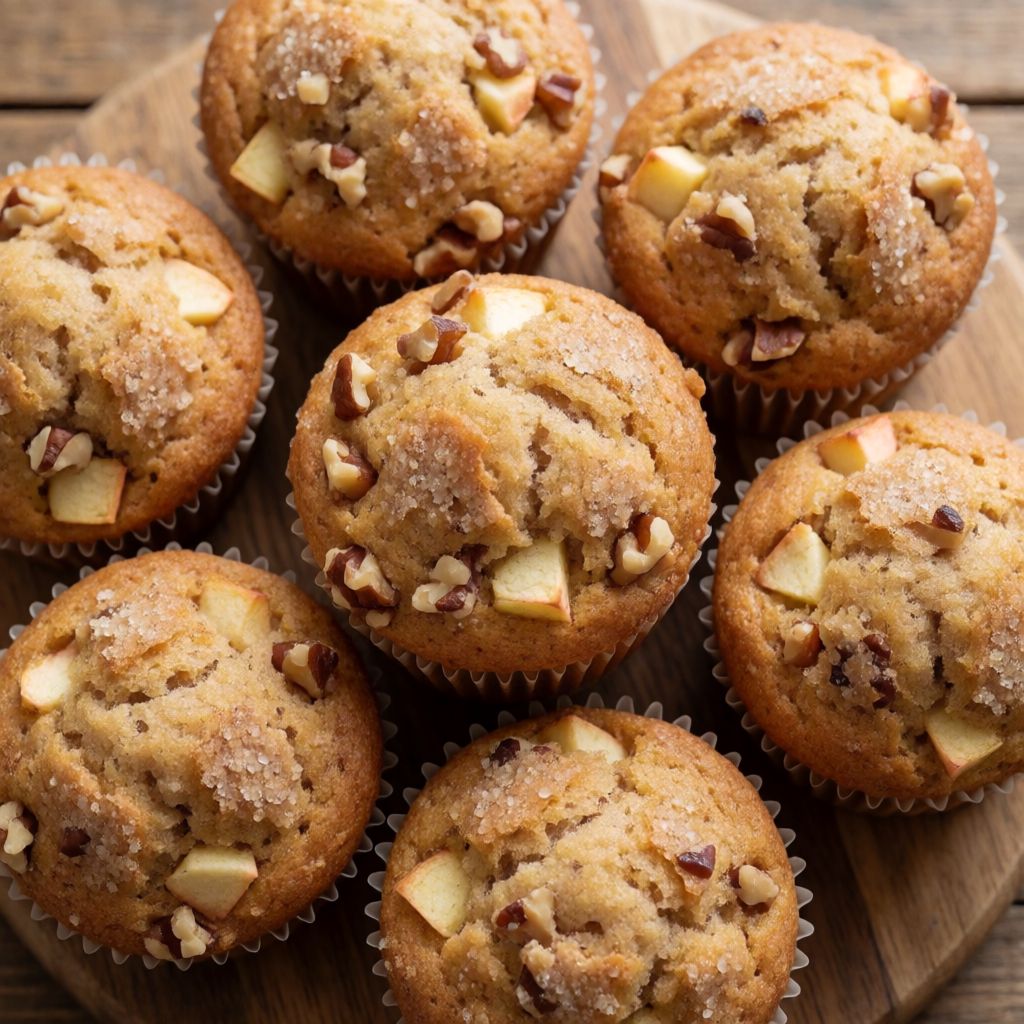
 AI photo
Apple and Walnut Muffins
Soft spiced muffins with diced apple and walnuts, dusted with icing sugar.
Labels are worked out automatically from the ingredients and can be wrong. Check the packaging if it matters to you.
Ingredients
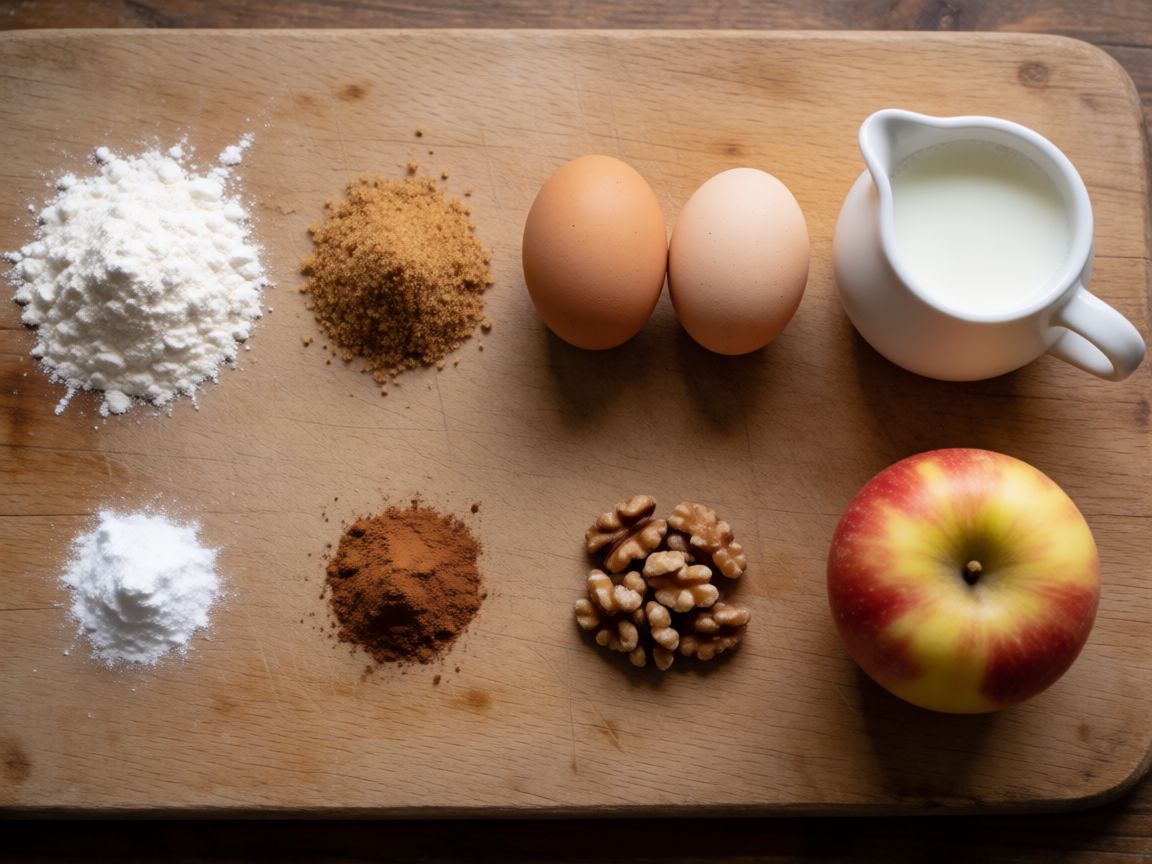
- 180 g Plain flour
- 60 g Brown sugar
- 2 pcs Eggs
- 8 g Baking powder
- 50 ml Milk
- 50 ml Vegetable oil
- 1 tbsp Cinnamon
- 1 pcs Apple
- 50 g Walnuts
- 2 tbsp Honey
- Icing sugar to taste










Steps
In a large bowl mix the flour, baking powder, brown sugar, cinnamon and chopped walnuts. Stir well and set aside.
Peel the apple, cut a few thin slices for decoration, then dice the rest and put it in another bowl.
Add the milk, vegetable oil, honey and whole eggs, and mix thoroughly with a spoon until smooth.
Add the prepared dry mixture and stir into a smooth, lump-free batter.
Preheat the oven (conventional setting) to 180°C.
Divide the batter among a muffin tin or paper cases, filling each about two-thirds full.
Before baking, press a thin apple slice gently into the top of each muffin.
Bake for about 15-20 minutes, turning the tin halfway through for even baking. The muffins are ready when a skewer comes out dry.
18 minLet the muffins cool completely, then serve dusted with icing sugar.
A muffin is a cake that got impatient — no creaming butter and sugar for ten minutes, no resting dough. It's built on a simple split: dry ingredients in one bowl, wet in another, and they meet only once, briefly. That split is the whole mechanism. Flour develops gluten the moment it gets wet and gets worked — that's what gives bread its chew. You don't want chew here, you want crumb, so you mix dry-into-wet only until the lumps vanish and not a stroke more. Overbeaten muffin batter turns tough and tunnelled with holes; a muffin that's merely stirred stays soft and open.
What decides whether this works is baking powder and heat arriving at the right moment. The powder is already fizzing faintly from the second it touches the wet mix — that's why you don't let the batter sit around admiring itself, you get it into the tin and into the oven. Wait too long and you've burned your lift before the oven even starts pushing it upward.
The apple does two jobs. Diced through the batter, it gives you pockets of moisture that keep the crumb from going dry — this is a low-fat, low-sugar batter by cake standards, so that moisture matters more than usual. The reserved slice pressed into the top isn't decoration for its own sake — it's a label. Once six muffins are baked, cooled and sitting on a rack, you can't tell outside from in; the slice tells you which one has walnuts and apple without cutting one open.
Twelve minutes of real work, feeds six — call it one each with tea, plus a spare for whoever gets to the tin first.
Flour: plain, not strong bread flour. Strong flour has more gluten-forming protein, and that's exactly what you're trying to avoid overdeveloping here — bread flour would give you a muffin with the chew of a bap. If you only have self-raising to hand, drop the baking powder to about half and taste-check the raise; it'll still work, it's just already carrying its own lift.
Baking powder, 8 g, is doing almost all the structural work, since there's no long whisking of eggs to trap air mechanically. It's a double-acting powder in most UK tins — some gas on contact with liquid, more on contact with heat. That's the reason for working fast after mixing: every minute the batter sits on the counter is a minute of lift leaking away before the oven gets a chance to set it. Some say letting muffin batter "rest" improves it, the way it helps pancake batter — no, because that trick is about relaxing gluten you deliberately haven't built up; here there's nothing to relax, only gas to lose.
Brown sugar over white isn't fashion — it carries molasses, which means a little moisture and a rounder, less sharp sweetness that sits well against cinnamon and honey rather than fighting them. White sugar will still rise the cake; it just tastes flatter and slightly drier in the mouth.
Vegetable oil rather than melted butter is the right call for something this small and quick — oil stays liquid at room temperature, so the crumb stays soft once the muffins cool, where butter would start to set and stiffen the structure slightly as it cools. Any flavourless oil does the job — sunflower, rapeseed, the basic "vegetable" bottle from a UK supermarket are all fine. Olive oil will work but its flavour will argue with the cinnamon.
The apple: pick one that holds shape under heat rather than collapsing to mush — a Braeburn or Bramley-adjacent firm eating apple, not a very soft dessert apple past its best. Peeling matters less for taste than for the slice on top: skin on the decorative slice will blacken and curl a bit faster in the oven, so if you want that neat pale fan, peel it.
Walnuts give bitterness and crunch against the sweetness — pecans are a close substitute if that's what's in the cupboard, same oily richness, milder edge. Skip nuts entirely if there's an allergy concern; the muffin loses texture contrast but the mechanism of rise and moisture doesn't depend on them.
Honey alongside sugar adds a bit of its own moisture-holding — honey is slightly humectant, meaning it clings to water, which is another small insurance against dryness in a recipe with very little added fat. Golden syrup is the nearest kitchen-cupboard swap if you're out of honey, though you'll lose a little floral edge.
On the "turn the tin halfway through" step: a domestic oven, unlike a professional one, rarely heats evenly — there's usually a hotter back or a hotter top element doing more work than you'd like. Turning the tray is compensating for that unevenness, not a ritual step; if your oven is a fan oven with genuinely even circulation, you can skip it and nothing is lost.
And the skewer test matters more than the clock. "15-20 minutes" is a floor, not a verdict — ovens vary, muffin tins vary in how much metal sits between the heat and the batter. Pull a skewer from the centre of one muffin: wet batter clinging to it means wait; dry, maybe a few moist crumbs, means out. Let them cool fully before the icing sugar — dust it warm and it melts into a wet smear instead of sitting as a visible, deliberate layer of snow on top.