
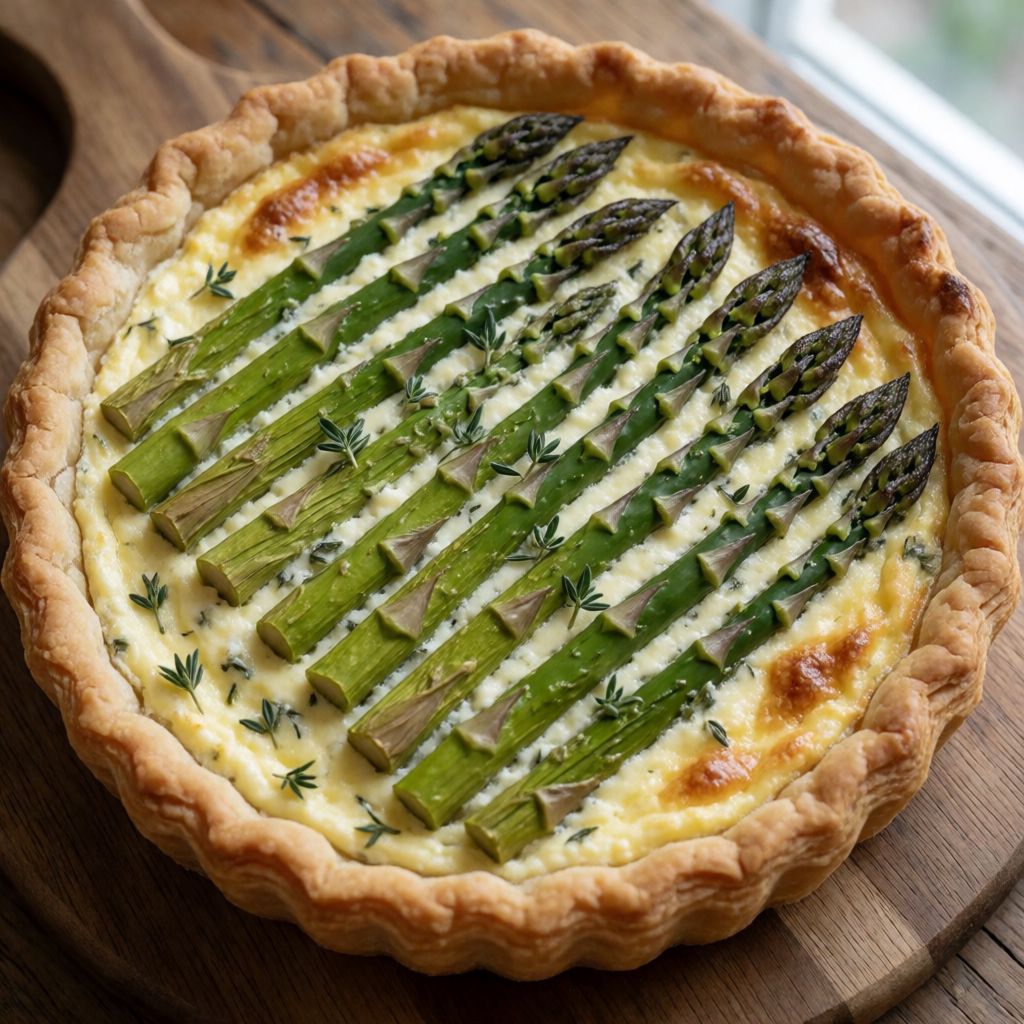
 AI photo
Asparagus Tart
A savoury asparagus and ricotta tart baked in puff pastry.
Labels are worked out automatically from the ingredients and can be wrong. Check the packaging if it matters to you.
Ingredients
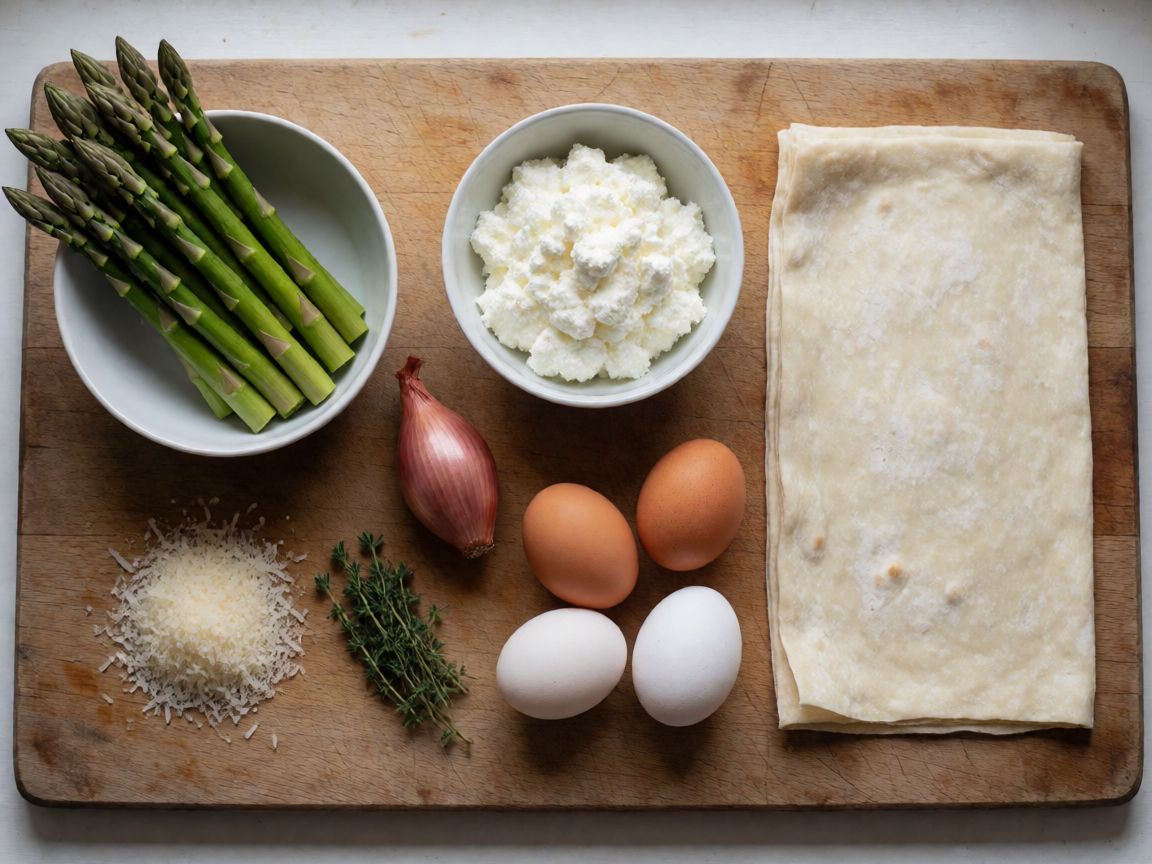
- 500 g Asparagus
- 250 g Ricotta
- 1 pcs Shallot
- 3 pcs Eggs
- 100 g Parmesan
- Thyme to taste
- Olive oil to taste
- Salt to taste
- Black pepper to taste
- 1 pcs Ready-rolled puff pastry





Steps
Wash the asparagus under running water and peel with a vegetable peeler. Tie the stalks into a bundle with kitchen string.
Place the asparagus in a large pot of water and cook, depending on the thickness of the stalks.
Drain the cooked asparagus in a colander and leave to cool.
Cut off the tips, set them aside separately, and slice the stalks into rounds.
Finely chop the shallot and fry it in a pan with olive oil until golden.
Add the sliced asparagus stalks to the shallot and sauté over medium heat for about 5 minutes.
5 minIn a bowl, beat the eggs with a mixer, add the ricotta and continue beating until smooth.
Add the Parmesan, the sautéed asparagus and the thyme. Season with salt and black pepper and mix.
Line a 24 cm tart tin with the puff pastry.
Prick the base with a fork and spread the filling evenly over the surface.
Arrange the asparagus tips on top, decorating the surface to your liking.
Brush the surface of the tart and the asparagus tips with olive oil.
Bake in a preheated oven at 180°C for at least 50 minutes in static (fan-off) mode.
50 minTake the tart out of the oven and let it cool slightly.
Serve on a platter whole or cut into slices or cubes.
What was changed
Oven temperature was set to since the original recipe did not specify one; all other ingredients are available in local shops as is.
An asparagus tart is a custard that happens to be baked standing up, inside a pastry case instead of a dish. Ricotta and eggs are the custard — that's it, that's the whole trick. Everything else, the shallot, the thyme, the Parmesan, is seasoning for a base that sets by heat the same way a crème brûlée does, just with savoury intent and a crust underneath to hold it together.
What decides whether this works is moisture, not flavour. Puff pastry is thin layers of butter and dough that want to puff upward by steam — and a wet filling poured straight on top steams the base from underneath before it's had a chance to crisp. That's why you prick the base: not for decoration, for escape routes. Small holes let trapped steam out through the bottom instead of lifting the whole base into a soggy, risen mess under your filling.
Asparagus itself has the same water problem in miniature. It's mostly water held in a fibrous structure — boil it, and you're pushing water in; it needs to come back out and the heat needs to concentrate what's left before it goes near the custard. That's the whole reason for the sauté after boiling: not extra cooking, but drying and deepening. Skip it and you get grassy, watery pockets sitting in an otherwise set custard — the tart will look fine and taste thin.
Take the asparagus first, because it's the ingredient most people get wrong in two opposite directions. Thick stalks need peeling — that's not fussiness, it's because the outer skin is genuinely fibrous and stays chewy no matter how long you cook it, so the peeler removes a problem, not a formality. Tying it in a bundle to boil is an old kitchen trick with real logic behind it: the tips are delicate and cook in a fraction of the time the base of the stalk needs, so standing the bundle upright with tips above the waterline (or near it) lets the thick ends get the full boil while the tips essentially steam. In a British kitchen you won't have an asparagus steamer, and you don't need one — a tall pot, string, and the bundle leaned against the side does the same job.
Some say asparagus should be snapped where it "naturally breaks" rather than cut. No — that method wastes a third of the stalk assuming it's all tough, when usually only the very bottom inch or two is actually fibrous. Peel and trim with a knife and you keep more of what you paid for.
The ricotta is doing a specific job: it's a low-moisture, mild cheese that sets softly rather than weeping water the way, say, cottage cheese would. If you only have cottage cheese, drain it hard through a sieve first or your custard base will be loose. Mascarpone is richer and will work but tips the tart toward dessert-tart territory in texture — fine, just know what you're choosing. The eggs are the actual setting agent — three eggs for this volume of dairy is roughly the ratio that gives you a sliceable set rather than a runny one or a rubbery one; more egg and you get something closer to a frittata in a crust, less and it won't hold at all when you cut it.
Parmesan here isn't melting cheese, it's seasoning cheese — it brings salt and a savoury depth the ricotta doesn't have on its own, and because it's hard and dry it doesn't add more liquid to a filling that's already managing moisture carefully. Any aged, hard, salty grating cheese does the same job — a mature cheddar, which you'll have in any UK fridge, is a perfectly honest substitute, just sharper and less nutty.
For the fat you sauté the shallot and asparagus in: olive oil with "no smell of its own" is the wrong phrase for olive oil — that's actually the criterion for a neutral oil like sunflower or vegetable oil, used when you don't want the oil's flavour competing. Olive oil is chosen here precisely because it does have flavour. Use it; if you only have a flavourless oil in the cupboard, it'll still work, you'll just lose a layer of taste, not function.
Puff pastry — buy it ready-rolled, as the recipe assumes, because laminating butter and dough into dozens of paper-thin layers by hand is a job for a bakery, not a Tuesday. It's sold refrigerated or frozen in any UK supermarket; if it's frozen, let it thaw in the fridge, not on the counter, or the butter layers will start melting unevenly before you've even got it in the tin, and that uneven melt is exactly what stops it puffing cleanly in the oven.
Last thing: let the tart sit after it comes out, even just ten minutes. The custard is still technically finishing its set from residual heat, the same way a cake is still cooking slightly as it cools. Cut it too soon and it slumps on the plate instead of holding a clean slice — not a disaster, just not the shape you wanted. This feeds eight as a light lunch or starter, fewer if it's the main event alongside nothing but a salad.