
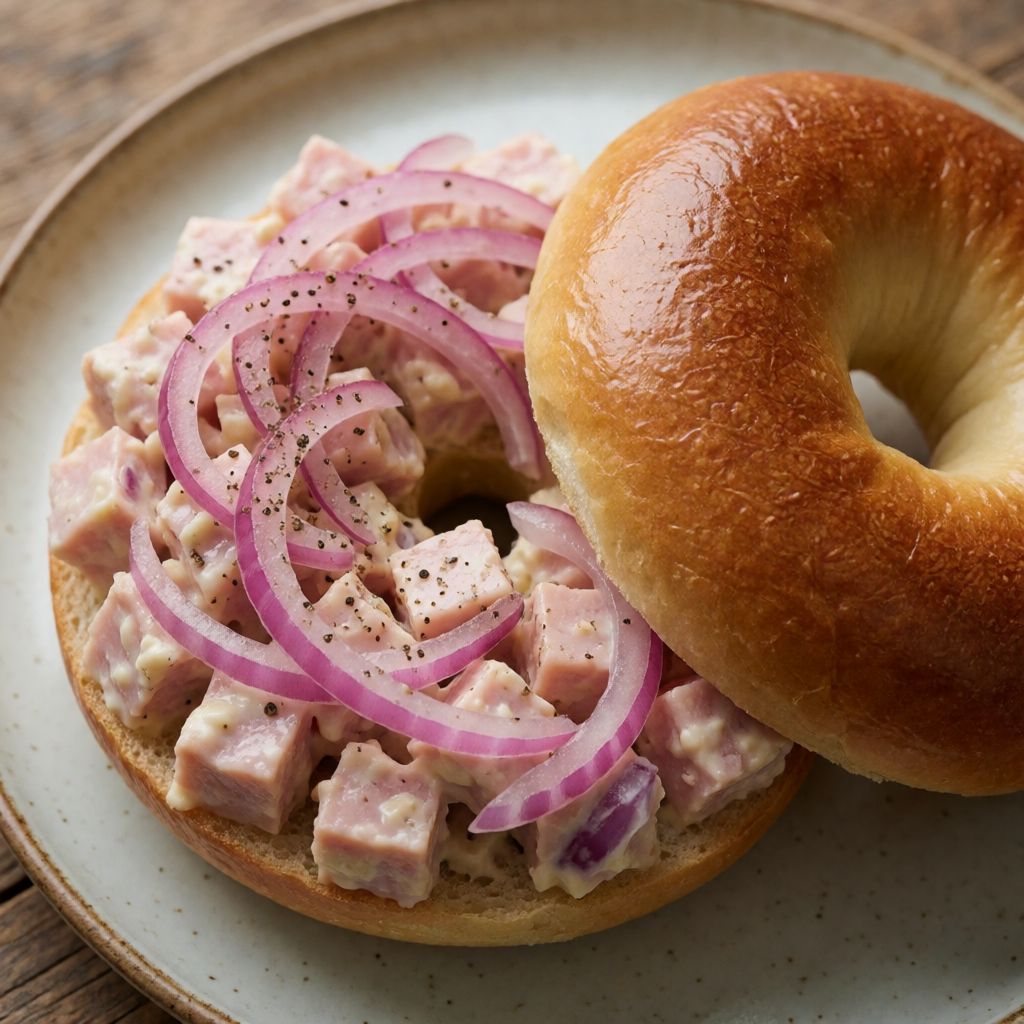
 AI photo
Bagels with Ham Salad
A hearty bagel filled with creamy ham salad, quick-pickled red onion, rocket and watercress.
Labels are worked out automatically from the ingredients and can be wrong. Check the packaging if it matters to you.
Ingredients
- 4 pcs Red onion thinly sliced
- 200 ml Apple cider vinegar
- 100 ml Water
- 100 ml Sugar
- 1 tsp Black pepper peppercorns
- 200 g Ham farmhouse, cooked
- 3 tbsp Mayonnaise
- 100 ml Crème fraîche 18%
- 0.5 pcs Red onion finely chopped
- 0.5 bunch Chives finely chopped
- 1 tsp Dijon mustard
- 1 tsp Sweet mustard
- Salt to taste
- Black pepper to taste, fresh
- 8 pcs Bagels
- 70 g Rocket
- 1 bunch Watercress














Steps
Slice the red onion into thin rings and place in a scalded jar.
Bring the vinegar, water and sugar to the boil together with the black peppercorns, until the sugar dissolves.
5 minPour the boiling vinegar mixture over the onion, seal the jar and keep in a cool place.
Cut the ham into very small cubes or grate it finely.
Mix the mayonnaise, crème fraîche, red onion, chives, Dijon mustard and sweet mustard, then add the ham, mix well and season to taste with salt and pepper.
Warm each bagel and fill it with the ham salad, rocket, pickled red onion and watercress.
This is Monday's answer to Sunday's ham. You roast a gammon or buy a decent farmhouse ham on Saturday, and by Monday lunchtime it needs a second life that isn't just "more ham sandwiches." That second life is a ham salad — chopped fine, bound in mayonnaise and crème fraîche, sharpened with two mustards and raw onion — stuffed into a warm bagel with rocket, watercress, and a sweet-sharp pickled onion that cuts through all that richness. It's a sandwich, but built like one, not assembled like one.
What decides whether it works is the ham salad's texture and balance, not the bagel. Cube or grate the ham small — "very small cubes" isn't fussiness, it's so every bite has ham distributed through it rather than one lump you bite around. Grate it on a box grater if cubing bores you; the shred-and-fold texture works even better with mayonnaise because it has more surface to grab the dressing.
The two creams — mayonnaise and crème fraîche — aren't there for richness alone. Mayonnaise alone is heavy and one-note; crème fraîche alone is too sharp and thin to hold the ham together. Together you get a dressing that coats without drowning, and the crème fraîche's acidity does half the job the mustard does, so you're not relying on vinegar alone to wake the whole thing up.
The pickled onion is the piece people skip, thinking "it's just garnish." No — it's the acid that resets your palate between bites of rich ham cream. Without it, three bites in, the sandwich turns sludgy on the tongue. With it, you can eat the whole thing.
Start with the pickle, because it needs the most lead time and the least attention once it's made. Red onion sliced thin — thin meaning you can see light through it, not rings you could stack a burger patty with — goes into a scalded jar. Scalding isn't tradition for tradition's sake: it kills whatever's lingering on the glass so your pickle doesn't turn cloudy or off in a few days. The vinegar-water-sugar brine, boiled just until the sugar dissolves (watch for the liquid turning clear, not cloudy — that's your cue, not a stopwatch), does two things at once: the heat softens the onion's bite without cooking it limp, and the sugar balances the vinegar's sharpness so you get sweet-sour, not just sour. Apple cider vinegar here isn't precious — any vinegar with a fruit note works; white wine vinegar is fine, malt vinegar will fight the mustard later, so skip that one. Pour it boiling over the onion — the heat is what does the quick-pickling; cold vinegar on raw onion just gives you onion in puddle, not pickle. Seal and chill: a few hours gets you bendy, bright pink-edged onion; overnight gets you something closer to a proper pickle. This keeps in the fridge well past the sandwich — use it on cheese, in salads, wherever you want brightness without raw onion's rawness.
The ham: farmhouse, cooked, meaning something with actual grain and bite — leftover gammon from the Sunday roast is exactly the right instinct, or a thick-cut ham from the deli counter, not the thin pre-sliced stuff from a packet, which turns mushy once dressed and gives you no texture against the cream. Cut small or grate it — grating is faster and gives a better dressing-to-ham ratio if your knife skills aren't surgical.
Mayonnaise and crème fraîche are doing different jobs, which is why neither substitutes cleanly for the other. Mayonnaise brings emulsified fat and a neutral creaminess that coats; crème fraîche brings cultured tang and a lighter body. If you've only got soured cream, use it — it's close enough in acidity, just slightly thinner, so go a little lighter on mustard to compensate. Greek yoghurt works in a pinch but it's sharper and leaner; add a touch more mayonnaise if you go that route.
The two mustards — Dijon for heat and backbone, sweet (something like a honey or wholegrain sweet mustard) for the fruit-note sweetness — aren't interchangeable with "just use mustard." Dijon alone is sharp without roundness; sweet alone is flat without bite. Together they do what the sugar did in the pickle: balance one edge against another. If you've only got English mustard, use a third of the amount — it's far hotter and will dominate everything else.
Rocket and watercress aren't decoration, they're the one place in this sandwich that's raw, peppery, and alive — rocket's mustard-oil bitterness and watercress's sharp bite both play the same game as the Dijon, just with chlorophyll instead of a jar. If you can't get watercress, baby spinach with a squeeze of lemon gets you some of the way, though you lose the pepper.
And the bagel — warm it, don't toast it to crisp. Warming softens it enough to bite through without the filling squeezing out the sides, and brings back the yeasty smell that a cold bagel from the fridge loses. A domestic toaster set low, or a few minutes cut-side-up under the broiler watching it, not timing it — you want it soft and warm through, not browned and brittle.
This feeds eight as a light lunch — more if you're serving it alongside something, fewer if it's the whole meal and people are hungry. The patience here isn't in the cooking, which is quick; it's in the waiting for the pickle, and in resisting the urge to eat the sandwich the moment you've built it — give the bagel a minute to warm through properly, and the whole thing holds together instead of falling apart in your hands.