
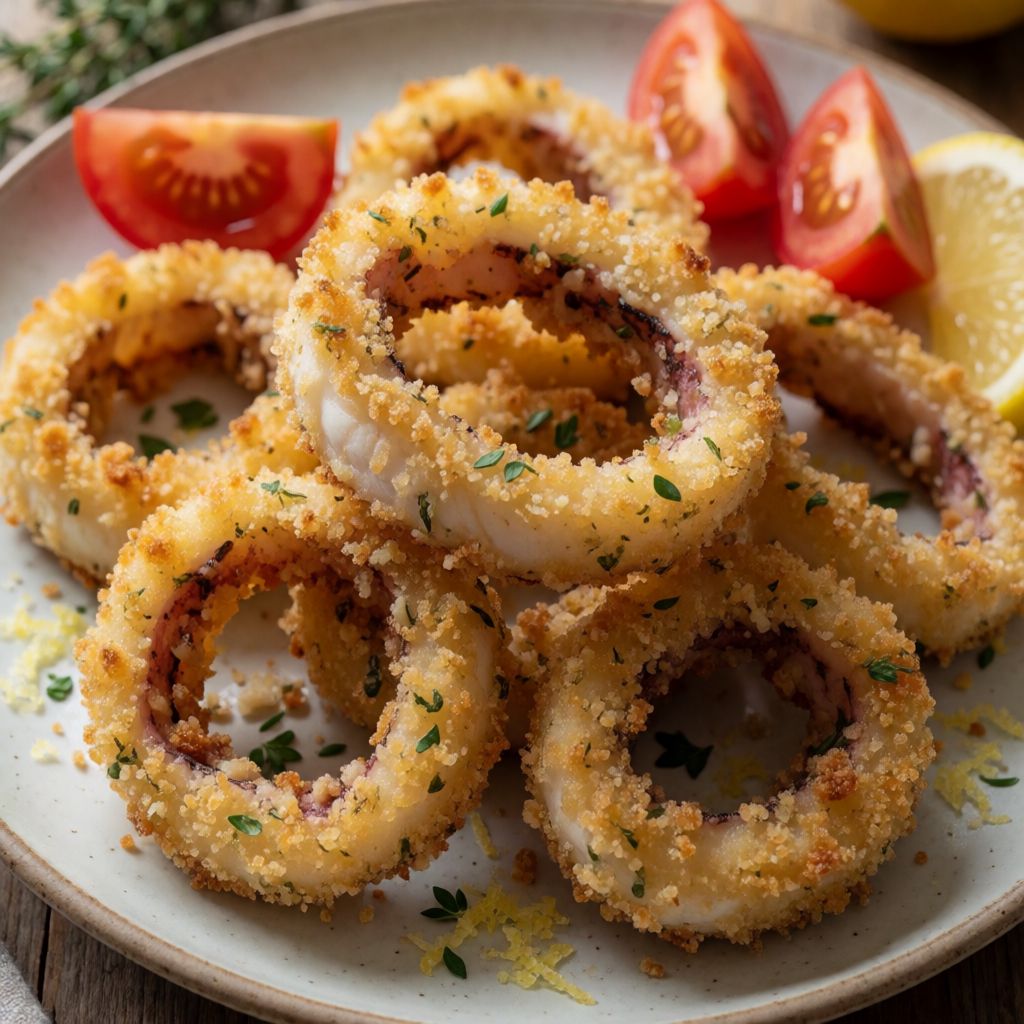
 AI photo
Crispy Baked Squid Rings
A light, crispy recipe for oven-baked squid rings, ready in minutes.
Labels are worked out automatically from the ingredients and can be wrong. Check the packaging if it matters to you.
Ingredients
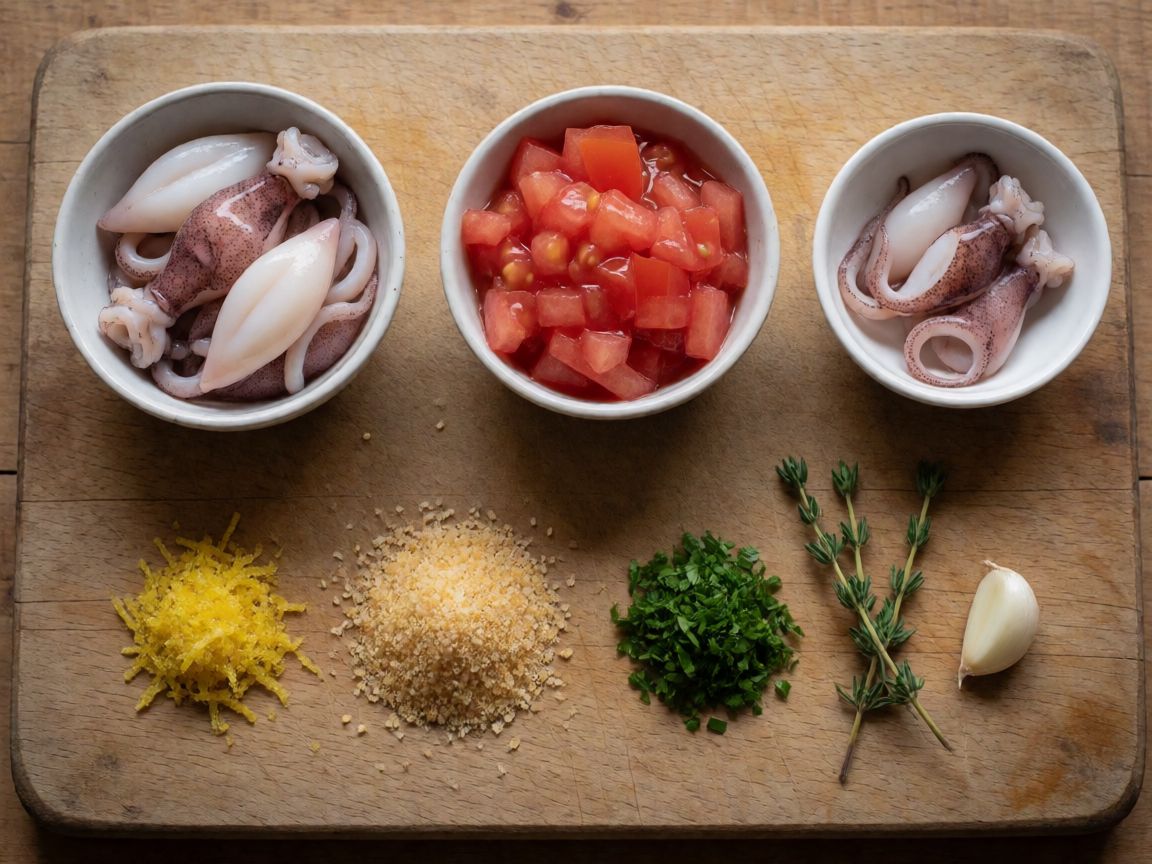
- 500 g Squid
- 200 g Cherry tomatoes
- 1 pcs Lemon zest grated
- 2-3 tbsp Breadcrumbs dried
- 1 bunch Parsley chopped
- 2 pcs Thyme sprigs
- 1 clove Garlic
- 3 tbsp Olive oil
- Salt to taste
- Black pepper to taste










Steps
Rinse the squid under running water, pull on the head and pull out the clear quill from the mantle. Cut the eyes from the head and remove the beak.
Remove the innards from the mantle and rinse well under water. Make a small cut and peel off the skin.
Cut the mantle into rings about 1 cm thick.
Put the rings in a bowl with olive oil, chopped parsley, thyme leaves, salt and black pepper.
Wash and dry the cherry tomatoes, cut into thick slices. Season with salt, add olive oil and add to the squid with the lemon zest and garlic.
Mix well and add the breadcrumbs.
Spread everything on a baking tray lined with baking paper, without overlapping the rings.
Bake in the oven at 190°C for 15 minutes.
15 minAlternatively, use a fan oven at 180°C.
Check that the internal temperature reaches 63°C.
This is squid rings tossed in oil, herbs, garlic and lemon zest, scattered with breadcrumbs and halved cherry tomatoes, and sent into a hot oven for a quarter of an hour. No batter, no deep-fat fryer, no smell of frying oil hanging in the flat for two days. The crunch comes from dried crumb going gold and dry in oven heat, not from oil crisping a coating - that's the whole trick, and it's why this recipe can exist on a Tuesday evening rather than only in a restaurant kitchen with a vat of oil at the ready.
What decides whether it works is timing, and squid gives you almost no room either side of it. Squid flesh is nearly pure protein with barely any fat to cushion it. Heat seizes those protein fibres fast - cross the window and you don't get tender squid cooked a bit longer, you get rubber bands that used to be squid. So fifteen minutes here is not a target, it's closer to a ceiling. Watch instead: the ring goes from translucent grey-white to a clean opaque white, it curls gently rather than snapping into a tight coil, and the crumb on top turns from pale to freckled gold-brown. Press a ring with a spoon - it should give, then come back soft. Hard and springy means you've already gone too far.
Squid itself: 500 g feeds four as a starter, less as a main - this is a small plate dish, built for speed, not bulk. Buy it fresh if your fishmonger has it and the flesh smells of the sea and nothing else; otherwise frozen squid is genuinely fine, sometimes better, because freezing relaxes the muscle fibres a touch and the rings come out marginally less prone to toughening. Cleaning it properly - pulling the quill, cutting away the beak and eyes, peeling the skin - isn't fussiness, it's prevention: the quill is cartilage and won't soften no matter how you cook it, the skin curls and toughens unevenly under dry heat and leaves tough strips through an otherwise tender ring. Skip the cleaning and you're not saving time, you're baking in a defect you'll meet with your teeth later.
Cherry tomatoes aren't decoration, they're the only source of moisture and acid on the tray. Cut them into thick slices rather than halves so they hold their shape and don't collapse into mush before the crumb has coloured - a thin slice gives up its juice too fast and you get steam where you wanted roast. Salt them separately before mixing in; salt pulls a little water out immediately, and you want that happening on the chopping board, not pooling under the squid on the tray. Any small, sweet tomato works the same way - the criterion is thick skin and firm flesh, not the cherry variety specifically.
Lemon zest, not juice, and that's deliberate. Juice is liquid, and liquid steams the crumb exactly the way overlapping squid does. Zest gives you the oil from the peel - the bright, slightly bitter top note that cuts the faint iodine smell squid can carry - without adding a drop of water to a tray that's already trying to stay dry and crisp.
Breadcrumbs: use dried ones, not fresh soft crumb from today's loaf. Dried crumb has already given up its moisture, so in the oven it has nothing to do but absorb a little oil and tomato juice and still brown. Fresh crumb would just go soggy and sit there pale. If you've no dried breadcrumbs, dry fresh ones yourself in a low oven for a few minutes first, or use panko, which is built the same way - dry and open enough to crisp fast.
Parsley, thyme and garlic are the aromatics, and none of them need to be precise. Parsley fresh if you can, chopped coarse rather than minced to dust - you want flecks of green, not a powder that burns. Thyme leaves stripped from the stalk; dried thyme at half the amount works in a pinch, oregano too, since what you're after is a resinous, slightly bitter edge against the sweetness of roasted tomato. Garlic goes in raw and fine - one clove is plenty, since fifteen minutes of oven heat will mellow it on its own; you don't need to fry it first, and frying it separately only risks burning it bitter before it ever reaches the tray.
Olive oil here is doing double duty - carrying flavour, and conducting heat evenly into the crumb so it browns rather than just drying grey. Olive oil earns its place because its own fruitiness pairs with the tomato, historically how this dish's Mediterranean relatives are built - cheap, quick-grilled seafood dressed simply because the seafood itself was never the expensive part, the cook's time was. If you don't have olive oil, any oil with no smell of its own will crisp the crumb just as well - sunflower or rapeseed, both common enough in a British kitchen - you'll just lose that particular pairing with the tomato.
On the oven: 190°C conventional and 180°C fan aren't two options to pick on a whim, they're the same real temperature described two ways. A fan oven moves hot air across the food constantly, so it transfers heat faster at a given dial setting than a still, conventional one - hence the ten-degree drop to land in the same place. Preheat properly before the tray goes in; a half-warm oven means the squid starts exuding water before any crisping has begun, and you've recreated the overlap problem by timing rather than by crowding.
And patience, because this dish tempts you to rush it twice - once at the chopping board, where uneven rings cook unevenly, and once at the oven door, where the smell alone will have you opening it to check every three minutes, which drops the temperature and stretches the cooking time you're trying to keep short. Cut the rings to roughly the same width, set the timer, and leave the door shut until it's genuinely time to look.